

Hong Kong’s New World clan bets on property rebound for lifeline
The territory’s housing prices are forecast to climb as much as 15% this year, with prime mall rents up by 5%
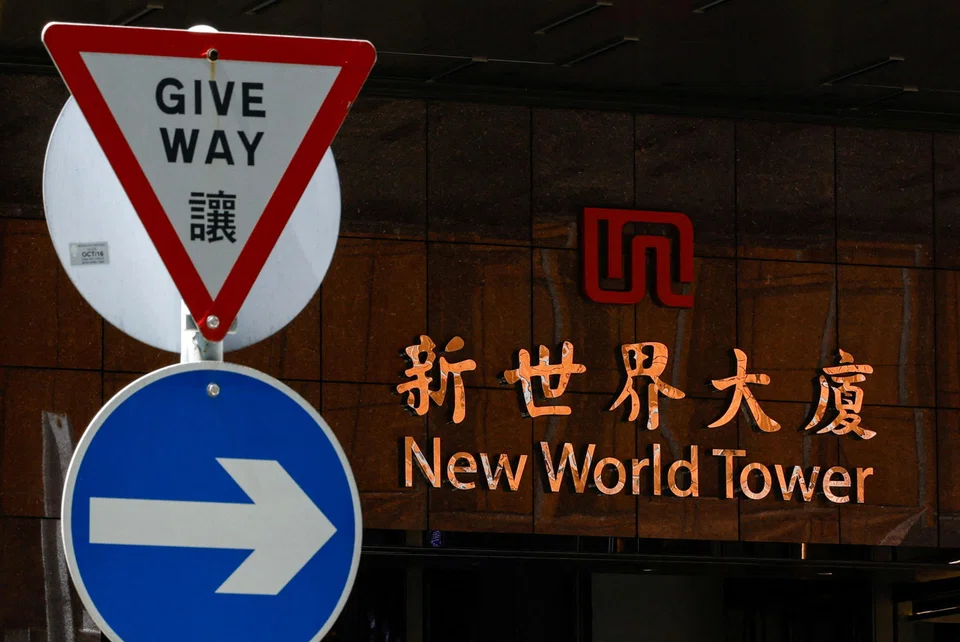
[HONG KONG] Unwilling to cede control over New World Development, Hong Kong’s billionaire Cheng family is now betting on the revival of the city’s property market. It is mulling options, such as a public share sale, to meet the embattled developer’s debt obligations.
After high-profile flirtations with investors including Blackstone, the Chengs are now convinced that the property market rebound will gather pace.
That will alleviate the pressure on them to strike a deal that would involve giving up a controlling stake, sources said.
An improving outlook for New World has also given the family, led by patriarch Henry Cheng, confidence to be more selective with investors, said sources, asking not to be identified discussing private deliberations.
One of the leading options is a roughly US$4 billion share sale by New World, either to selected investors including the Chengs or to all shareholders on a pro-rata basis.
This would mean that the family, holding about 45 per cent in the company, will contribute about US$1.8 billion, sources noted.
They added that talks on all proposals are preliminary, and details including the investment size are subject to change.
The pivot comes as Hong Kong housing prices are forecast to climb as much as 15 per cent this year and prime mall rents by up to 5 per cent, said JPMorgan Chase and CBRE Group.
That recovery would bolster the developer’s core business operations, which narrowly avoided default in 2025 thanks to a record US$11 billion bank refinancing.

Jeff Zhang, an analyst at Morningstar, said: “Residential market recovery will benefit New World’s earnings and liquidity profile.
“(Its) latest projects in Hong Kong Island and West Kowloon have been well received by local homebuyers, leading to stronger cash inflow.”
The Chengs were desperate for outside capital until the end of 2025. At one point, a major private credit lender sought guaranteed returns of up to 20 per cent in talks to inject liquidity into New World, sources said.
Meanwhile, Blackstone’s proposal entailed the family ceding its control of New World, in exchange for US$2.5 billion from the asset manager.
Retaining control
But it was not long before the family backpedalled. Talks with Blackstone slowed as the family explored deals with other investors without ceding influence, Bloomberg reported in March.
The Chengs have good reasons to bet on a bullish property market. New homes have been selling well over the past few months, allowing developers to raise prices for future projects.
New World’s apartment sales for the six months ended December had reached more than half of its full-year target ended June. It still has more than 5,000 units of stock for buyers in the next few years, said the company.
Still, deleveraging would remain a lengthy process for the company, with refinancing continuing to be the primary source of near-term liquidity replenishment, before the company funnels more sales proceeds to debt repayment, Morningstar’s Zhang said.
New World’s debt crisis stems from an ill-timed expansion, which resulted in the developer racking up about HK$212.4 billion (S$34.6 billion) in total liabilities.
Many projects it invested in did not come into fruition until after 2019, when Hong Kong’s economy and real estate market were battered by social unrest, Covid and global interest rate hikes.
In 2025, property prices fell to a nine-year low after shedding a third of their value in four years.
The resultant liquidity crisis unravelled the succession prospects of Adrian Cheng, Henry Cheng’s eldest son, leaving the door open for someone professional from outside the family to take the helm.
As Henry Cheng worked to overcome the liquidity challenges, he even explored the sale of assets in the Rosewood Hotel Group, whose operations are led by his daughter Sonia Cheng.
Since the US$11 billion refinancing, New World has taken more steps to further strengthen its liquidity, allowing the Cheng family to wait till the property market turns.
It secured a US$508 million loan backed by its crown-jewel asset in Hong Kong, and conducted a debt swap that trimmed about US$1.2 billion from the company’s debt pile.
The company is not out of the woods yet. It continued to post losses in the six months ended December while its cash-to-debt ratio worsened. The group has also paused payments for dividend and some perpetual bond interests.
A partnership with external investors to shore up New World’s finances remains on the cards.
Sources said that the family’s talks with CapitaLand Group and Ares Management resumed earlier this year, following a preliminary discussion last year.
Representatives for Blackstone and Ares declined to comment.
Spokespersons for New World Development and Chow Tai Fook Enterprises, the main investment vehicle of Hong Kong’s billionaire Cheng family, did not respond to requests for comment.
A spokesperson for CapitaLand Investment, the group’s listed asset management arm, said that the firm does not comment on market rumours.
The Cheng family’s financial health could also cloud its funding plans. Its private investment arm is seeking to refinance a US$932 million loan due in June, after repaying another borrowing with its own cash last year amid a tough financing environment, it was reported in March.
“Maturity pressure is postponed rather than resolved,” said Barclays analyst Wilson Ho in a note.
“The macro outlook has turned more favourable, but we believe it has not been totally in the clear. New World still has about one year to strengthen its capital structure ahead of its maturity wall.” BLOOMBERG
Decoding Asia newsletter: your guide to navigating Asia in a new global order. Sign up here to get Decoding Asia newsletter. Delivered to your inbox. Free.
Share with us your feedback on BT's products and services
TRENDING NOW

DBS, OCBC, UOB rout lops billions off STI as inflation, rate concerns spook investors

Grab CEO’s wife Chloe Tong on life with Anthony Tan and finding her purpose

OCBC sheds S$8 billion in value as shares close nearly 6% down; analysts cautious on banks

Deal between tycoon friends sparks scrutiny of Philippine power sector

