US denies Iran report on draft peace deal to reopen Strait of Hormuz
The document is ‘a complete fabrication’, says the White House
 Add BT as a preferred source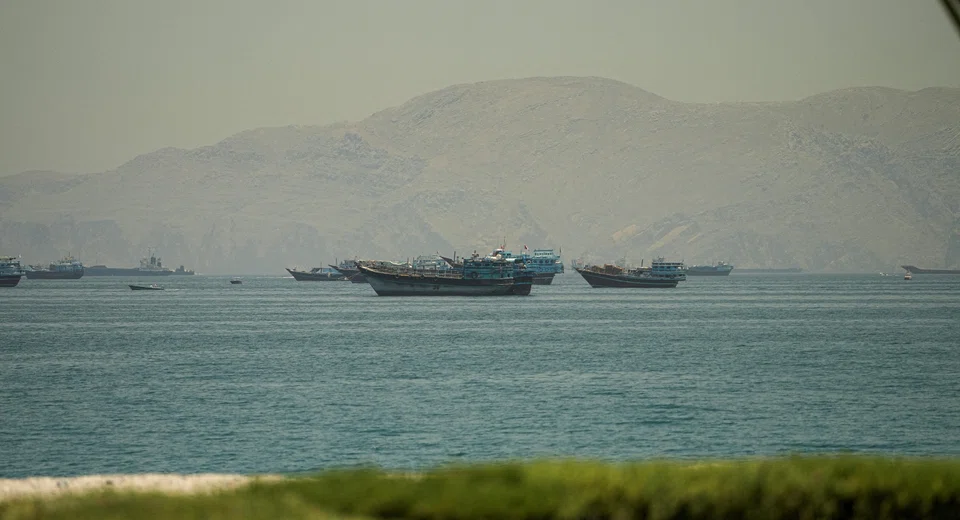
THE US has denied an Iranian state television report on a draft interim peace deal that said maritime traffic through the Strait of Hormuz could return to normal within a month of it coming into effect.
“This report from Iranian controlled media is not true and the MOU (memorandum of understanding) they ‘released’ is a complete fabrication,” the White House said in a social media post on Wednesday (May 27).
“Nobody should believe what Iranian state media is putting out.”
Oil had dropped on the Iranian report, with Brent falling almost 4 per cent to below US$96 a barrel. It has declined more than 7 per cent this week as traders become increasingly optimistic that there would be an agreement.
Other key points reported by Iran’s IRIB News included the US lifting its naval blockade on Iranian ports and the American navy leaving waters surrounding Iran.
The reported draft also said that Iran and Oman would have a mechanism in place to oversee shipping in the strait. That is one of the most contentious issues holding up a deal, with the US saying vessels must be allowed free passage.
Oman has not commented in recent weeks on Iran, saying the two are in discussions about managing the strait.
“Managing the passage of ships, their inspection and receiving service fees are at the discretion of the Islamic Republic and in partnership and in cooperation with Oman,” IRIB reported, adding that Iran has not committed to unconditionally reopening the strait.
Iran and the US are negotiating to extend their ceasefire by around two months and reopen the vital Strait of Hormuz. Teheran’s effective closure of the waterway at the start of the war in February has sent oil and natural gas prices soaring and pushed up inflation globally.


Both Iran and the US have said their talks, via mediators such as Pakistan and Qatar, are making progress. US Secretary of State Marco Rubio said on Tuesday that it would take a few more days to reach an agreement.
An Iranian delegation recently returned to Teheran after intense talks in the Qatari capital of Doha that yielded good progress, said a diplomat with knowledge of the visit.
The negotiations, held in coordination with the US, focused on the Strait of Hormuz and Iran’s highly enriched uranium, while the issue of Teheran’s frozen funds was also discussed as part of a potential final agreement, said the diplomat, who asked not to be identified speaking of private discussions.
Tensions remain high; on Monday night, the US killed several Iranian soldiers in an attack on ships that it said were laying mines near the strait. Iran fired back at American jets and said it downed an unmanned drone.
“Indirect contacts with the Americans are continuing,” Ali Bagheri-Kani, deputy secretary of Iran’s Supreme National Security Council, said on Wednesday in Russia, where he is attending a security forum.
“Until we have agreed on all issues, we consider that we have agreed on nothing,” he added.
“There is no doubt that the conditions for passage through the Strait of Hormuz and the procedure for doing so will not be the same as before. A completely different procedure will be introduced. Iran and Oman, as neighbouring coastal states, are holding talks to determine a new mechanism for passage through the Strait of Hormuz.”
The warring sides, which agreed to a fragile ceasefire in early April, also need to agree on what portion of Iranian financial assets will be unfrozen and how quickly.
On Tuesday, Iranian state media said that Teheran wants US$12 billion unfrozen once the so-called memorandum of understanding – as the two sides are describing the interim deal – is agreed.
Iran hawks in the US, including Senator Lindsey Graham, are likely to baulk at that and pressure Trump to revert to bombing the country.
Another potential obstacle is a parallel war in Lebanon between Israel and Teheran-backed Hizbollah militants.
Israel has stepped up attacks in recent days and said its ground forces are moving further into its northern neighbour’s territory.
Israeli forces will go beyond a strip of land roughly 10 km into the south of Lebanon, the military said. Israel has increased strikes elsewhere in the Arab country and killed the new head of the military wing of Hamas, another group allied with Teheran, in Gaza on Tuesday.
Iran has insisted that the ceasefire has to cover “all fronts”, including Lebanon.
Israel, which started the wider war when it bombed Iran alongside the US, is reluctant to accept any restrictions on its operations in its northern neighbour. It has said that its actions are necessary to protect its border communities and counter Hizbollah’s rockets and drones.
Hizbollah, classified as a terrorist organisation by the US, has “crossed all red lines” with a surge of lethal drone attacks, Eli Cohen, a minister in Prime Minister Benjamin Netanyahu’s security Cabinet, told Israel’s Army Radio.
Several explosive drones fell in Israeli territory near the border with Lebanon on Wednesday, the Israel Defense Forces said. BLOOMBERG
Decoding Asia newsletter: your guide to navigating Asia in a new global order. Sign up here to get Decoding Asia newsletter. Delivered to your inbox. Free.
Share with us your feedback on BT's products and services