
Hoteliers to get more help with job redesign
The revamped job redesign scheme will help Singapore's hard-hit hotel industry qualify for wage support
 Add BT as a preferred source
Singapore
THE hotel industry is getting enhanced government support with job redesign which would qualify them for wage support, as it looks to digitalisation in its next phase of recovery.
Hoteliers can now refer to a list of 16 whitelisted job roles with recommended technology implementation to streamline and speed up their job redesign process.
The list was curated with suggestions from the Singapore Hotel Association (SHA), Singapore Tourism Board and the Food, Drinks and Allied Workers Union.
According to the list, the role of the concierge can be transformed into a guest experience ambassador - someone who can recommend itineraries based on guest experiences from the customer relationship management system. This would require additional skills in data analytics.
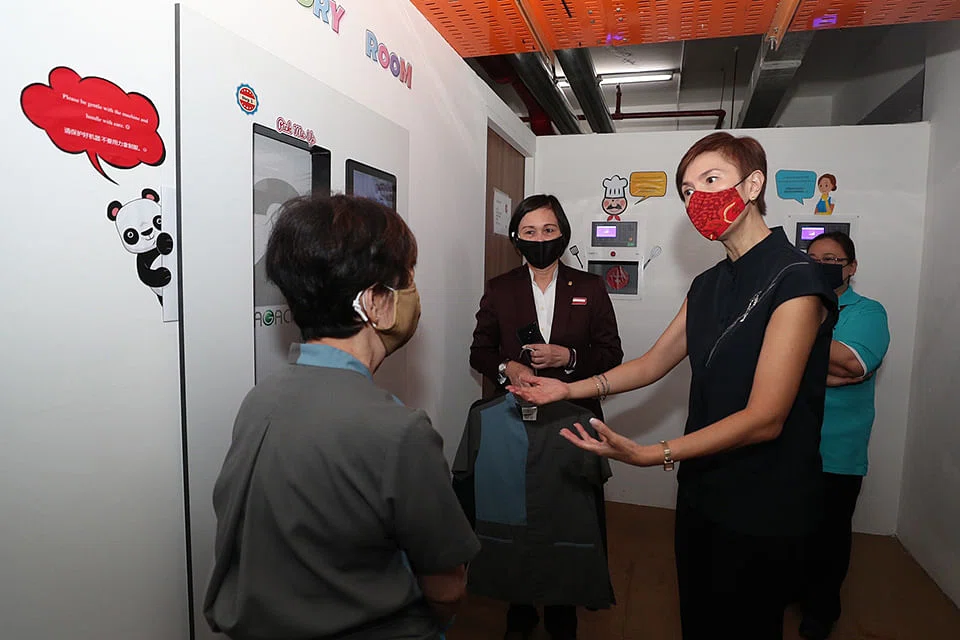
Speaking to reporters following a tour at Parkroyal on Kitchener Road, Manpower Minister Josephine Teo said: "Every hotel has a concierge, but now it is not just about making sure that the guests get their bags - that's still important - but it's also about how that interaction with the guests is a positive one."
Navigate Asia in
a new global order
Get the insights delivered to your inbox.
Employers that participate in the Job Redesign Reskilling Programme for Hotel Industry would be able to get up to 90 per cent wage support, with a cap of S$3,000 a month for non-PMETs and S$6,000 for PMETs. They can also get up to 90 per cent funding for course fees.
Parkroyal tapped on an earlier iteration of the programme and began redesigning its jobs in 2019, and these efforts were intensified during the downtime last year caused by the Covid-19 pandemic. So far, 64 employees have been reskilled or upskilled.
Benny Chung, the hotel's general manager, said there was some hesitance at first, but the key was to make the training programme structured.
"We systematically explain to them what they need to do first, second, third and fourth, so as long as they follow the procedure, they will never go wrong," said Mr Chung.
Learning these new skills has also helped to his staff to gain confidence, while boosting morale as a whole, which has in turn reduced turnover, he added.
Margaret Heng, executive director of SHA, said in time to come, hotels may no longer have clear-cut roles, as workers pick up multiple skills.
"With the very lean workforce that we have within the industry, it is important that we really have to change the way we look at the organisation itself," said Ms Heng, adding that this is the best time to review processes and work on job redesign so that the hoteliers can emerge stronger from the crisis.
In 2020, more than 10,300 employers hired new staff or redesigned their jobs through WSG programmes, a 45 per cent increase from the year before, according to the 19th edition of the Jobs Situation Report on Friday.
Of these, 1,500 employers ramped up their career conversion programmes for new hires.
Close to 350 employers transformed their jobs, through the Industry 4.0 Human Capital Initiative, Job Redesign Reskilling Programmes and enhanced support for Job Redesign under the Productivity Solutions Grant.
Overall, Mrs Teo said redesigning jobs and investing in training are useful strategies for employers in overcoming challenges in hiring the right people.
Those who are willing to go beyond looking for people who are "plug and play" - applicants with the skills and experience to hit the ground running immediately-- are more likely to have success at hiring, she said.
Instead, employers could tap government schemes that help with training, especially since many mid-career jobseekers have transferable skills and can be effective in new roles with the appropriate "skills top-up", the Ministry of Manpower (MOM) and Workforce Singapore (WSG) said in a joint statement.
Jobseekers also tend to have higher aspirations that go beyond wages.
Employers that are able to express the company's vision while impressing upon jobseekers the career prospects of the role are also more successful in attracting applicants, she said.
At the same time, having a well-articulated job description is very important since it is the first touch point for any jobseeker, said the minister.
Decoding Asia newsletter: your guide to navigating Asia in a new global order. Sign up here to get Decoding Asia newsletter. Delivered to your inbox. Free.
Copyright SPH Media. All rights reserved.

