

How GovTech and National Library Board use design to better serve Singaporeans, even in challenging times
From giving staff a say on how best to serve the community to adapting quickly to fast-changing needs, two statutory boards are staying ahead in the digital age with a design-led organisational culture
 Add BT as a preferred source
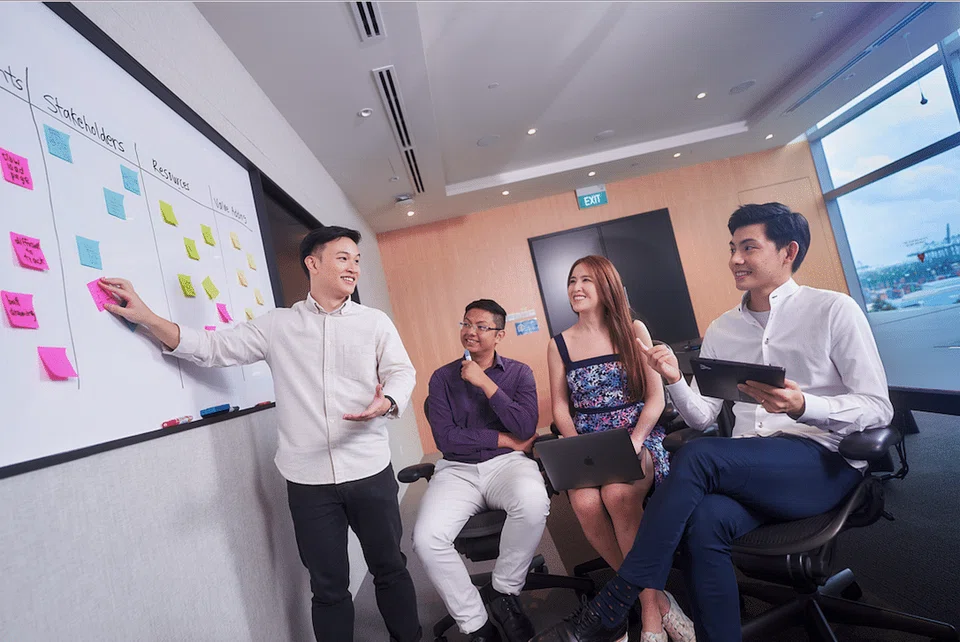
One has been making headlines for responding swiftly to the Covid-19 outbreak with a suite of digital tools to help the public and fellow Government agencies better manage the crisis. The other is on a digitalisation push to take learning outside of physical libraries. The Government Technology Agency of Singapore (GovTech) and the National Library Board (NLB) are two organisations that have successfully used design to streamline processes and provide better services for all in Singapore.
As a statutory board that sits under the Prime Minister's Office, reporting to the parent ministry of Smart Nation and Digital Government Office, GovTech is responsible for the digital transformation of Singapore's public sector. It plays an important role in helping to achieve Singapore's smart nation goals, creating digital solutions that transform the society, economy and government.
To do this, GovTech adopts a design principle of "being agile to adjust its strategies" quickly to better serve its users' changing needs.

"Our customers make up the entire nation - comprising government agencies, public officers, hundreds of thousands of businesses and six million residents. Keeping up with the needs of every person in the country is no small task, which is why being Agile is one of GovTech's core values," says Mr DN Prasad, Senior Director of Strategy, People and Organisation, GovTech.
"The entire organisation is structured to be able to rapidly respond to emerging trends of users' needs. Cross-functional teams (or 'squads') are organised according to the projects they are working on, and all projects have fixed checkpoints in their life cycles to ensure that the teams are able to assess user needs, review progress and make the necessary changes quickly."
A prime example of GovTech's agility is something everyone in Singapore is well acquainted with - SafeEntry. When the Multi-Ministry Task Force announced that every business in Singapore needed to use SafeEntry to help control the spread of Covid-19, GovTech had just 10 days to develop a system that would enable effective contact tracing for six million people. Because it quickly realised that the entry-point tablet used to replace hard copy contact tracing was not going to be scalable, it instead leveraged existing systems to produce the QR code check-in and check-out process.
In the opening weekend, over 70,000 locations and 30,000 businesses applied for their own unique SafeEntry codes. With such high volume of "customers", GovTech had to quickly devise a way to make the onboarding process as seamless as possible. Tapping on Corppass (a Singpass equivalent for corporate entities), the team managed to reduce each application's transaction time to just six seconds, at one point creating 16,600 QR codes in one day. Since then, GovTech has quickly resolved many issues as users' needs and the situation evolved.
Ms Pink Lim, Deputy Director of Group Planning and Operation, plays a mentoring role in the Design Thinking (DT) Community in GovTech, where she guides the DT Community Leaders. She adds that the core of design thinking is really about user centricity. Applying DT has enabled GovTech to redesign processes and services for greater relevance. "It is to walk in the shoes of the citizens and businesses who interact with the government, engage users to understand their challenges, and co-create solutions to address their real needs."
The second design principle GovTech lives by is "synergising a diversity of insights within the organisation", where the leaders encourage a culture of inclusion and collaboration in the workplace.
Employees in product teams are split into squads and tribes, where a squad is a co-located and cross-functional team of no more than 10 people that works closely together. A collection of squads then makes up a tribe, which facilitates cross-squad collaboration to happen quickly and enables easy knowledge sharing. For example, squads which worked on TraceTogether and SafeEntry were in the same tribe.
Mr DN Prasad also shared that GovTech's internal annual Innovation Challenge had a 70 per cent implementation rate for the projects surfaced. Staff from various teams can voluntarily sign up to experience parts of the design thinking process, and this results in cross-functional teams developing their products or solutions and pitching them to the senior leaders.
GovTech is one of 10 organisations featured as case studies in the Design-Led Culture Study Playbook, titled "It's All About Culture: Better Businesses by Design", a collaboration between DesignSingapore Council (Dsg) and ROHEI Learning & Consulting.
The Playbook examines and studies the culture of design-led organisations and uncovers the key strategies, or "recipes for success", involved in developing it. Close to 50 in-depth interviews were conducted with senior management personnel from 27 diverse, design-led organisations, including family-run small and medium-sized enterprises, large local enterprises, international conglomerates and government agencies.
This culminated in 22 principles for building a design-led culture, which includes concrete steps organisations can take to implement them at work, regardless of their industry or size. The Playbook also shares the success stories of companies to demonstrate the strong correlation between business success and having a design-led culture, which has translated into sustained innovation, increase in revenue, and more.
Reimagining our typical libraries into spaces suitable for all
Like GovTech, NLB faces the challenge of serving a vast public audience - over 25 million yearly, ranging from the very young to the elderly. Under its latest LAB25 (Libraries and Archives Blueprint 2025), NLB aims to position itself as a learning marketplace with an integrated network of hubs and nodes to take learning outside of its physical premises.
During the pandemic, NLB quickly pivoted online and rolled out close to 4,700 digital readiness programmes from April 2020 to March 2021 that catered to all age groups. It also scaled up other digital content including e-books, e-newspapers and online learning packages.
Beyond reading, NLB aims to help equalise and elevate digital literacy in local communities, especially for those who may need more help to access digital services and programmes.
To achieve this, it adopted the design principle of "inviting input and responding actively", ensuring that staff's feedback is acted upon to encourage the openness to share.
Ms Catherine Lau, Assistant Chief Executive of NLB's Archives and Libraries Group, chairs a weekly "huddle" with her divisions. These sessions allow for staff to pitch ideas and initiatives for the library, and for the leaders to provide feedback and work with them to turn the ideas into reality.
"Sometimes some ideas are really quite far out, and some just take a certain formula. It doesn't matter, as long as each one of us feels free to suggest user-centric ideas to improve the experience for our patrons," says Ms Lau. In fact, over a hundred projects are discussed and launched from these huddles every year.
Another design principle NLB follows is "systematically advocating the voice of the user".
Ms Lau points out that one way in which this principle is evident, is by the teams formed within the organisation to support reading and learning by specific user segments, to ensure relevance in serving a broad spectrum of the population.
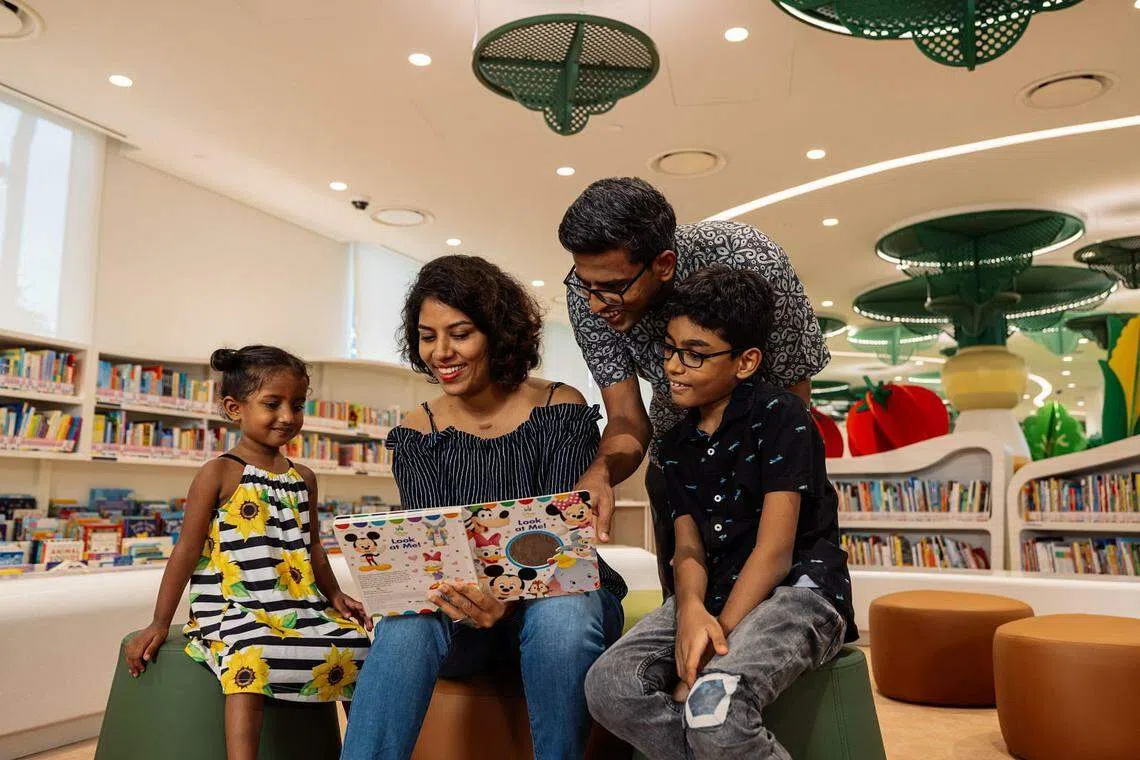
"For instance, there are five segments just for children - babies, preschoolers, children in primary school, tweens and teens. We have built capabilities to understand, engage the respective user groups, and to refine our offerings based on users' feedback."
The process of redesigning Singapore's public libraries started with a study of the external environment, to better meet the current needs of their users. With NLB's focus on nurturing communities of learning, digital solutions were sought to create online platforms for collaborative learning and exploration. The leadership team also looked into involving communities through partnerships, volunteer programmes and other initiatives that built on the principles of co-creation and co-ownership.
One of the first libraries to undergo this transformation was the library@chinatown.
NLB approached the redesign of this library by seeking input from various sources. They partnered with grassroots organisations in Chinatown to better understand the community, and also worked with experts of Chinese culture to curate the library's selections. By combining expert opinions and data collected directly from users, NLB discovered that a large majority of its users comprises working adults who want to encourage their children to read more in Chinese. To address this, NLB included an extensive children's section despite the small size of library@chinatown.
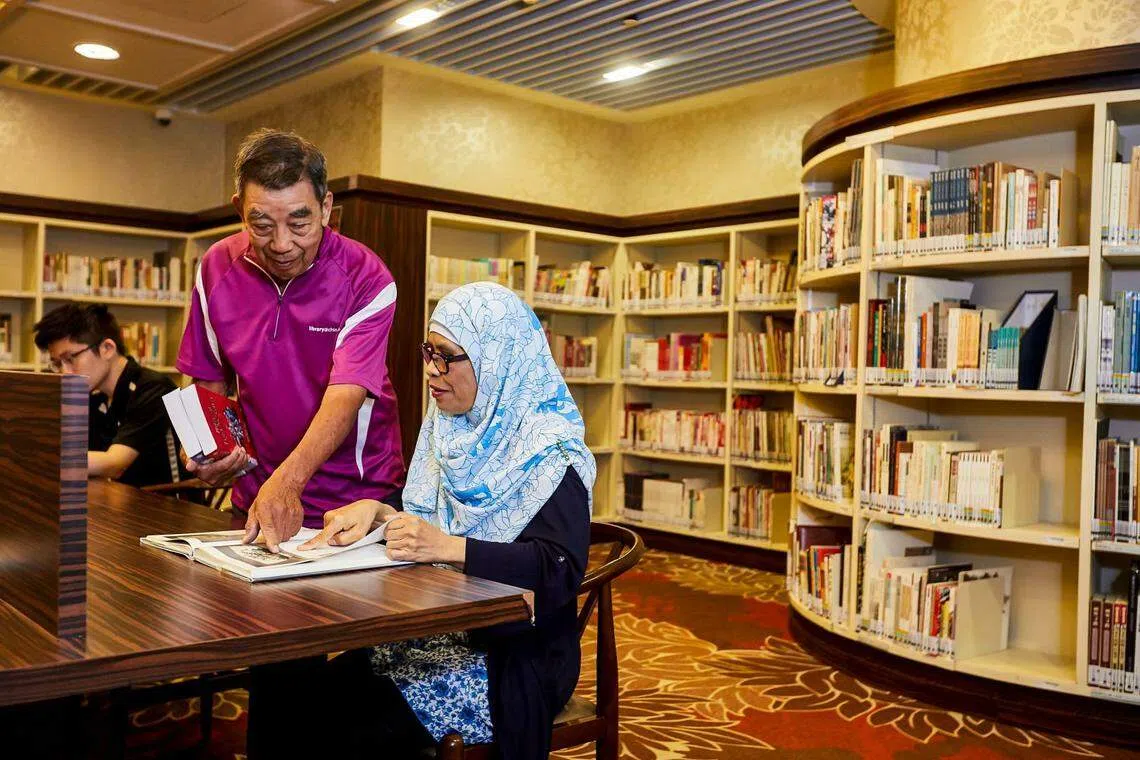
Through consultations, NLB also realised that it could try out a volunteer-run model to encourage patrons to perform self-help services. The entire library is now run by volunteers, including planning and supporting events, running programmes like storytelling and crafts for children, customer service, collection maintenance, and recruitment and training.
"Design thinking is not a good-to-have but a must-have for any business, whether it's in the public or private sector," says Ms Lau. "This Playbook stands out because it demystifies the design process, focusing on leadership, culture and adoption rather than just a successful end result. It is a valuable resource for us to systematically build awareness and the capabilities to take design thinking to greater heights. Start somewhere that speaks to you as a leader. Take small steps and experiment."
"It's All About Culture: Better Businesses by Design" examines the culture of design-led organisations and uncovers the key strategies involved in developing it. The Playbook outlines 22 principles for building a design-led culture, which are grouped into six broad categories.
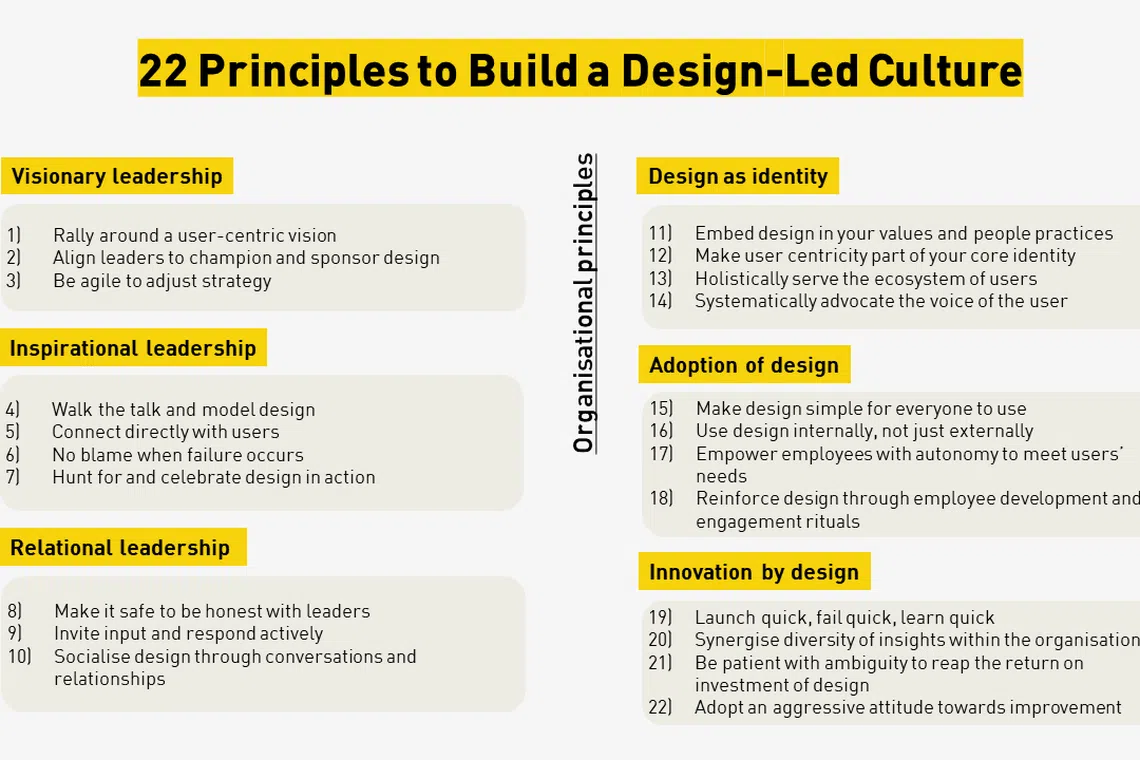
Companies are encouraged to first complete the Design-Led Culture Survey (featured in the Playbook), to uncover their areas of strength and those they can improve on before reading more about the principles, recommendations and case studies to find out how they can better build a design-led culture.
Download the Design-Led Culture Study Playbook here.

Decoding Asia newsletter: your guide to navigating Asia in a new global order. Sign up here to get Decoding Asia newsletter. Delivered to your inbox. Free.
Share with us your feedback on BT's products and services
TRENDING NOW

Lamborghini-driving boss of Eminent Frog Porridge charged with S$3.8 million tax evasion, money laundering

Not in education, employment or training: Why more Hong Kong youths are opting out of work

With AI, it’s not about coding better; workers need to think better: Koh Boon Hwee

Malaysian tycoon Vincent Tan’s sell-downs point to pruning rather than an exit plan

