

HSR still holds out deals for firms with longer-term horizon
Jurong area will also continue to gain from plans for second CBD and Jurong Region Line

Nisha Ramchandani

Singapore
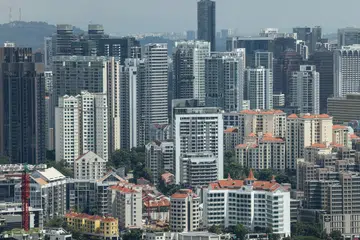
THE postponement of the High Speed Rail (HSR) project would likely incur missed opportunities for infrastructure firms in the short-term, while pushing companies to take a long-term view when considering their plans for the Jurong Lake District.
Economists that The Business Times spoke to said that there could be some impact from Malaysia and Singapore hitting pause on the project, though with the HSR delayed rather than cancelled, deals could still materialise over a longer time frame.
Vishnu Varathan, head of economics & strategy at Mizuho Bank, said: "There are certainly some growth prospects foregone, in terms of GDP growth from the construction and follow-through activities such as employment, as well as what it would have done for sentiment in creating a greater vibe around the economy. This is a lower-hanging fruit that may have been engineered with greater certainty to lean against unpredictable global factors, and would have been a useful growth source that has regrettably been pulled off."
However, he went on to point out that postponing the project also gives the two nations the opportunity to review costs, which could lower the cost of the entire project and give Singapore more bang for its buck.
Senior economist at United Overseas Bank, Alvin Liew, said that it was hard to assess the impact from the postponement on near-term growth outlook, although some business opportunities would likely be delayed.
Meanwhile, uncertainty around the HSR project could prompt companies to take a wait-and-see approach about shifting or setting up operations in the Jurong Lake District, senior director and head of research at Knight Frank Lee Nai Jia said. However, a bright spot is that the district could potentially see some spillover from the One North area as the companies there grow, he added.
Where residential demand is concerned, while prospective buyers are now likely to discount the HSR effect when making purchases, other buyers may still focus on the potential of other developments, such as the upcoming Jurong Region Line, he added. Dr Lee said he expects that sales of new homes in the area could stabilise, while resale prices will likely hold firm.
Still, Huttons Asia head of research Lee Sze Teck reckoned the district's proposition as a second central business district hasn't dimmed, given the introduction of infrastructure such as new office spaces and shopping malls to entice people.
He pointed out: "The development of Jurong East as a regional centre was drawn up in 1991, way before the HSR, to reduce stress on the transportation network."
Plans are also moving ahead with respect to the Jurong Region Line, which comes onstream in stages from 2026, and shifting the Science Centre to free up land for other uses. A new megaport at Tuas is also in the works.
While the Jurong Country Club had already been acquired by the government and earmarked as a site for the HSR terminus, Mr Lee suggested that the site could be used for other purposes in the interim, such as a golf driving range or a MICE venue.
The Raffles Country Club was also acquired by the government last month to make way for the HSR.
On Wednesday, Singapore and Malaysia agreed to suspend construction of the Kuala Lumpur-Singapore HSR until May 31, 2020, with Malaysia to reimburse Singapore S$15 million by end-January 2019.
The timeline has also been revised, with service to kick off at the beginning of 2031, instead of end-2026 as previously planned.
Meanwhile, if Malaysia does not proceed with the HSR project by May 31, 2020, the project will be terminated and Malaysia will have to cover the costs incurred by Singapore in fulfilling the HSR bilateral agreement.
In July, Transport Minister Khaw Boon Wan said in Parliament that Singapore has already invested over S$250 million on the HSR project, and is likely to spend another S$40 million by year-end.
Benefiting from the delay of the project are airlines plying the Singapore-Kuala Lumpur route, which is the busiest international city pair in the world, Mr Liew pointed out. These include Jetstar Asia, AirAsia, Singapore Airlines, Malaysia Airlines and Malindo Air.
Even if the HSR ultimately fails to materialise, the Jurong district remains a very viable place, Knight Frank's Dr Lee said, pointing to other uses such as a future manufacturing hub.
In such an event of the project being terminated, there would be a need to re-examine the plots surrounding the HSR since they might have been set aside for hotels or shopping malls.
"(The government) would need to look at alternative uses to (replace) these components planned around the HSR," said Huttons' Mr Lee.
TRENDING NOW

Knight Frank’s Tan Tee Khoon leaves firm, Nicholas Keong takes over auction business

Keppel Energy, Sembcorp Utilities and Tuas Power to supply biomethane in pilot project

GovTech retrenches another 38 staff in second round of layoffs
Take-up of new private homes dives 45% in Q3 as prices accelerate with 1.4% rise

