Humanoid robots have a data problem. China’s ‘training centres’ hope to fix it
China has more than 150 companies that make these droids
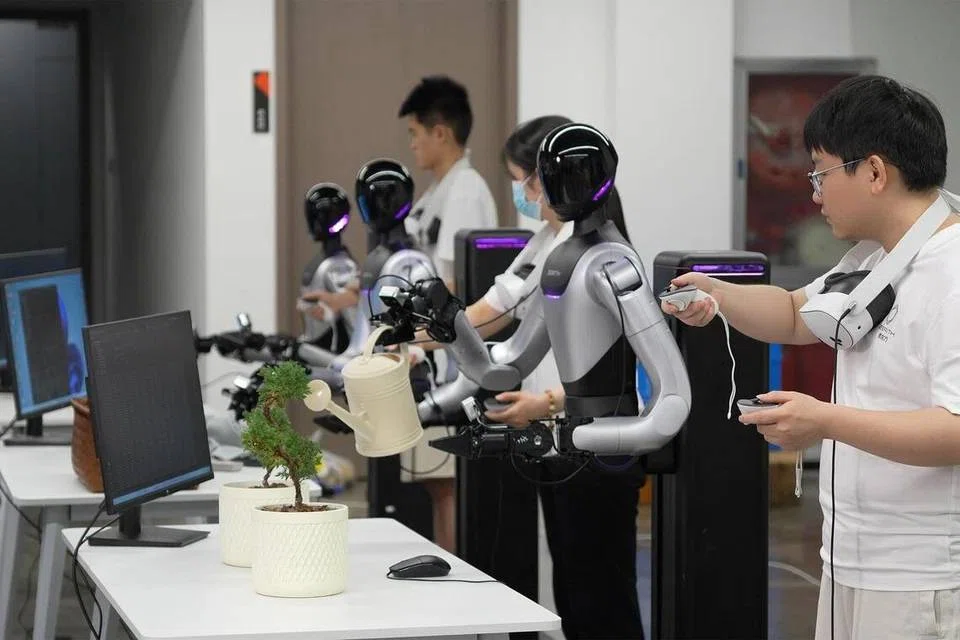
[SHENZHEN] Home economics meets Star Wars at this “training centre” in the city of Hefei, where humanoid robots are being schooled in the art of household chores.
Some of them water potted plants; others fold long-sleeved shirts and put stuffed toys in a basket. The humans controlling the droids have them repeat each task over and over, as a computer system logs their every move.
The goal: to collect the data needed to teach China’s growing pool of humanoid robots how to behave more like humans – data that experts said is sorely lacking.
Across the country, such data collection facilities have sprung up – with a wave of new openings and announcements in 2025 – as businesses and local governments rush to plug the data gap and make the machines genuinely useful in the real world.
Humanoid robots have been all the rage in China. They won fans in 2025 dancing at a Chinese New Year gala show and running a half-marathon, and have been touted as housekeepers and factory workers of the future.
Billions of dollars have been poured into what is seen as a new battleground for US-China rivalry. China has more than 150 companies that make these droids.
But hype aside, the technology is far from mature. At a “robot Olympics” in Beijing in August, humanoids crashed into each other playing football and kept falling down.
“Humanoid robots still aren’t that intelligent in many cases,” said Associate Professor Mo Yilin of Tsinghua University’s Department of Automation. “Right now, what’s most lacking is data.”
Just as chatbots are powered by large language models trained on reams of data, the artificial intelligence models that drive robots also need to learn from tons of data sets – the kind that cannot simply be scraped off the internet.

Currently, data for humanoid robotics amounts to only tens of thousands of hours, said Prof Mo. By comparison, there are tens of billions of hours worth of data for autonomous driving – a far less complicated problem.
Looking to fill this gap are companies like Zerith, a robotics start-up founded in January by Gen Z graduates from Tsinghua University and supported by the Hefei government.
At its 300 sq m data-collection facility, slightly bigger than a tennis court, some 30 young people spend hours each day guiding the humanoids through household tasks like cleaning toilets and sorting objects.
Donning virtual-reality (VR) gear, the human operators control and operate the robots – a process known as teleoperation.
“The system logs exactly how much force to apply when wiping a toilet lid, for example, and at what angle,” said brand director Wang Bowen.
Teaching a humanoid how to clean a public washroom from scratch takes around 10,000 data samples, he estimated, with several hundred more needed each time the robot encounters another washroom with a different set-up.
This includes tasks like scrubbing toilets and wiping sinks.
Zerith uses the data it generates to train its own robots and sells the data collected to other AI robot developers, Wang said. The firm also markets data-collection hardware and software to local governments and corporations that operate their own robot “training centres”.
Indeed, data collection facilities much larger than Zerith’s have opened across the country. Local governments have been sinking resources into this bottleneck for the humanoid industry. A State Council action plan on AI in August called for “stronger innovation in the supply of data” and the continued development of high-quality data sets.
Beijing’s Shijingshan district announced in September that a Humanoid Robot Data Training Centre – touted as China’s largest – had begun operating. Spanning more than 10,000 sq m, it aims to generate six million data points a year, with applications ranging from manufacturing to retail to eldercare.
Earlier in January, the state-backed Humanoid Robot Kylin Training Ground opened in Shanghai – a training facility that houses some 100 humanoids from a range of manufacturers.
Its aim? To collect 10 million pieces of data by the end of 2025. It is also growing a network of training bases in other provinces, including Henan and Jiangsu.
Such data collection facilities have also sprung up in provinces like Zhejiang, Shandong and Hubei, with more yet in the works.
Robot-maker UBTech recently announced that it had won tenders to supply training centres in Guangxi’s Fangchenggang and Jiangxi’s Jiujiang cities with its droids, valued at 264 million yuan (S$48.3 million) and 143 million yuan respectively.
The boom in training centres is producing not just data but something else that is scarce – jobs for young people, even as advances in AI cloud the prospects for white-collar workers.
China’s youth unemployment rate has exceeded 17 per cent since July, as a record number of graduates in 2025 surged into a difficult job market.
Almost anyone can be a robot teleoperator, said industry players. Young people – many of whom grew up with video games and do not command high salaries – are especially suited for the job.
Former milk-tea store employee Xu Shantao, 23, switched careers earlier in 2025 to become a robot teleoperator at a training centre in Hubei. He told local media outlet Hubei Daily that he initially found the work dull but soon got used to it, and felt a “sense of accomplishment” seeing the robots make progress.
Another operator, 22-year-old fresh graduate Joel Zhuang, told The Straits Times that he spends 7½ hours a day teleoperating his robot trainee, taking it through tasks like fitting plastic pieces into moulds.
Asked if he gets bored, he shrugged before replying: “You entertain yourself and find the joy within.” THE STRAITS TIMES
Decoding Asia newsletter: your guide to navigating Asia in a new global order. Sign up here to get Decoding Asia newsletter. Delivered to your inbox. Free.
Share with us your feedback on BT's products and services