
In first talks, duelling accusations set testy tone for US-China diplomacy
US officials accuse Chinese delegation of violating the format for meetings; China accuses US of condescending approach
 Add BT as a preferred source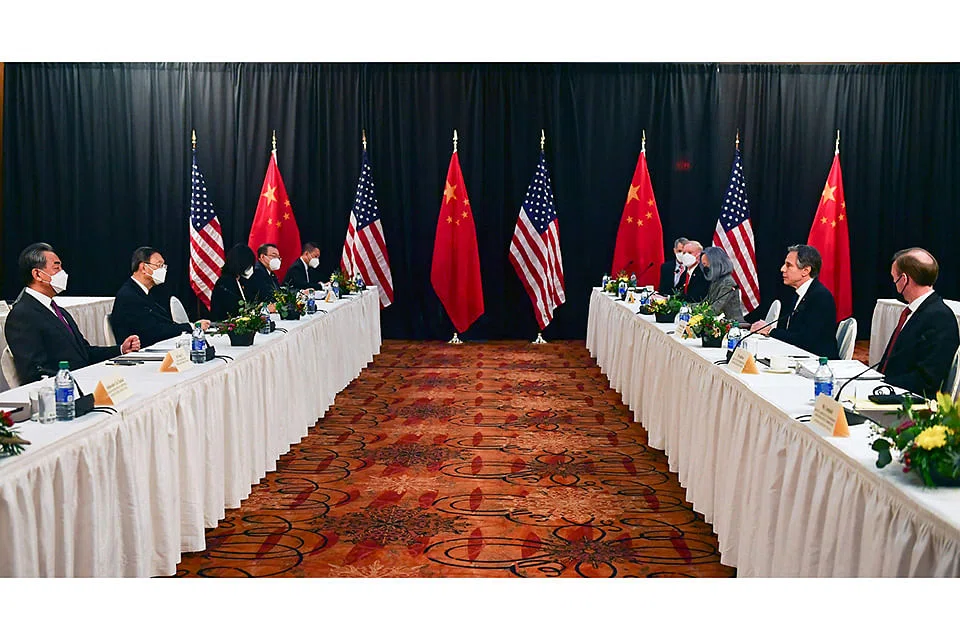
Anchorage, Alaska
EVEN before the Biden administration's first face-to-face meeting with senior Chinese diplomats on Thursday, US officials predicted the discussions would not go well.
They were right: The traditional few minutes of opening greetings and remarks dissolved into more than an hour of very public verbal jousting, confirming the expected confrontational tone between the geopolitical rivals.
US officials said the two days of talks would continue but immediately accused the Chinese delegation of violating the format for the sensitive discussions that had sought to find some common ground amid the many conflict points between them.
Yang Jiechi, China's top diplomat, accused the United States of taking a "condescending" approach to the talks and said the US delegation had no right to accuse Beijing of human rights abuses or give lectures on the merits of democracy.
At one point, he said the United States would do well to repair its own "deep seated" problems, specifically pointing to the Black Lives Matter movement against American racism.
Navigate Asia in
a new global order
Get the insights delivered to your inbox.
At another, after it looked as if the opening remarks had concluded and journalists were initially told to leave the room to let the deeper discussions begin, Mr Yang accused the US of being inconsistent in its championing of a free press.
"I don't think the overwhelming majority of countries in the world would recognise the universal values advocated by the United States, or that the opinions of the United States could represent international public opinion," Mr Yang said through an interpreter.
"And those countries would not recognise that the rules made by a small number of people would serve as the basis for the international order."
US Secretary of State Antony Blinken initially appeared surprised but adopted a more resolute tone.
He had opened the talks by asserting that the Biden administration's diplomacy intended "to advance the interests of the US and to strengthen the rules based international order".
"The alternative to a rules-based order is a world in which might makes right and winners take all," he said. "And that would be a far more violent and unstable world for all of us."
But after Mr Yang's lengthy comments - which US officials called a violation of an agreement that had limited the opening remarks to two minutes - Mr Blinken motioned for the dozen or so journalists to remain for his response.
In an implicit contrast with China, Mr Blinken said the US had a long history of openly confronting its shortcomings, "not trying to ignore them, not trying to pretend they don't exist, trying to sweep them under the rug".
He recalled a meeting from more than a decade ago between Joe Biden and Xi Jinping when both men, who now lead their respective countries, were vice-presidents.
"It's never a good bet to bet against America," Mr Biden had said then, according to Mr Blinken, who added: "That remains true today."
As journalists were again asked to leave after the American response, Mr Yang turned directly to the TV cameras and said, in English: "Wait," before he launched into another long critique of US policy.
Several times over the course of an hour, Beijing's diplomats criticised new economic sanctions that were issued against 24 Chinese officials on the eve of the talks.
"This is not supposed to be the way one should welcome his guests," Chinese Foreign Minister Wang Yi said.
The sanctions punished Chinese officials who the Biden administration said had undermined democracy in Hong Kong by rewriting the territory's election laws and pushing the changes through its pliant Communist Party-controlled legislature.
Biden administration officials had earlier said the sanctions were not deliberately timed to affect the talks in Anchorage.
But they clearly offended the Chinese diplomats, who seized on them as proof that the diplomatic overture was intended not to set ground rules for a bilateral understanding of each capital's priorities but to give the US a home-turf platform for embarrassing Beijing.
The tit-for-tat, which a senior US official later described as "grandstanding" by the Chinese for their domestic audience, left little doubt that not much would be achieved from the diplomatic discussions.
However, the official said later, the discussion cooled down after journalists left the room and yielded a substantive conversation that lasted far longer than planned.
After an often-conflicting strategy for dealing with China over the past four years - which pitted former president Donald Trump's desire for a trade deal against punishing Beijing for its rampant abuses of minority Uyghurs, military aggressions in regional waters and refusal to immediately address the coronavirus outbreak - the Biden administration has sought to take a fresh approach.
The new policy toward China is one based largely on competition - economic and diplomatic - but it is also prepared to alternately cooperate or confront Beijing when necessary.
The talks in Anchorage were meant to set a baseline for that approach. It is now unclear how much cooperation between the two nations will be possible, although that will be necessary to achieve a host of shared goals, including limiting Iran's nuclear programme and North Korea's weapons systems.
Senior Biden administration officials had earlier joked that hopes of making much progress in the talks were so low that it would be more efficient for both sides to simply fax over their respective talking points. NYTIMES
Decoding Asia newsletter: your guide to navigating Asia in a new global order. Sign up here to get Decoding Asia newsletter. Delivered to your inbox. Free.
Share with us your feedback on BT's products and services

