

India hikes spending, cuts deficit in last budget before 2024 vote
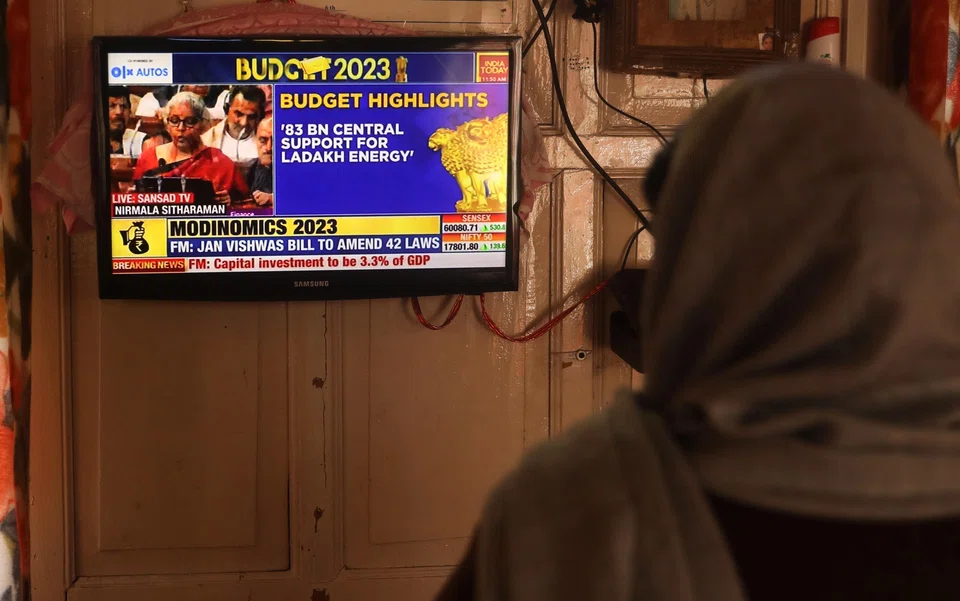
INDIA’S government has unveiled one of its biggest jumps in capital spending in the past decade, and said the fiscal deficit would fall next year as it tries to create jobs while maintaining financial discipline.
Finance Minister Nirmala Sitharaman on Wednesday (Feb 1) presented the budget for the next fiscal year, which starts on Apr 1. “After a subdued period of the pandemic, private investments are growing again,” she said.
“The budget makes the need once again to ramp up the virtuous cycle of investment and job creation. Capital investment is being increased steeply for the third year in a row, by 33 per cent to 10 trillion rupees (S$160.5 billion).”
Ruling-party lawmakers thumped their desks after she revealed the increase in capital spending, which will be the second-sharpest jump since the FY2021/2022 budget. The increased amount represents 3.3 per cent of India’s gross domestic product (GDP).
On Tuesday, the finance ministry’s annual economic survey forecast that the country’s economy could grow by between 6 per cent and 6.8 per cent year on year in the next fiscal year. This was down from a projection of 7 per cent for the current year, and sent a warning about the impact of cooling global demand on exports.
But Sitharaman said that despite a global slowdown arising from the Covid-19 pandemic and the war in Ukraine, the Indian economy was “on the right track”.
She said the government would target a budget deficit of 5.9 per cent of GDP in the upcoming fiscal year, down from 6.4 per cent for the current year and lower than the 6 per cent forecast in a Reuters poll.
Vivek Kumar, an economist at QuantEco research in Mumbai, said: “Against the backdrop of an anticipated slowdown in global growth, reliance on public capex (capital expenditure) as a countercyclical policy will help in supporting overall growth.”
Total expenditure for the next fiscal year is expected to rise 7.4 per cent to 45 trillion rupees. Gross market borrowing is estimated at 15.4 trillion rupees, while net borrowing is seen at 11.8 trillion rupees.


The government also announced that it would be raising the minimum tax-rebate limit to 700,000 rupees from 500,000 rupees. Indian shares surged after news of this. Meanwhile, bond yields moved lower after the government lifted gross borrowing.
Sitharaman said the aim of these measures was to have strong public finances and a robust financial sector for the benefit of all sections of the country. She also allocated 350 billion rupees for an energy transition, on the back of Prime Minister Narendra Modi’s focus on green hydrogen and other cleaner fuels to meet the country’s climate goals.
After taking office in 2014, Modi ramped up capital spending, including on roads and energy. He also wooed investors through lower tax rates and labour reforms, and offered subsidies to poor households to clinch their political support.
His government will face elections in key states this year, and a national vote in 2024.
The government has been under pressure to create jobs in the country of 1.4 billion, where many have struggled for employment. A lack of well-paying jobs for young people has been one of the biggest criticisms of the prime minister, who is still widely projected to win the general election. REUTERS
Decoding Asia newsletter: your guide to navigating Asia in a new global order. Sign up here to get Decoding Asia newsletter. Delivered to your inbox. Free.
Share with us your feedback on BT's products and services

