

Indonesia holds rate as new chief forecasts further rupiah gains
Keeping borrowing costs steady avoids adding further pressure to the real sector
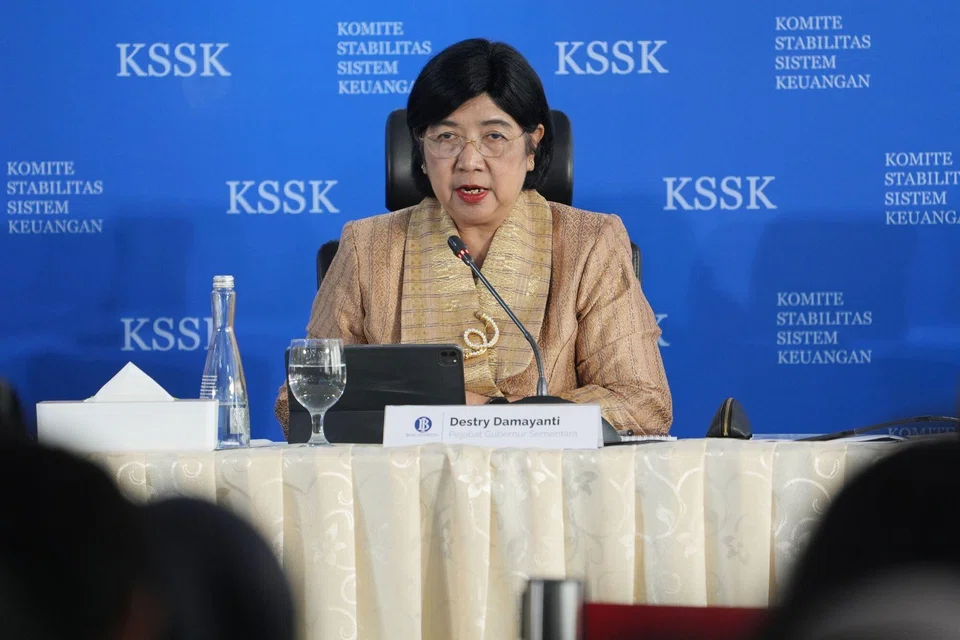
[JAKARTA] Indonesia’s central bank held its policy rate steady in the first monetary decision under acting governor Destry Damayanti, who forecast a continued advance in the rupiah that should mitigate upward pressures on prices.
Bank Indonesia (BI) left its benchmark rate at 5.75 per cent for a second straight month, as expected by 34 of 35 economists surveyed by Bloomberg. The central bank has already hiked rates by 100 basis points this year to shore up the currency and investor confidence.
“This decision remains consistent with efforts to strengthen the rupiah’s stability against the impact of heightened global volatility caused by the war in the Middle East, maintain the inflation target of 1.5 to 3.5 per cent for 2026 and 2027, and support sustainable economic growth,” Destry said in an online briefing.
The rupiah should continue to strengthen as BI wields all monetary instruments incentives to attract foreign inflows, she said, adding that the central bank will keep intervening in onshore and offshore markets and offer incentives for foreign inflows.
It will also use macroprudential measures to ensure ample liquidity keeps flowing to banks to enable more lending.
The rupiah held an earlier gain of 0.1 per cent at 17,835 against the US dollar, while stocks kept a 0.6 per cent loss. The 10-year government bond yield maintained a decline of four basis points to 7.12 per cent, the lowest in six weeks.
The first meeting under Destry, the sole nominee to run BI, is being scrutinised by investors, after the abrupt resignation of ex-governor Perry Warjiyo in July fuelled concerns about BI’s autonomy.
The prospect of a smooth transition to an experienced leader and an easing of external risks have helped revive capital inflows and strengthen the rupiah, which has gained nearly 1 per cent so far in August.
Lavanya Venkateswaran, senior economist at OCBC, said BI’s signals on upholding rupiah stability were “broadly unchanged” under Destry.


“Monetary policy continuity has broadly been reaffirmed through this decision,” she said.
“We continue to expect BI to raise its policy rate in the remainder of 2026. However, the risk may be for fewer rate hikes than presently penciled into our baseline.”
Like Warjiyo, Destry spoke for several minutes about the global environment and local economy before announcing the actual rate decision.
The hold decision shows that Warjiyo’s departure has not prompted an abrupt shift in BI’s policy path, though investors will parse Destry’s comments for clues as to how quickly she will move towards a more accommodative stance.
She is expected to be permanently named governor after parliamentary hearings in the coming weeks.
Destry said a stable rupiah should mitigate the impact of global spillovers and imported inflation on Indonesia.
BI also views global price pressures as building, and expects that the US Federal Reserve will raise its key rate in the fourth quarter. That could keep the American currency strong and US Treasury yields rising, she said.
Keeping borrowing costs steady avoids adding further pressure to the real sector.
Last quarter, economic growth came in at 5.29 per cent year on year, slowing less than expected, with government spending and investment helping counter a weakening in household demand.
The central bank is maintaining its forecast of 4.9 to 5.7 per cent growth for 2026, she said, noting that it will keep coordinating with the government to support the economy.
BI may still want to tread cautiously given the still highly uncertain geopolitical backdrop, while consumer price pressures could re-emerge in the coming months as the effects of the El Nino weather pattern intensify.
Investors will also remain watchful of BI’s policy guidance and coordination with Indonesian President Prabowo Subianto’s administration. BLOOMBERG
Decoding Asia newsletter: your guide to navigating Asia in a new global order. Sign up here to get Decoding Asia newsletter. Delivered to your inbox. Free.
Share with us your feedback on BT's products and services






