

Indonesia plays China against Japan for better infrastructure deals
China's desire to develop political and commercial links to Indonesia a boon for Jokowi
Singapore
AFTER more than five years of feasibility studies and high-level lobbying, Japanese officials thought they were on the brink of bringing bullet trains to Indonesia. Then China showed up.
"Suddenly, the minister of state-owned enterprises announced they had made something with the Chinese," said Hiromichi Muraoka, senior Indonesia representative of the Japan International Cooperation Agency (Jica), the country's foreign aid arm. "That surprised me."
In the region, decades of investment by Japan and its companies are now being challenged by China. And nowhere could the shift become more influential than in Indonesia.
China's desire to develop political and commercial links to the country is a boon for Indonesia's President Joko "Jokowi" Widodo, who believes he can leverage competition with Japan to get better deals, according to Wellian Wiranto, an economist at OCBC Bank in Singapore.
"Indonesia needs a lot of infrastructure and China has the expertise and the money," Mr Wiranto said. "You add that up with the political factor between Japan and China, and it's quite hopeful that China will be pumping more money into Indonesia."
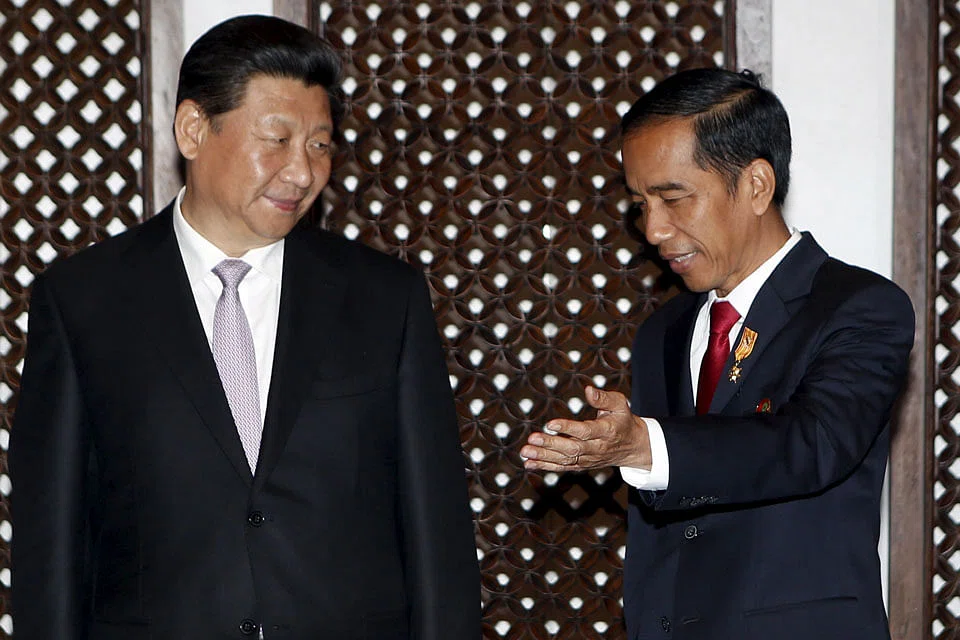
Jokowi and China's President Xi Jinping also have interests in common. The Indonesian leader wants to develop the country's ports and fishing to create a "global maritime axis", an ambition that complements Mr Xi's plan for a "Maritime Silk Road" in Asia. Indonesia also supports China's suggestion for the Asian Infrastructure Investment Bank, which could end up funding projects Indonesia needs.
With China's wages rising and economic growth slowing, Chinese companies have additional incentives to invest abroad.
Hence the headache for Mr Muraoka. Japanese feasibility studies into high-speed trains in Indonesia date back to at least 2009. The aim is to cut the rail journey between Jakarta and Bandung, the country's third-biggest city, to less than 40 minutes, from three hours.
The project would cost 726.4 billion yen (S$8 billion), partly from the Indonesian government, according to a November 2012 feasibility study posted on the website of the Japan External Trade Organization.
As late as March 24, Jica President Akihiko Tanaka urged Jokowi to consider the Japanese proposal when the two met in Tokyo, according to a release from the agency.
Then, on April 23, Indonesia's State-Owned Enterprises Minister Rini Soemarno dropped her bombshell. She said that the government was considering a Chinese offer to build the railway as part of a US$50 billion funding commitment from Chinese state banks. Ms Soemarno told reporters that the Chinese proposal was attractive because it didn't require Indonesia to provide funding guarantees.
Indonesia estimates it needs to spend US$450 billion on roads, railways, ports and power stations to revive an economy that shrank in the past two quarters. The state budget can only cover about 30 per cent of that, according to the investment board.
China is starting from a low base. It only re-established diplomatic relations with Indonesia in 1990 after a break of 23 years. During that time, former president Suharto carried out a brutal crackdown on communism and repressed the language and culture of the local ethnic Chinese.
Japan has been carrying out economic and development assistance programmes in Indonesia since the late 1950s.
Rizal Affandi Lukman, deputy minister for international economic cooperation, said that he expects China will jump from its current ranking of 10th-biggest investor to top the list within five years.
High-level contact between Indonesia and China suggests Jokowi is happy to court that investment. He has visited China twice since becoming president in October.
When Indonesia hosted the Asian-African summit last month, Mr Xi flew down on the final day to Bandung, location of the group's first meeting 60 years ago. He walked alongside Jokowi to the conference venue, recreating a stroll that former leader Sukarno and premier Zhou Enlai took back in 1955.
Turning China's interest into actual investment has been more elusive. China has a history of not delivering on promised projects, said Tamba Hutapea, deputy director for planning at the investment board, something he put down to a lack of familiarity between the two nations.
"I understand why the government is willing to open up for Chinese investors, but they need to put some guidelines on how they want to do business," said Yadi Jaya Ruchandi, chief operating officer of the Indonesia Infrastructure Guarantee Fund, a state-owned enterprise formed to support public-private partnerships.
"There is a wariness about Chinese investment that is masked by Jokowi and his aides' eager efforts to market Indonesia to Chinese investors," said Aaron Connelly, a research fellow in the East Asia Program at the Lowy Institute for International Policy in Sydney. "Indonesian policy makers have been frustrated with the quality of Chinese firms' work on projects financed by Chinese investment, particularly in the power sector."
Even with the Chinese as competitors, the scale of Indonesia's infrastructure needs means Japan's investment is unlikely to end. Japanese companies are building a mass rapid transit system in Jakarta, and Jica said that it approved loans for seven projects last year worth 62.3 billion yen.
On his trip to Japan in March, Jokowi urged a group of businessmen and officials to invest in Indonesia's infrastructure. He's promised to settle land disputes that have blocked a Japanese-backed power station in Java.
Chinese companies hoping to join them must also navigate the corruption, bureaucracy, cultural differences and changing regulations that have bedeviled foreign investments in the country for decades. China's investments in countries such as Vietnam and Ethiopia have relied on bringing in its own workers for many factory and construction jobs. Chinese companies could find that more difficult in Indonesia, which is clamping down on work visas for foreigners who do jobs that locals could do. BLOOMBERG
TRENDING NOW
32 companies, 6 individuals bag accolades at Singapore Corporate Awards 2026

He built the Vingroup empire. Now South-east Asia’s richest man is handing some key roles to his sons
URA to review guidelines on floor space to give developers more design flexibility: Chee Hong Tat
Chagee, Mixue and Luckin won the market. Sustaining their edge is the harder part

