

Indonesia's Prabowo proposes deficit at 2.4% of GDP in 2027 budget
He also proposed creating a commodity exchange for Indonesia’s strategic commodities
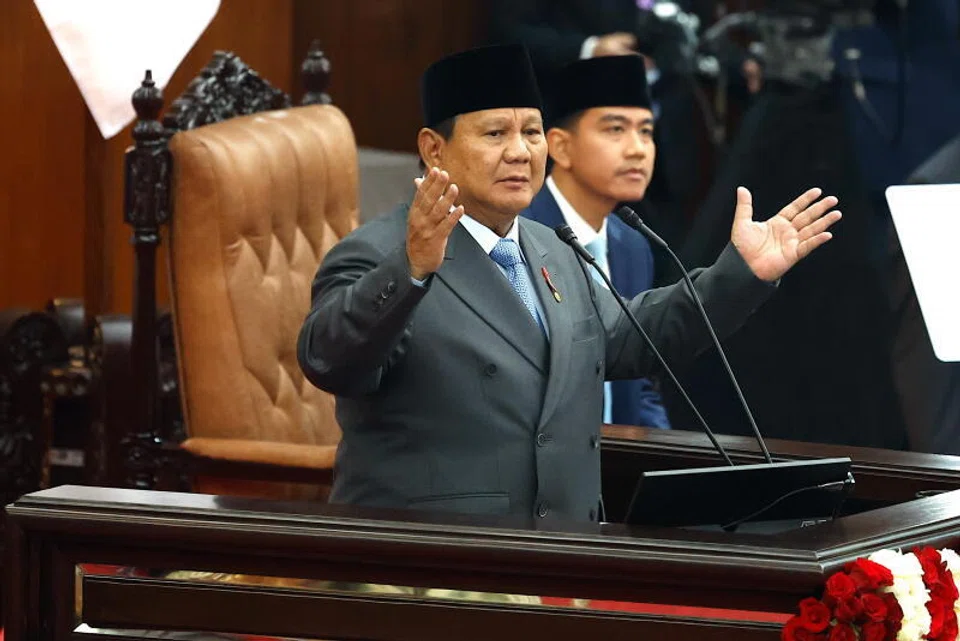
[JAKARTA] Indonesia’s President Prabowo Subianto on Friday (Aug 14) proposed a US$230 billion budget for 2027 with a fiscal deficit set at 2.4 per cent of GDP, the smallest in three years as he moved to allay investor concerns about fiscal profligacy.
In his annual budget speech to Parliament, Prabowo also set a growth target of 6 per cent for 2027 after saying in an earlier speech South-east Asia’s largest economy could expand by the same rate this year.
“The architecture of the 2027 budget is designed to remain expansive, in a collaborative, directed and measured way to propel economic growth and increase welfare more quickly,” the president said.
The 2027 budget will focus on eight key programmes, which include achieving food and energy self-sufficiency, building domestic industrial sectors and improving education, Prabowo said in a wide-ranging speech lasting around 80 minutes.
Prabowo, who pledged tighter control over the country’s natural resources, also proposed a plan to create a commodity exchange for Indonesia’s strategic commodities, aiming to launch operations on January 1, 2027.
It would follow a plan to monitor commodity exports through a company, Danantara Sumberdaya Indonesia.
“We want to develop an Indonesia reference price for Indonesia’s main commodity exports,” he said in a fiery speech, adding that Indonesia would prefer to keep minerals like nickel, tin, and coal in the ground if buyers do not agree with the price Indonesia sets.
“Indonesia must not forever remain a country where commodities are extracted while their prices and profits are determined elsewhere. We do not merely want to be a global producer of commodities; we must become a price-setter for global commodities.”
Prabowo’s fiscal policies have been under scrutiny from investors since he took office in October 2024, especially after an increase in the government’s fuel subsidy budget this year following a spike in global crude prices, raising questions about how his costly flagship programmes can be funded.
His fiscal agenda has also been complicated by the depreciation of the rupiah and the large outflows of capital triggered by concerns about Indonesia’s fiscal health, the independence of its central bank, transparency issues in the equity market and a controversial policy to centralise commodity exports.
Prabowo proposed to spend 4,097.2 trillion rupiah (US$229.73 billion) in 2027, up 3.9 per cent from the projected spending level for this year. Revenues are expected to reach 3,426 trillion rupiah next year, up 6.8 per cent from this year’s estimate. The proposed budget deficit is the smallest gap since 2024 and down from the 2.85 per cent of GDP deficit projected for 2026. Indonesia’s law limits the government’s annual budget deficit to 3 per cent of GDP.
Aside from GDP growth, the budget figures were based on assumptions that the 2027 inflation rate would be kept at around 2.5 per cent, the rupiah exchange rate at an average of 17,500 per dollar and the 10-year bond yield at an average of 6.9 per cent.
“These are rather conservative estimates compared to the budget proposal for 2026,” said Maybank economist Brian Lee, noting that Prabowo also talked about fiscal discipline in procurement and warned against wasteful spending.
However, Permata Bank economist Faisal Rachman said he expected the fiscal deficit to be wider than targeted at between 2.7 per cent to 2.9 per cent of GDP, reflecting his more moderate GDP growth outlook of 5.2 per cent. Revenues could also be constrained by the potential normalisation of commodity prices, he added. A 6 per cent growth rate for Indonesia would be its fastest since 2012. Prabowo aims to bring economic growth up to 8 per cent by 2029. Growth was 5.3 per cent in the second quarter of this year.
The rupiah strengthened 0.2 per cent on Friday to trade at 17,820 a dollar, while the 10-year bond yield fell slightly to 7.062 per cent.
Inflation in July stood at 2.88 per cent, comfortably within the central bank’s target range, thanks to the government’s fuel subsidies.
The president notably made no reference to his flagship programme to give free meals to children and pregnant women.
Instead, Prabowo promised to revitalise thousands of health clinics and hospitals and renovate schools across the country, starting from next year. The free meals programme has already been scaled back this year, with its budget trimmed from 335 trillion rupiah to 229 trillion rupiah. It has been beset by problems, including a corruption investigation, leadership changes and cases of mass food poisoning.
Indonesia’s Constitutional Court also ruled last month that starting from 2028, the government will not be able to use its education budget to fund the programme, a decision that further limits Prabowo’s fiscal room to manoeuvre. REUTERS
Decoding Asia newsletter: your guide to navigating Asia in a new global order. Sign up here to get Decoding Asia newsletter. Delivered to your inbox. Free.
Share with us your feedback on BT's products and services






