

Inflows of CMP workers unable to meet firms' needs even before tightening: Lawrence Wong

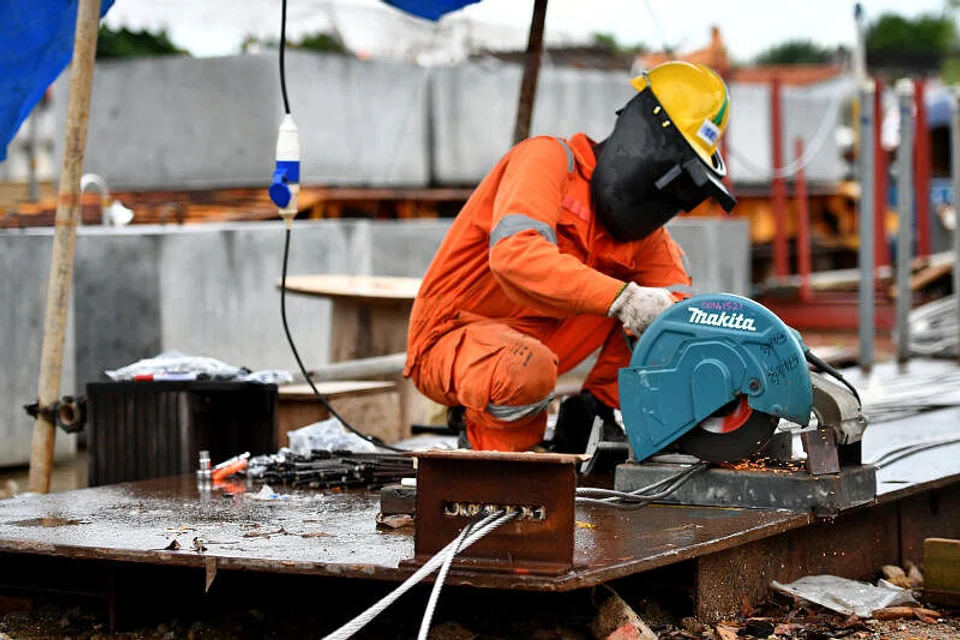
WHILE desire for tighter border measures amid the Covid-19 pandemic is understandable, the recent inflow of workers has already been unable to meet firms' needs, said Education Minister Lawrence Wong, who co-chairs the multi-ministry taskforce on Covid-19, in a ministerial statement in Parliament on Tuesday.
"I fully understand and share the desire amongst many to be tight on our border measures," said Mr Wong, adding that the government has indeed maintained a tight posture - most recently with stricter curbs on arrivals from higher-risk countries. "But we also need to be very clear about what this means for Singapore and Singaporeans."
Construction contractors in particular have been hard-hit, with building projects - including new public flats - being delayed. The marine and process industries may find it hard to deliver projects on time, and may have to forgo new opportunities and projects.
Nor is the effect confined to these industries, as the manpower shortage resulting from Covid-19 border curbs will "have a cascading effect on the whole economy".
Before the pandemic, some 200,000 travellers passed through Changi Airport daily. Arrivals plummeted with the "circuit breaker", rising to only 820 arrivals a day by November last year.
Between December and March this year, daily arrivals were stable at around 1,200, in part due to more migrant workers for the construction, marine, and process (CMP) sectors, as well as foreign domestic workers.
"But the inflow of CMP workers we've allowed up till now is still unable to meet our needs," noted Mr Wong. This is because many migrant workers have returned to their home countries. "Whatever numbers we are bringing in barely replace those who have left."
Many companies, including small and medium enterprises, urgently need new workers to make up the shortfall and have been applying to the Manpower Ministry for relevant approvals. This application backlog has been building up significantly, even before the latest travel restrictions.
Larger or resource-rich countries can afford to shut their borders, but trade and travel are "existential issues" for Singapore, Mr Wong said. "They are how, as a country, we earn a living and remain relevant to the world."
Singapore can keep borders closed for a short time but not over a prolonged duration. It has thus worked towards reopening while strengthening precautions and safeguards, and taking a dynamic approach towards border controls - throttling down numbers and imposing stricter restrictions if any deterioration is observed in other countries.
But "even with the tightest of border controls, there may still be imported cases leaking into the community", he said. That is why Singapore cannot just rely on border measures, but needs a full suite of protective measures and safeguards in the community.
Speaking on the tighter community measures taken in May, Mr Wong said: "I think it's very important for us to understand that we are now on the knife's edge, and our community cases can go either way."
Over the next few weeks, Singapore stands a chance of getting things under control by the end of the month - but it only takes one lapse for an infection to spread, risking the chance of a super spreader event, he said.
READ MORE: Construction firms to be able to seek relief for increased foreign manpower costs
Decoding Asia newsletter: your guide to navigating Asia in a new global order. Sign up here to get Decoding Asia newsletter. Delivered to your inbox. Free.
Copyright SPH Media. All rights reserved.
TRENDING NOW

Once staunchly pro-China, Malaysian Chinese businesses are now distancing themselves from Beijing

Britain’s mansion tax shows the difficulty of targeting wealth
Three hats, one goal: How Ng Kian Swan runs sustainability at NUHS
COE review: The gap between luxury and mass-market cars isn’t the only one worth bridging

