

Intra-Asean flows gain ground even as US, China trade blows
Asian economies have gained from the resulting trade diversions, but Asian exports, which are inputs in China, may be hit when Chinese goods become expensive in the US

Singapore
EVEN as all eyes are trained on US-China trade tensions and the possibility of a global recession, trading within the region has been trending upwards.
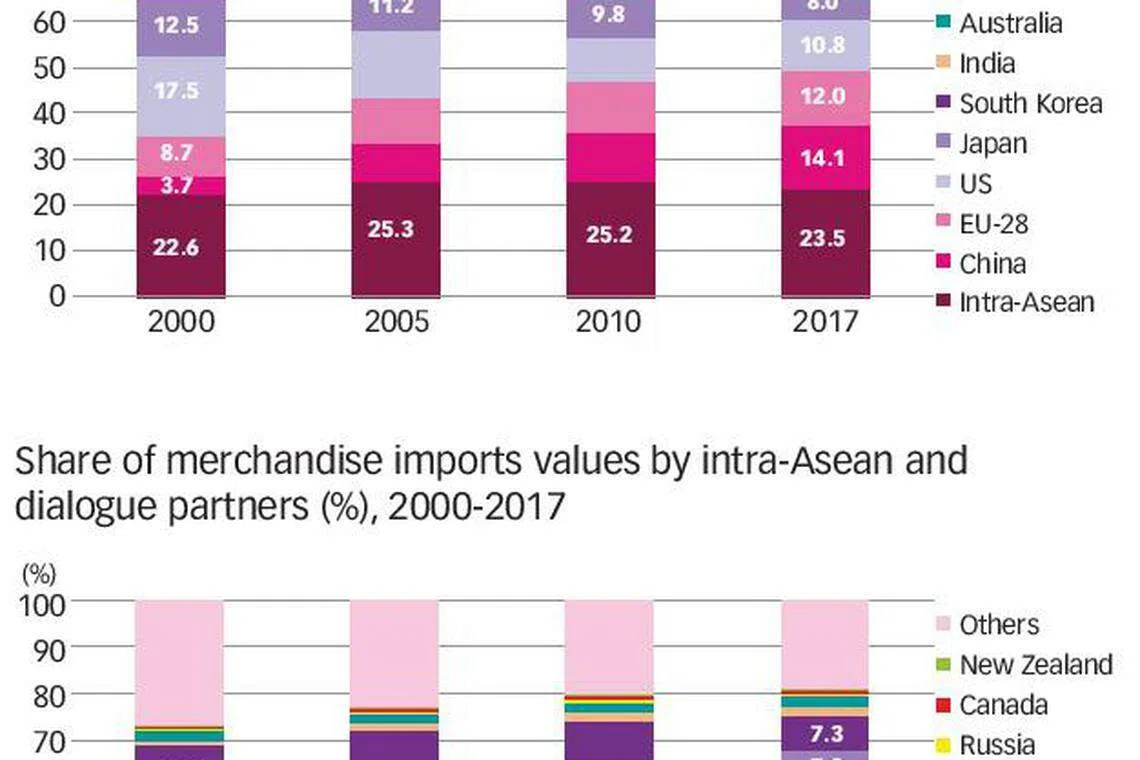
Data from the Asean Secretariat shows that intra-Asean merchandise exports have consistently accounted for the largest share of merchandise value among intra-Asean and dialogue partners.
In 2000, intra-Asean merchandise made up 22.6 per cent of merchandise-export value. In 2005, it had risen to 25.3 per cent; in 2010, 25.2 per cent; and in 2017, 23.5 per cent.
In terms of imports, intra-Asean contributed 21.4 per cent in 2000, 24.5 per cent in 2005, 25.0 per cent in 2010 and 22.3 per cent in 2017.
Singapore was the largest exporter and importer within the Asean trade market, with shares of 29.0 per cent and 25.4 per cent of the Asean total respectively in 2017.
Tan Chin Hwee, the Asia-Pacific chief executive of Trafigura, an independent commodity trading and logistics house, said: "We doubled our revenue in four years to US$181 billion and Asia will continue to be the growth engine.
"More intra-Asia trade is a likely outcome with this trade war, with a lot of demand and the supply already in the same time zone to begin with."
Going by data from Trafigura's annual reports, revenue from Asia represented 29.4 per cent of total revenue from external customers in 2015; this figure climbed to 38.1 per cent in 2016 and hit 43.1 per cent in 2017. It moderated to 38.5 per cent of total revenue last year.
Mr Tan said: "This trade war will now force the ecosystem to work closer together as trust in the United States is eroding."
A report by Nomura on June 3 noted that many Asian economies have benefited from the trade diversion. The report, which studied a full year's worth of trade data, identified Vietnam has having been the largest beneficiary by far, gaining 7.9 per cent in gross domestic product (GDP) as a result of the trade diversion.
Taiwan was second, gaining 2.1 per cent of GDP, and Chile third at 1.5 per cent.
Other Asian economies rounding off the top 10 included Malaysia (in fourth position), Hong Kong (sixth), Korea (eighth) and Singapore (ninth).
Mei Yuan, assistant professor of economics at Singapore Management University, attributed the recent years' increase in trade flows among Asian countries to a large extent to the region's growing participation in global value chains.
Precisely because of this inter-dependence, Asian countries will be affected by the trade war between US and China.
On the one hand, the resulting trade diversion is benefiting some Asian economies more than others, he noted.
"On the other hand, if we take global value chains into consideration, things will become more complicated.
"Since exports from many Asian economies are used as intermediate inputs in China, these economies will be adversely affected when Chinese goods become more expensive in the US market," he said.
Dr Mei also pointed out that capacity constraints will determine the extent to which other Asian economies can benefit from the trade diversion.
In May this year, Tony Cripps, chief executive of HSBC Singapore, said Asean businesses need to "build more visibility and credibility" among international firms, particularly in their ability to handle and deliver production orders, so as to create a stronger incentive for companies to move their supply chains to Southeast Asia.
Other hot-button issues that matter include how Asean companies can deliver competitive production costs, and how they harness technology and innovation to improve productivity.
At a government level, improvements in ports, rail and other transport infrastructure is required.
The community must also come together to clear a pathway to longer-term initiatives to remove the non-tariff barriers around the flow of goods across Asean, as well as to develop skilled labour, protect intellectual property (IP), strengthen cyber security and promote the movement of commercial data across borders, he said.
Separately, it is worth noting that trade in services has increased significantly.
Total Asean exports of services rose from US$113.4 billion in 2005 to US$360.5 billion in 2017.
Over the same period, total Asean imports of services grew from US$140.8 billion in 2005 to US$342.7 billion in 2017.
This means that after having experienced a continuous trade deficit, Asean recorded a positive balance on trade in services from 2016, to reach US$17.9 billion in 2017.
The share of intra-Asean trade in services has remained relatively constant, at around 17 per cent of the total services pie.
CIMB Private Banking economist Song Seng Wun said the increase in trade flows has been domestic-led, a "natural progression of increased domestic consumption as more families have more disposable income".
Citing air travel as an example, he noted that factors such as rising disposable income, millennials' embrace of travel and the increased opportunities offered by budget carriers have opened up opportunities for consumption.
"Even though we say there is a risk of recession and global growth has slowed, this region is still reflecting stronger growth than the rest of the world. So there's still a stronger opportunity even though the rate of growth has slowed."
READ MORE: Flat global growth for 2019, but no recession, says Aberdeen
TRENDING NOW

Government to bring forward raising of retirement age, give employers more financial support to create flexi-load jobs

Former minister Maliki Osman, Revolut chairman join Asia Gulf Holdings advisory board

Is Manila Asia’s new dining hot spot?
Simba at risk of losing operating licence over spectrum misuse

