

Iran and IAEA agree on timeline to remove hurdle to reviving nuclear deal
 Add BT as a preferred source
DeeperDive is a beta AI feature. Refer to full articles for the facts.
Vienna
IRAN and the UN nuclear watchdog on Saturday (Mar 5) agreed to a 3-month plan that in the best case will resolve the long-stalled issue of uranium particles found at old but undeclared sites in the country, removing an obstacle to reviving the Iran nuclear deal.
Eleven months after indirect talks between Iran and the United States on salvaging the 2015 deal began in Vienna, delegates are trying to settle the final thorny issues within days as Western powers say time is running out since Iran's nuclear advances will soon make the deal redundant.
One unresolved issue, diplomats say, has been Iran's demand for the closure of the International Atomic Energy Agency's (IAEA's) probe into uranium particles found at 3 apparently old but undeclared sites, which suggest that Iran had nuclear material there that it did not declare to the agency.
The agency has long said Iran has not given satisfactory answers on those issues, but on Saturday they announced a plan for a series of exchanges after which IAEA chief Rafael Grossi "will aim to report his conclusion by the June 2022 (IAEA) Board of Governors" meeting, which begins on June 6.
The joint plan clears the way for a possible agreement to revive the 2015 deal, though Grossi emphasised that his conclusion would not necessarily be positive. Where anything other than full resolution would leave implementation of any agreement, however, remains to be seen.
Navigate Asia in
a new global order
Get the insights delivered to your inbox.
"It would be difficult to imagine you can have a cooperative relationship as if nothing had happened if the clarification of very important safeguards issues were to fail," Grossi said in a news conference when asked what the effect on reviving the deal would be if the issues were not closed.
He also suggested that the presentation of his conclusion would happen before "Re-Implementation Day" - the day by which the bulk of US sanctions-lifting and Iranian implementation of nuclear restrictions will have happened under any future agreement - even though they are officially unrelated.
"It is obvious that for Iran it is important to try to have the processes I wouldn't say running in absolute synchronicity, but there is a sort of a loose relationship," he said when asked if the 3-month timeframe was based on the timing of Re-Implementation Day.
Grossi was speaking after a trip to Teheran in which he met Iran's nuclear chief Mohammad Eslami and Foreign Minister Hossein Amirabdollahian. REUTERS
Decoding Asia newsletter: your guide to navigating Asia in a new global order. Sign up here to get Decoding Asia newsletter. Delivered to your inbox. Free.
Share with us your feedback on BT's products and services
TRENDING NOW

Air India asks Tata, Singapore Airlines for funds after US$2.4 billion loss

Beijing’s calculated silence on the Iran war
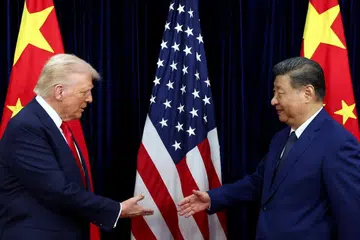
China pips the US if Asean is forced to choose, but analysts warn against reading it like a sports result

Richard Eu on how core values, customers keep Singapore’s TCM chain Eu Yan Sang relevant

