Israel and US are on alert for Iran to strike back at Israel
 Add BT as a preferred source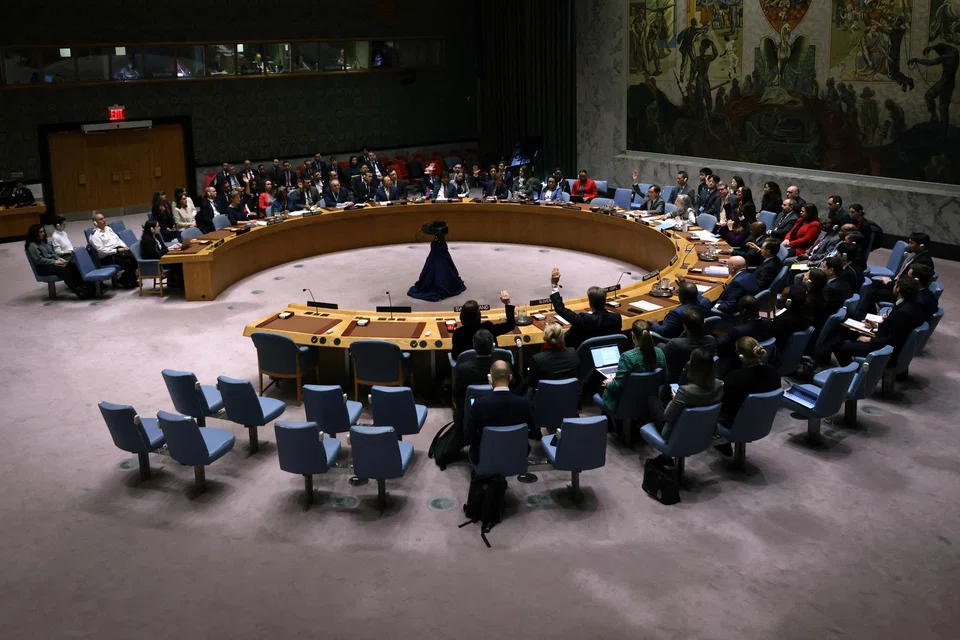
IRAN vowed Friday (Apr 5) to avenge Israel’s killing of senior commanders and other officers of its elite Quds Force, at a public funeral held for the dead men, elevating fears of open war but leaving unsaid how it would retaliate or when.
US officials in Washington and the Middle East said Friday that they were bracing for possible Iranian retaliation for the Israeli airstrike Monday in Damascus, Syria. US military forces in the region have been placed on heightened alert. According to an Israeli official, Israel has also placed its military on high alert, canceled leave for combat units, recalled some reservists to air defense units and blocked GPS signals.
Two Iranian officials who asked not to be named because they were not authorized to speak publicly said that Iran had placed all its armed forces on full high alert and that a decision had been made that Iran must respond directly to the Damascus attack to create deterrence.
“Our brave men will punish the Zionist regime,” Gen. Hossein Salami, the commander in chief of Iran’s Revolutionary Guard, told the crowd in Tehran, Iran, attending the funeral of the officers killed in Damascus. “We warn that no act by any enemy against our holy system will go unanswered, and the art of the Iranian nation is to break the power of empires.”
The Israeli airstrike hit a building that was part of the Iranian Embassy complex in Damascus, killing three generals and four other officers of the Quds Force. The force, an arm of the Revolutionary Guard, conducts military and intelligence operations outside Iran, often working closely with allies that oppose Israel and the United States, including Syria, Hezbollah in Lebanon and Hamas.
Iran’s ambassador to the United Nations, Amir Saeid Iravani, said Thursday that he would give interviews to US news outlets “after Iran’s response to Israel.”
There are precedents for a forceful response by Iran. Four years ago, after the United States killed the chief of the Quds Force, Maj. Gen. Qassem Soleimani, Iran fired missiles at US bases in Iraq, injuring more than 100 troops.
Although its proxy militias around the Middle East have launched a number of attacks on Israel since the war between Israel and Hamas began Oct. 7, Iran has taken care to avoid a direct conflict that could lead to full-fledged war.
Hassan Nasrallah, the leader of Hezbollah, delivered a video speech that was broadcast in Iran and in Lebanon during the funeral, saying that a response from Iran could come anytime and that “we must be prepared for all eventualities.”


“Be certain that the Iranian response to the targeting in Damascus is inevitably coming,” Nasrallah said.
In the past few months, Israel has killed at least 18 members of the Quds Force, among them four senior commanders who were veterans of Middle East wars, according to Iranian media. But the airstrike in Damascus was far out of the ordinary, both in killing so many senior figures at once and in hitting a diplomatic building, normally considered off limits in conflicts. Israeli officials said the building functioned as a Revolutionary Guard base and so was a legitimate target.
The building housed the official residence of Iran’s ambassador to Syria, who said on state television that he and his family had left the building when it was hit.
The final decision on a matter as important as a strike against Israel rests with Supreme Leader Ayatollah Ali Khamenei, who is also the commander in chief of the armed forces. It was Khamenei who ordered the 2020 attack in retaliation for the killing of Soleimani.
US military analysts assess that it is more likely that Iran would strike Israel itself than that it would have its proxies attack US troops in the region, including in Iraq and Syria, as they did more than 170 times in the four months after the Hamas-led Oct 7 assault against Israel. Those attacks against American targets stopped in early February, but Pentagon officials said they were watching the situation closely.
An Israeli defense official said that Israeli analysts had reached the same conclusion: that Iran itself would attack and not act through Hezbollah, its closest militant ally, which has been engaging in regular exchanges of fire with Israeli forces since the war began.
Prime Minister Benjamin Netanyahu of Israel, before a security Cabinet meeting about a potential Iranian attack, said Thursday, “We will know how to defend ourselves, and we will act according to the simple principle of whoever harms us or plans to harm us – we will harm them.”
Lt. Gen. Alexus Grynkewich, the top US Air Force commander in the Middle East, told the Defense Writers Group in Washington this week: “From a military perspective, the biggest concern that I have is, does this lead to some sort of regional escalation? We’re watching very carefully; we’re listening to what the Iranians are saying in terms of how they intend to respond.
“I do continue to assess that the Iranians are not interested in a broader regional conflict,” he added. “They want to take advantage of the crisis as it exists, but they’re not interested in war with Israel, war with the United States or war with anybody else right now.” NYT
Decoding Asia newsletter: your guide to navigating Asia in a new global order. Sign up here to get Decoding Asia newsletter. Delivered to your inbox. Free.
Share with us your feedback on BT's products and services