

Israel hits Tehran again after killing Khamenei, leadership council takes over
Israel’s present focus is to undermine the Iranian government so that it collapses, an Israeli official
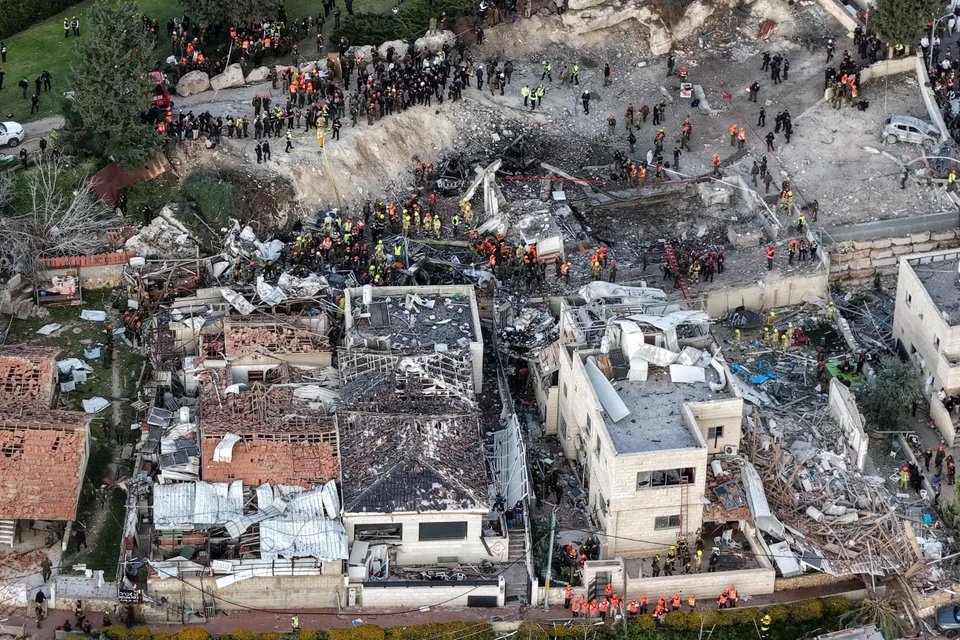
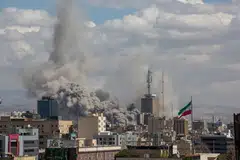
[JERUSALEM] Israel launched a new wave of strikes on Tehran on Sunday and Iran responded with more missile barrages, a day after the killing of Supreme Leader Ali Khamenei pitched the Middle East and the global economy into deepening uncertainty.
US and Israeli strikes - and Iranian retaliation - sent shockwaves worldwide through sectors from shipping to air travel to oil, amid warnings of rising energy costs and disruption to business in the Gulf, a strategic waterway and global trade hub.
US President Donald Trump said the attack was intended to ensure Iran could not have a nuclear weapon, to contain its missile programme and to eliminate threats to the United States and its allies.
The US has hit more than 1,000 Iranian targets since the start of the campaign, US Central Command said.
In an interview with the Atlantic magazine on Sunday, Trump, who has encouraged the Iranian people to topple their government, said Iran’s leadership wanted to talk to him and he had agreed.
In a separate interview with the Daily Mail, Trump said the military campaign against Iran could continue for the next four weeks.
He has yet to lay out his longer-term aims in Iran, which faces a power vacuum that could leave it in chaos, with unforeseeable consequences for the region.
The first US casualties of the campaign, including the deaths of three service personnel, were confirmed on Sunday.
“We have three, but we expect casualties, but in the end it’s going to be a great deal for the world,” Trump said on NBC News.
SEE ALSO
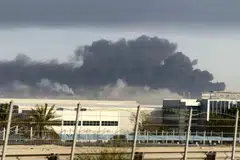
With the vital Strait of Hormuz closed and the Gulf cities of Dubai, Abu Dhabi and Doha under bombardment, the scale of the risk taken by Trump in attacking Iran months before US midterm elections that will decide control of Congress is becoming clearer.
Only around one in four Americans approve of the operation, according to a Reuters/Ipsos poll on Sunday.
And if Hormuz - the passage for about 20 per cent of world oil supplies - remains closed for more than a few days, US consumers will start to feel the pressure on prices at the pumps.
Existential challenge for Iran
The Israeli military said late on Sunday that its air force had established aerial superiority over Tehran, and that a wave of strikes across the capital had targeted intelligence, security, and military command centers.
Israel’s present focus is to undermine the Iranian government so that it collapses, an Israeli official said on condition of anonymity, adding that Israel “is acting in its own ways” to get Iranians to take to the streets.
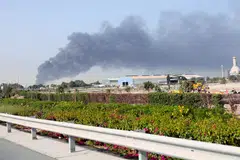
Iran’s Revolutionary Guards said on Sunday they had hit three US and UK oil tankers in the Gulf and the Strait of Hormuz, and attacked military bases in Kuwait and Bahrain with drones and missiles.
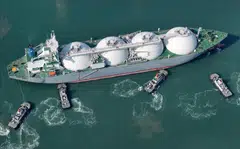
Shipping data showed hundreds of vessels including oil and gas tankers dropping anchor in nearby waters with traders expecting sharp jumps in crude oil prices on Monday.
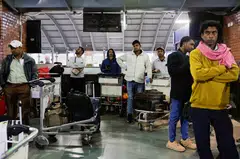
Global air travel was also heavily disrupted as continued air strikes kept closed major Middle Eastern airports, including Dubai - the world’s busiest international hub - in one of the biggest aviation interruptions in recent years.
In Iran, facing its biggest existential challenge since the 1980-88 war with Iraq, President Masoud Pezeshkian said a leadership council composed of himself, the judiciary head and a member of the powerful Guardian Council had temporarily assumed the duties of Supreme Leader.
Oman’s foreign ministry said Iranian Foreign Minister Abbas Araqchi had indicated Tehran was open to de-escalation. But in a post on X, Araqchi suggested Iran was ready to keep fighting.
“We’ve had two decades to study defeats of the US military to our immediate east and west,” he wrote. “Bombings in our capital have no impact on our ability to conduct war.”
It remained unclear what the longer-term prospects were for Iran to rebuild its leadership and replace the 86-year-old Khamenei, who had held power since the death of the founder of the Islamic Republic, Ayatollah Ruhollah Khomeini in 1989.
Russian President Vladimir Putindenounced Khamenei’s death as a cynical murder and China’s Foreign Minister Wang Yi described it as “blatant killing”.
Israel, which has pressed successive US administrations to take action against Iran, claimed responsibility for killing Khamenei while he was in his central leadership compound in Tehran, and showed no signs of curbing its attacks.
“We have the capabilities and the targets to keep going on for as long as necessary,” Israeli military spokesperson Lieutenant Colonel Nadav Shoshani said.
Iran hits back
Trump warned that the US would hit Iran “with a force that has never been seen before” if it struck back.
But as Iran fired renewed missile barrages across the region, air raid sirens sounded across Israel late on Sunday, warning of the latest incoming attack, including in Tel Aviv, where projectiles were seen streaking across the night sky.
Israel’s ambulance service said nine people were killed in the town of Beit Shemesh, the United Arab Emirates said Iranian attacks killed three people, and Kuwait reported one dead.
Trump said on social media that the US military had destroyed nine Iranian warships so far and was “going after the rest.”
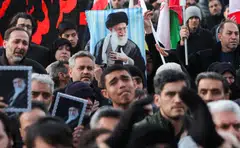
Inside Iran, some grieved for Khamenei while others celebrated his death, exposing a deep fault line in the stunned country.
Thousands of Iranians were killed in a crackdown authorised by Khamenei against anti-government protests in January, the deadliest wave of unrest since the Islamic Revolution of 1979.
Khamenei, who built Iran into a powerful anti-US force and spread its sway across the Middle East during his 36-year iron-fisted rule, was working in his office at the time of Saturday’s attack, state media said. The raid also killed his daughter, grandchild, daughter-in-law and son-in-law.
Experts said that while his death and those of other Iranian leaders would deal Iran a major blow, it would not necessarily spell the end of Iran’s entrenched clerical rule or the sway of the elite Revolutionary Guards over the population.
His death sparked protests among Shi’ites in neighbouring Pakistan, where police clashed with demonstrators who breached the outer wall of the US consulate in Karachi, leaving nine people dead.
In Iraq, police fired tear gas and stun grenades to scatter hundreds of protesters who gathered outside the Green Zone in Baghdad, where the US Embassy is located. REUTERS
Decoding Asia newsletter: your guide to navigating Asia in a new global order. Sign up here to get Decoding Asia newsletter. Delivered to your inbox. Free.
Share with us your feedback on BT's products and services






