

It’s not just the US dollar. China supports yuan against 23 other currencies
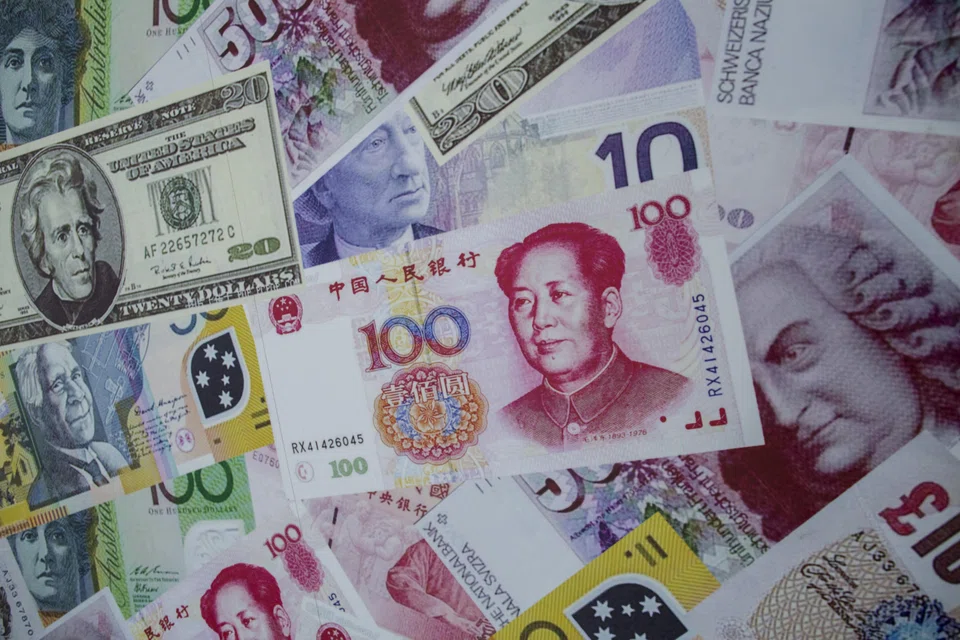
CHINA’S struggle with a weak yuan extends far beyond how it trades against the US dollar.
The People’s Bank of China (PBOC) has been supporting the yuan versus 23 trading partners’ exchange rates – including the euro, yen and pound – with its daily fixings against these currencies since mid-August, according to calculations by Bloomberg. That has resulted in the stabilisation of an official gauge measuring the yuan’s value versus peers.
Traders have sold the yuan this year as disappointing economic data and turmoil in the real estate sector spurred the central bank to cut interest rates. As its monetary policy diverges with the rest of the world and weakens its currency, Chinese officials have to weigh how that may lead to capital outflows as confidence weakens.
While there has been less attention on the PBOC’s efforts to prop up the currency against other major peers, it seems to be working. The trade-weighted basket has gained about 1.2 per cent since the end of July, while the onshore yuan has weakened around 2 per cent versus the greenback during the period.
“Boosting export competitiveness by allowing the yuan to weaken more drastically at this point could reap less looking at slowing global demand,” said Fiona Lim, a senior foreign exchange analyst at Malayan Banking Berhad in Singapore. Further weakness would “cost more in terms of confidence, capital outflows and financial stability”, she said.
The PBOC has been digging deeper into its policy tool kit to stem a slide in the currency, as the yuan slid to a 16-year low against the US dollar last week.
The currency stabilised this week as authorities delivered their most forceful defence yet through verbal warnings and set the dollar-yuan reference rate at the strongest margin on record.
To be sure, the yuan basket index’s relative stability may also be partly due to Asian currencies’ weakness against the US dollar on bets that the Federal Reserve may keep interest rates higher for longer. The yen and the South Korean won are down more than 3 per cent versus the greenback since late July.
Non-dollar fixings
The fixings for other basket currencies such as the euro, the second-largest component after the US dollar, are calculated and submitted by market makers to the central bank based on their respective cross-rates and the US dollar-yuan rate. Bloomberg’s analysis going back to 2018 shows the reference rates have rarely deviated from market trends, likely due to a lack of liquidity and less significance to policymakers.


Yet the fixings have started to carry a stronger bias in the past couple of weeks. Calculations on the US dollar-yuan rate likely used to guide other currencies suggest the PBOC has been setting the yuan at about 0.5 per cent stronger than what had been expected by market participants. The five-day moving-average gap is the widest since November last year when the yuan was experiencing a bout of weakness.
The greenback’s 20 per cent weight in the CFETS RMB Index suggests the US dollar-yuan reference rate alone won’t be enough to support the trade-weighted basket, indicating that the PBOC may have implemented some adjustments to its fixings in non-dollar rates. BLOOMBERG
Decoding Asia newsletter: your guide to navigating Asia in a new global order. Sign up here to get Decoding Asia newsletter. Delivered to your inbox. Free.
Share with us your feedback on BT's products and services
TRENDING NOW

He built the Vingroup empire. Now South-east Asia’s richest man is handing some key roles to his sons

CPIB hauls Multi-Chem CEO, COO in for questioning; stock hits ‘circuit breaker’

SC Capital Partners sells Rivervale Mall in Sengkang for around S$276 million

From Haidilao to Oriental Kopi: How some of Asia’s favourite F&B players are faring in 2026

