

Janet Yellen seals success as market's therapist
'Normalcy' of her statement underscores triumph, given the 'extraordinary' Fed moves when she took over
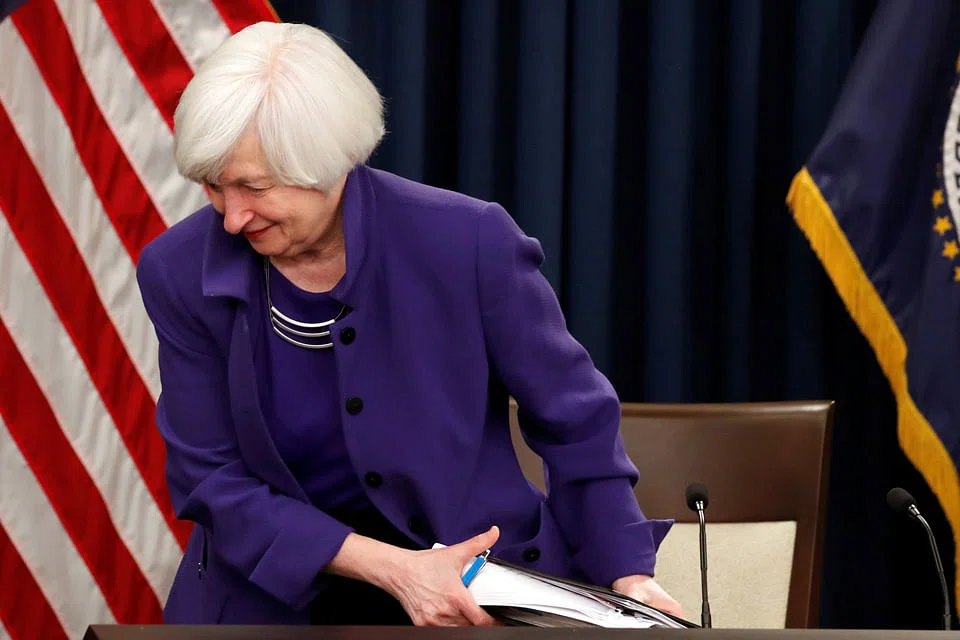
JANET Yellen's final act as chair of the US Federal Reserve on Wednesday was a subtle change of tone on inflation, a finesse that epitomised her slow and steady approach to getting the economic world back to normal.
If Ms Yellen's predecessor, Ben Bernanke, was the surgeon who performed a massive operation to save his patient, Ms Yellen was the physiotherapist who nudged the patient back onto his feet and gently encouraged him to get back to life as it was before.
In her final statement before handing over the reins to Jerome Powell, her rate-setting committee warned of rising inflation expectations.
The statement also offered a more modest assessment of economic prospects than the rosy picture painted by US President Donald Trump during his State of the Union speech on Tuesday.
While Mr Trump claimed he had conjured up a "new American moment" by boosting employment and wages with the "biggest ever tax cuts in American history," the central bank was considerably more measured about the current economic climate:
"Gains in employment, household spending and business fixed investment have been solid, and the unemployment rate has stayed low," the Fed said.
In the immediate wake of Mr Trump's razzmatazz, such sentiments sounded even more understated than your average central bank statement.
And yet, the very normalcy of the statement was something of a triumphant exit for Ms Yellen. When she took over from Mr Bernanke in 2014, the buzzword in Fed statements was "extraordinary".
There was the extraordinary shock to credit markets in 2008; the extraordinary decision to cut rates to zero a few months later; and not one, but two rounds of extraordinary bond-buying by the Fed.
Mr Bernanke may loom larger in history as the man who unleashed the most extraordinary central-bank intervention in global markets in history in a tenure worthy of Trumpian hyperbole.
But Ms Yellen, arguably, had the tougher job, managing the transition from the extraordinary back to the ordinary.
Her success in getting the US economy closer to normal can be measured in the yield on the 10-year Treasury note, which hit a record low of 1.375 per cent in July 2016, about halfway through her term.
It closed on Wednesday at 2.72 per cent, near its highest level since the financial crisis, albeit still far shy of the historical average around 6 per cent.
In this light, the return of quotidian central-banking concerns like rising inflation is a sign that the global economy has finally shaken off the after-effects of the Great Recession.
"The Fed now expects inflation on a 12-month basis to move up this year and stabilise around the 2 per cent objective in the medium term," said analysts at brokerage Bank of America Merrill Lynch Global Research, in a note to clients.
"This is a decisive change from the December language which stated that inflation on a 12-month basis would remain somewhat below 2 per cent in the near term."
The Fed's change of stance on inflation is significant because it's a tacit warning that the central bank will continue raising rates until such time as inflation is under control.
Anticipation of the Fed's hikes is the main reason that Treasury yields have risen so sharply in early 2018.
The sharp rise in Treasury yields is the main reason that the stock market tumbled on Tuesday, with the Dow Jones Industrial Average falling more than 360 points.
"We believe economic growth will continue to strengthen and inflation will move higher, keeping the Fed on track to raise rates gradually throughout the year," said John Lynch, chief investment strategist at brokerage LPL Financial.
Analysts at brokerage Goldman Sachs recently warned that the stock market rally will be in jeopardy if the Treasury yield continues its ascent.
One money manager said the uptick in yields and inflation is a case of the Fed's chickens coming home to roost.
A rapid increase in yields would constitute the US economy's hangover from Mr Bernanke's extraordinary interventions, according to Jeffrey Pavlik, founder of hedge fund Pavlik Capital Management.
He has long argued that the bond-buying and monetary easing was a risky strategy because of the amount of new debt it injected into the financial system, a problem that Ms Yellen did little to address with her gradual approach.
"They kicked the can down the road in lot of respects," said Mr Pavlik. "The amount of debt out there is pretty amazing. Our national debt went from US$8 trillion to US$20 trillion in 10 years and no one cared because interest payments were so low that it was not affecting budgets or deficits.
If Treasury rates keep rising, US interest payments will rise, too. That affects infrastructure spending and possibly even tax reform," said Mr Pavlik.






