

Japan's Okinawa orders halt to US military base work
 Add BT as a preferred source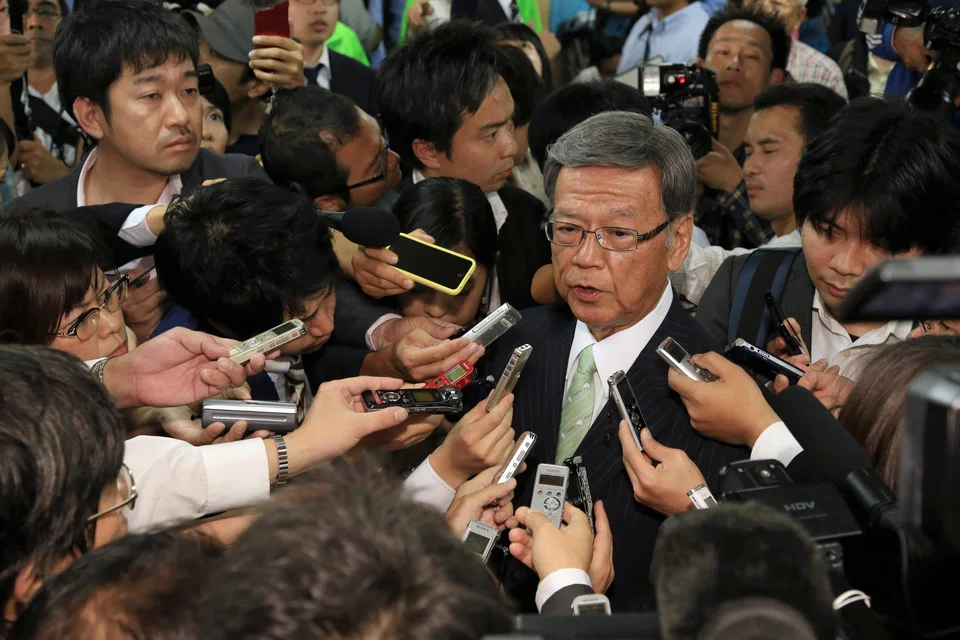
DeeperDive is a beta AI feature. Refer to full articles for the facts.
[TOKYO] The governor of Okinawa on Monday ordered a halt to construction of a controversial US military base, in the latest twist in a saga that has riven southern Japan for decades.
Setting up a new clash between the central government in Tokyo and the independently minded semi-tropical island chain, Takeshi Onaga told a news conference he could revoke a drilling permit if the defence ministry does not comply with his order.
Anti-airbase Mr Onaga was elected in November, ousting his pragmatic predecessor who had agreed to the drilling needed in the sparsely populated coastal region to relocate Futenma airbase, which sits in a crowded urban area.
"Because rock drilling has apparently been carried out (outside the area covered by the permit), I ordered them to suspend the work while the prefecture probes the issue," Mr Onaga said.
The move came after undersea research conducted by the Okinawa government last month found coral reefs in the area had been damaged by one of concrete blocks sunk there as part of a survey.
In Tokyo, Chief Cabinet Secretary Yoshihide Suga characterised Mr Onaga's move as "regrettable".
Navigate Asia in
a new global order
Get the insights delivered to your inbox.
"The construction work is taking place after (Okinawa) agreed on it. It's impossible" that the work be suspended, he told reporters.
Around half of the 47,000 US servicemen stationed in Japan are based in Okinawa, a strategically vital archipelago.
While most Japanese value the protection the US military alliance gives them, especially in the context of China's growing assertiveness in its numerous regional disputes, a sizable proportion of Okinawans want the Americans to leave the island chain.
The shuttering of Futenma and the opening of a replacement facility at Nago, 50 kilometres (30 miles) away, was first agreed in 1996 as the US sought to calm local anger after the gang rape of a schoolgirl by servicemen.
But it has been bogged down ever since, with local politicians blocking the move in a bid to reduce the American footprint.
In 2013 Mr Onaga's predecessor Hirokazu Nakaima agreed to drop his opposition in exchange for a hefty annual cash injection to the local economy.
Many islanders saw this as a betrayal, and in November booted him out of office in favour of Mr Onaga.
AFP
Share with us your feedback on BT's products and services
TRENDING NOW

‘We’ve seen the worst-case scenario’: How Indonesia’s Cinema XXI navigated crisis and change

Malaysia tourism hit by fuel shock; tour prices may jump 50%

From 1MDB to ‘corporate mafia’: Is Malaysia facing a new governance test?

China pips the US if Asean is forced to choose, but analysts warn against reading it like a sports result

