

Japan’s PM Takaichi aims for blizzard of votes in rare winter election
Record snow may hurt turnout, favouring organised voting blocs
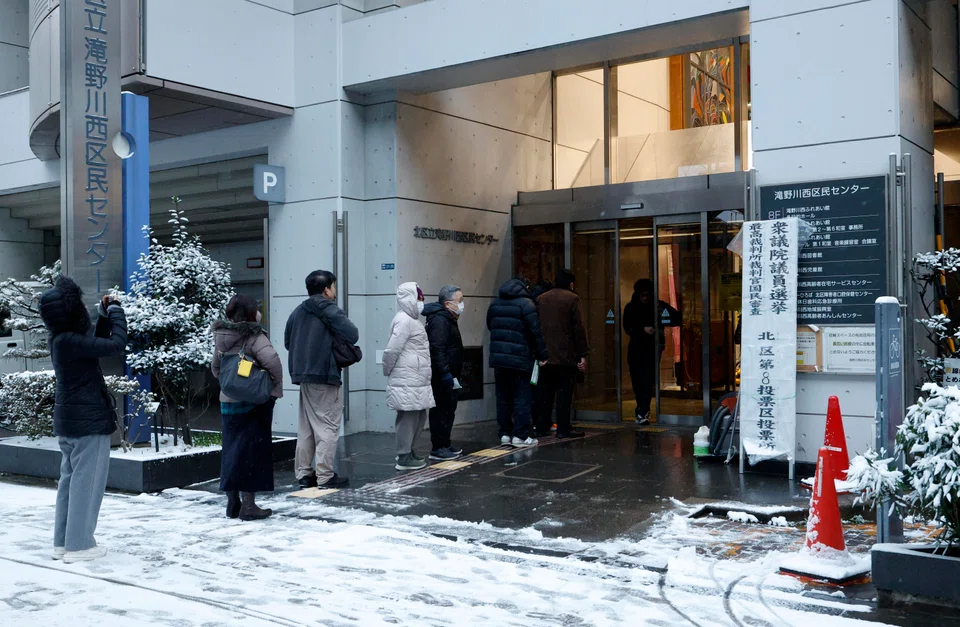
[TOKYO] Japanese voters trudged through snow on Sunday (Feb 8) to cast their ballots in an election predicted to hand Prime Minister Sanae Takaichi a solid win, though record dumps in some parts of the country snarled traffic and could dent turnout.
The conservative coalition of Takaichi, the nation’s first female leader, is on track to win around 300 of the 465 seats in the lower house of parliament, according to multiple opinion polls, a large gain from the 232 it is defending.
Outside a polling station in the town of Uonuma in the mountainous Niigata prefecture, teacher Kazushige Cho, 54, braved below-freezing temperatures and deep snow to cast his vote for Takaichi’s Liberal Democratic Party (LDP).
“It feels like she’s creating a sense of direction – like the whole country pulling together and moving forward. That really resonates with me,” he said.
Takaichi rides ‘sanakatsu’ wave among young voters
Takaichi, 64, who became prime minister in October after being selected LDP leader, called the rare winter election to capitalise on her strong approval ratings, with voters drawn to her straight-talking and image as a hard worker.
But her nationalistic rhetoric and security focus have stoked tensions with powerful neighbour China, and her fiscal largesse has rattled financial markets.
An election promise to suspend the 8 per cent sales tax on food to help households cope with rising prices has spooked investors concerned about how the nation with the heaviest debt burden among advanced economies will fund the plan.
“If Takaichi wins big, she will have more political room to follow through on key commitments, including on consumption-tax cuts,” said Seiji Inada, managing director at FGS Global, a consultancy. “Markets could react in the following days, and the yen could come under renewed pressure.”
Niigata resident Mineko Mori, 74, padding through the snow with her dog, said she worried that Takaichi’s tax cuts could saddle future generations with an even bigger burden.


Mori planned to vote for Sanseito, a small far-right party that broke through in a 2025 upper house ballot with promises to crack down on badly behaved foreigners and control immigration.
But younger voters are among the most supportive of Takaichi, with one recent poll finding more than 90 per cent of those under 30 favoured her.
The prime minister has sparked an unlikely youth-led craze called “sanakatsu”, roughly translated as “Sanae-mania”, with the products she uses, such as her handbag and the pink pen she scribbles notes with in parliament, in high demand.
That young cohort, however, is less likely to vote than the older generations that have long been the bedrock of LDP support.
On Thursday, Takaichi received the “total endorsement” of US President Donald Trump. China will also be keeping a close eye on the results.
Weeks after taking office, Takaichi touched off the biggest dispute with China in over a decade by publicly outlining how Tokyo might respond to a Chinese attack on Taiwan.
A strong mandate could accelerate her plans to bolster Japan’s defence, which Beijing has cast as an attempt to revive its militaristic past.
“I voted for a party that clearly has the will to protect the country,” Masanobu Igarashi, a retired soldier, said after casting his ballot for the LDP in Uonuma.
Whiteout could boost organised voting blocs
With almost a metre of snow forecast to fall in northern regions, some voters battled blizzard conditions to pass their verdict on Takaichi’s administration.
It is only the third postwar election held in February, with elections typically called during milder months.
Even the capital Tokyo was given a rare covering, causing some minor traffic disruptions.
Nationwide, 37 train lines and 58 ferry routes were halted on Sunday morning, according to the transport ministry. Japan Airlines and ANA cancelled a combined 230 domestic flights.
Turnout in recent lower house elections has hovered around the mid-50 per cent range. Any slump on Sunday could amplify the influence of organised voting blocs.
One of those is Komeito, which last year quit its coalition with the LDP and has merged into a centrist group with the main opposition Constitutional Democratic Party of Japan. Komeito has close ties to the lay-Buddhist Soka Gakkai group, which claims at least eight million members nationwide.
Voters will pick lawmakers in 289 single-seat constituencies, with the rest decided by proportional-representation votes for parties. Polls close at 8 pm (1100 GMT, 7pm Singapore time), when broadcasters are expected to issue projections based on their exit polls.
If the coalition of Takaichi’s LDP and its new partner, the Japan Innovation Party, known as Ishin, wins a supermajority of 310 seats, she could override the upper chamber, where the coalition does not have a majority.
If the polls have it all wrong and Takaichi loses control of the lower house, she has vowed to step down. REUTERS
Decoding Asia newsletter: your guide to navigating Asia in a new global order. Sign up here to get Decoding Asia newsletter. Delivered to your inbox. Free.
Share with us your feedback on BT's products and services






