

Japan’s Takaichi unveils 370 trillion yen long-term spending plan
The road map marks a key step in the premier’s effort to put her stamp on the country’s growth strategy
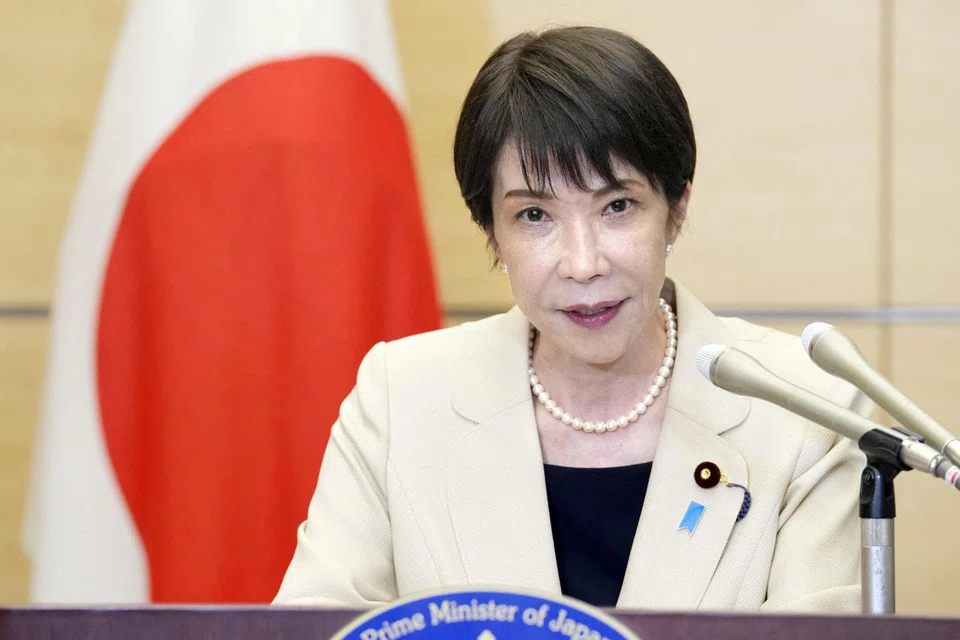
[TOKYO] Japanese Prime Minister Sanae Takaichi unveiled an investment roadmap for the country’s economy that envisions huge sums of spending while also raising questions about its viability owing to its 14-year timeframe.
The plan calls for investing more than 370 trillion yen (S$3 trillion) in the 14-year period ending in March 2041, with 101.6 trillion yen earmarked for artificial intelligence and chips spending alone, according to documents released on Wednesday (Jun 24) after a policy advisory panel’s meeting.
“As far as I can recall, this is the first time a roadmap for growth spanning such a long period has been presented, and I haven’t heard of any other countries’ plans like this, either,” said Harumi Taguchi, principal economist at S&P Global Market Intelligence.
The strategy outline through which Takaichi aims to create a “strong and prosperous investment framework” was mostly shrugged off by financial markets on Thursday.
Market participants said the long period made it hard to assess market implications. As a recent comparison, former prime minister Shinzo Abe released a revitalisation strategy titled “Japan is Back” in 2013 that set numerical targets to be achieved by 2020. It did not include spending pledges.
Takaichi’s blueprint calls for a combination of public and private investment to reach the target amounts, but it does not provide a break down between the two sectors. In the most optimistic growth projection, the government is seen contributing 10 trillion yen per year, meaning public contributions could amount to a little less than half.
It is also unclear how much of an additional impact the strategy would have, as private companies already invest hundreds of billions of US dollars in plant and equipment every year.
“With such a long timeframe, it’s impossible to predict how economic conditions will unfold, so the plan’s accuracy is inevitably very low, raising questions about its reliability,” Taguchi said. “It’s hard to imagine this serving as a catalyst for private investment.”
The investment road map marks a key step in Takaichi’s effort to put her stamp on Japan’s growth strategy as technological change and geopolitical tensions reshape economic priorities.
SEE ALSO








The premier is seeking to channel investment into sectors that can strengthen economic security – from supply-chain resilience to critical technologies – while boosting the country’s long-term growth potential through support for emerging industries.
Three scenarios
The government also released Wednesday long-term economic and fiscal projections incorporating Takaichi’s growth strategy under three scenarios. In the most optimistic case, in which the strategy delivers as intended, the debt-to-GDP ratio is expected to decline steadily even as the government contributes 10 trillion yen in real spending towards the plan each year.
In the other two – where technological and market uncertainties curb the strategy’s impact, or where current trends persist – the ratio is projected to begin rising again during the 2030s. All three scenarios assume inflation stabilises at around 2 per cent.
Takaichi’s government has shifted its fiscal focus towards reducing the debt-to-GDP ratio, moving away from using a primary balance target that had guided government policy for more than two decades. The debt-to-GDP metric is generally considered easier to improve during periods of inflation.
The projections underscore how heavily Japan’s fiscal outlook depends on the success of Takaichi’s growth agenda. The estimates do not take into account the costs of any hikes in defence spending or any potential consumption-tax cuts, suggesting fiscal pressures could prove greater than the forecasts imply.
Takaichi’s economic agenda has split investor sentiment. In the stock market, her push for large-scale investment helped the Nikkei 225 briefly top 70,000 for the first time ever this month. At the same time, concerns about fiscal sustainability helped push super-long Japanese government bond yields to multi-decade highs earlier this year.
Chips, AI
Of the investment for AI and chips, the bulk will go towards semiconductors, which form the core of physical intelligent systems, as well as vertical AI, which is designed for a specific job or industry. The investments are meant to ease supply bottlenecks by addressing structural labour shortages in the ageing nation.
The plan estimates semiconductor investment will generate 443 trillion yen in economic spillover effects by fiscal 2040, while physical AI and vertical AI investment will produce 144 trillion yen and 222 trillion yen, respectively.
The investment plan is part of Japan’s ongoing efforts to revive its chip industry. Since releasing a new strategy in 2021, the government has set aside about 7.2 trillion yen for semiconductors and AI, according to the Industry Ministry.
Of the total, the government has allocated sums to specific projects such as state-backed chip venture Rapidus, which has received public support worth roughly 2.6 trillion yen. BLOOMBERG
Decoding Asia newsletter: your guide to navigating Asia in a new global order. Sign up here to get Decoding Asia newsletter. Delivered to your inbox. Free.
Share with us your feedback on BT's products and services
TRENDING NOW

Government to bring forward raising of retirement age, give employers more financial support to create flexi-load jobs

Former minister Maliki Osman, Revolut chairman join Asia Gulf Holdings advisory board

Is Manila Asia’s new dining hot spot?

Simba at risk of losing operating licence over spectrum misuse

