

Job vacancies hit record high of 92,100 in June: MOM
 Add BT as a preferred source
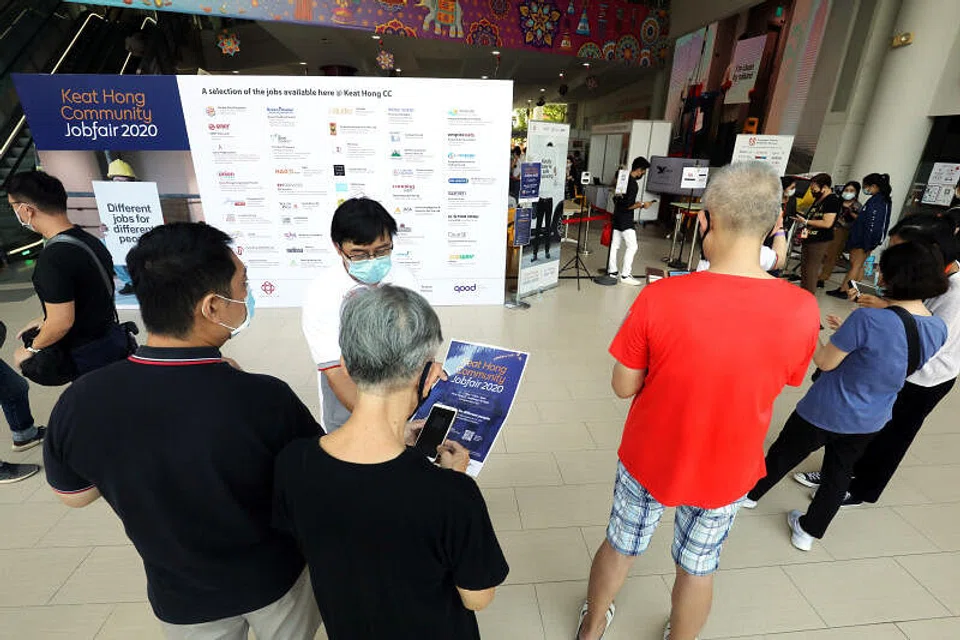
AMID ongoing border restrictions and sustained manpower demand in growth sectors, seasonally-adjusted job vacancies rose to an all-time high of 92,100 in June, according to the Manpower Ministry's (MOM) latest Labour Market Report.
Though some labour market indicators weakened in the second quarter as Covid-19 measures were tightened, the third quarter is likely to see improvement, said MOM officials at the report's release on Wednesday.
"A lot of the indicators have recovered to a level similar to pre-pandemic times," said Ang Boon Heng, director of MOM's manpower research and statistics department.
While there was another round of Covid-19 curbs in July, the MOM sees it as "unlikely to have a lot of impact on the third quarter", he added.
Maybank Kim Eng economist Chua Hak Bin expects the recovery to continue, but added: "The jobs market recovery is not a straight line trajectory and may still face a bumpy and winding road ahead even with the economic reopening."
Compared to March, the greatest rise in job vacancies was seen in manufacturing (+6,300) and construction (+5,100), which have been especially affected by border curbs.
Navigate Asia in
a new global order
Get the insights delivered to your inbox.
But vacancies also rose due to strong demand in industries such as information and communications (+2,700), administrative and support services (+2,400), and professional services (+2,400).
"However, at this moment, we do not observe heightened mismatches in the labour market," said MOM in its report, noting that the resident long-term unemployment rate, which is a proxy for structural unemployment, has declined.
The vacancy numbers reflect both recovery in growth sectors and worker shortages due to entry restrictions, said Dr Chua. While foreign worker shortages are probably a factor in services as well, this is not as severe as in construction, and the overall picture is still of an improving job situation for locals, he added.
With the number of unemployed persons also declining, the ratio of job vacancies to unemployed persons improved to 1.63, rising above 1 for the first time since March 2019.
Wednesday's report contains updated figures and additional indicators, compared to the MOM's advance release at the end of July. One such indicator is the re-entry rate for retrenched residents, which dipped in the second quarter of 2021 after two previous quarters of improvement.
Of retrenched residents, 64.4 per cent found employment within six months, down from 66.2 per cent in the previous quarter. However, this is more of a fluctuation than indicative of a trend, said permanent secretary for manpower Aubeck Kam.
The re-entry rate also rose for certain groups, such as workers aged below 50; clerical, sales and service workers; and those with degree qualifications.
Retrenchments are just one part of the overall labour market picture, with unemployment rates being more significant, said Kenny Tan, divisional director for manpower planning and policy.
Unemployment rates continued to ease in June, though they picked up in July, according to figures released earlier in September.
Overall, resident, and citizen unemployment rates were 2.7 per cent, 3.5 per cent, and 3.7 per cent respectively in June. They rose to 2.8 per cent, 3.7 per cent, and 3.9 per cent respectively in July.
Despite the uptick in July, "the overall trend is an improving one", said Mr Tan, adding that the MOM is "cautiously optimistic" about the outlook.
The seasonally-adjusted resident long-term unemployment rate improved to 0.9 per cent in June, down from the recent high of 1.1 per cent in March. Most age and education groups saw this rate decline, with the exception being residents aged 60 and over, who saw their long-term unemployment rate rise for the third straight quarter to 1.3 per cent.
Compared to March, most age and educational groups saw improvements in unemployment rates. One exception was residents in their forties, whose unemployment rate rose to 3.7 per cent, from 3.2 per cent before.(see Amendment note)
The unemployment rate also rose for degree holders to 3.5 per cent from 3.2 per cent before. But Mr Kam noted that for younger degree holders, the MOM is "not seeing greater difficulties" in their ability to gain employment.
Total employment fell by 16,200 in the second quarter, with a 4,800 rise in resident employment more than offset by a 21,000 fall in non-resident employment.
The picture was mixed at the industry level. Seeing employment growth were sectors such as health and social services (+4,200), information and communications (+3,700), and professional services (+1,900). This growth was due entirely to residents, as non-resident employment fell across all sectors.
At the other end were manufacturing (-4,300), construction (-5,100), and food and beverage services (-5,700).
For the full first half, total employment was down 4,000, with a 28,500 rise in resident employment more than offset by a 32,600 decline in non-resident employment, excluding migrant domestic workers.
The decline in non-resident employment was across all sectors and pass types, with 10,100 fewer Employment Pass holders, 9,800 fewer S-Pass holders, and 12,600 fewer holders of work permits and other work passes.
There were 2,340 retrenchments in Q2, up slightly from 2,270 in Q1 amid Phase 2 (Heightened Alert) measures. This took total retrenchments in the first half of the year to 4,620 or 2.3 retrenchments per 1,000 employees, comparable to half-yearly levels for 2018 and 2019.
MOM said it did not see elevated retrenchments in sectors hit by tightened Covid-19 measures, such as food and beverage services; retail trade; as well as arts, entertainment, and recreation.
However, these were the sectors - particularly F&B services - which saw a rise in short work-week or temporary layoff arrangements. There were 5,580 employees on such arrangements in Q2, up from 4,020 in Q1.
"While the number remained elevated compared to pre-pandemic times, the prevalence of such temporary work arrangements helped to keep retrenchments relatively low in H1 2021," said the MOM.
In a Facebook post, Manpower Minister Tan See Leng said: "The improvement in the labour market is a reflection of both businesses and workers adapting to the new environment, and seizing new opportunities."
He noted various schemes under the SGUnited Jobs and Skills Package which continue to be available until March 2022, including Workforce Singapore's (WSG) Career Conversion Programmes, SGUnited Traineeships and SGUnited Mid-Career Pathways programmes.
Jobseekers can approach WSG or SGUnited Jobs & Skills Centres' career-matching services. Mature jobseekers, jobseekers who have been unemployed for a period of six months or more, and persons with disabilities can also be assisted by Adecco, the appointed SGUnited Jobs and Skills Placement Partner, to explore job opportunities, added Dr Tan.
Amendment note: An earlier version of the article referred to Q1 when comparing unemployment rates. MOM has clarified that the point of reference is March 2021. The article has been amended accordingly.
Decoding Asia newsletter: your guide to navigating Asia in a new global order. Sign up here to get Decoding Asia newsletter. Delivered to your inbox. Free.
Copyright SPH Media. All rights reserved.
TRENDING NOW

On the board but frozen out: The Taib family feud tearing Sarawak construction giant apart

OCBC consumer banking chief Sunny Quek aims to double wealth business by 2029

Thai and Vietnamese farmers may stop planting rice because of the Iran war. Here’s why

Hengli’s ex-Singapore unit dismisses staff after US sanctions, at risk of being wound down: sources

