

Jockeying for ECB, BOE successors is underway
The choice of appointments is crucial as European monetary stability is essential at a time when the fragile British and eurozone economies are slowing down
London
TWO vital central bank changes are due to take place in 2019. They are the successors of Mario Draghi, president of the European Central Bank (ECB) and Mark Carney, governor of the Bank of England (BOE).
Mr Draghi's term ends in October 2019 and Mr Carney's four months earlier in June 2019, but jockeying for their positions is already underway.
The choice of appointments is crucial as European monetary stability is essential at a time when the fragile British and eurozone economies are slowing down.
Business people and economists credit Mr Draghi for boosting a depressed eurozone economy.
Back in July 2012, he promised "whatever it takes to preserve the euro".
High bond yields in Italy, Spain and Greece tumbled and European stock markets boomed.
Renewed optimistic sentiment helped drag the eurozone and rest of the European Union (EU) into a growth path. Unemployment tumbled, but growth remained slack.
Mr Draghi embarked on quantitative easing (QE) and pumped 60 billion euros (S$97 billion) a month into the financial sector via the purchases of bonds from banks and other institutions.
From March 2015 until March this year, the ECB has purchased an astounding 2.5 trillion euros of bonds.
Moreover, Mr Draghi and his ECB council intend buying a further 30 billion euros a month until the end of September.
The eurozone, especially German inflation is accelerating, but the expectation is that interest rates will remain at zero while uncertainty over Brexit continues.
Mr Draghi's successor could be critical for the path of the eurozone's economy. A monetary dove would continue with monetary ease and a hawk would place pressure on the Council to raise rates.
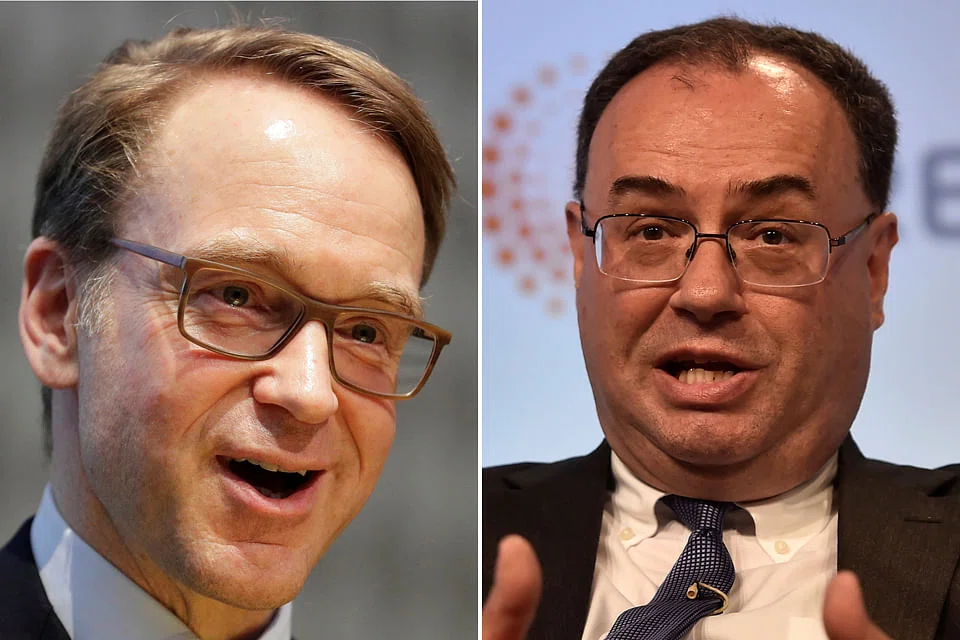
The favourite to succeed Mr Draghi is German Bundesbank president Jens Weidmann. But there could well be opposition from other nations as Mr Weidman is considered to be a monetary hawk.
He has been exceedingly wary of QE following the general German conservatism about inflation and excessive credit.
Brendan Brown, head of Economic Research at MUFG Securities EMEA, rates Mr Weidmann's chances as 50:50.
But he does not agree that Mr Weidmann is a monetary hawk and says that several German economists believe that he is not strict enough on inflation.
Even though the ECB is based in Frankfurt, a German central banker has never held the post of ECB president.
Mr Draghi's predecessors were Wim Duisenberg of the Netherlands and Jean-Claude Trichet of France. According to the Brussels rumour mill, however, several other nations don't want to give Germany too much power in the eurozone.
They complain that Germans already dominate the ECB as it is estimated that 30 per cent of its top managers are from Germany. The ECB maintains that the predominance of Germans is natural, as the bank is based in Frankfurt.
According to a Bloomberg survey of economists, other potential ECB presidential candidates include Bank of France governor Villeroy de Galhau, Central Bank of Ireland governor Philip Lane, International Monetary Fund managing director Christine Lagarde, Spain central bank governor Luis Maria Linde, and Netherlands central bank governor Klaas Knot.
ECB vice-president Vítor Constâncio departs at the end of May this year, and eurozone finance ministers have chosen Spanish Economy Minister Luis de Guindos to succeed him. Some observers now believe that Spain will favour Mr Weidman as Germany had supported its candidate.
Meanwhile, Andrew Bailey, former deputy governor of the BOE and currently chief executive of the Financial Conduct Authority, the UK's financial markets regulator, is tipped to succeed Mr Carney.
When he was at the BOE, Mr Bailey helped control banks during the 2008/2009 global financial crisis. He is thus thought to be an ideal BOE governor for the uncertain months post- Brexit.
Ben Broadbent and Dave Ramsden, deputy governors for monetary policy and for markets and banking respectively, are also potential successors.
Andy Haldane, the BOE's chief economist and its former executive director for financial stability, is regarded as an outside candidate.
In the meantime, ECB policy remains under the stewardship of Mr Draghi and the Council. They contend that it is best to be "patient" and "prudent" about withdrawing monetary stimulus.
"There are still uncertainties about the degree of slack in the economy," Mr Draghi said.
Latest economic statistics show that the eurozone's economic performance has been weaker than expected.
High debt levels and bubbles in real estate prices and rents in France, Germany and the Netherlands are worrying economists.
The appreciation of the euro against the US dollar and Asian currencies is another concern.
READ MORE: Will a poisoned chalice await Draghi successor in 2019?
TRENDING NOW
Malaysian king buys stake in Singapore-listed mining firm expanding into rare earths

Family offices ‘kept captive’ by relationship managers turn to independent advisers, direct deals

Once staunchly pro-China, Malaysian Chinese businesses are now distancing themselves from Beijing

Could stablecoins be the future of money?

