Jurong Innovation District to bring jobs and innovation: Tan See Leng
Singapore
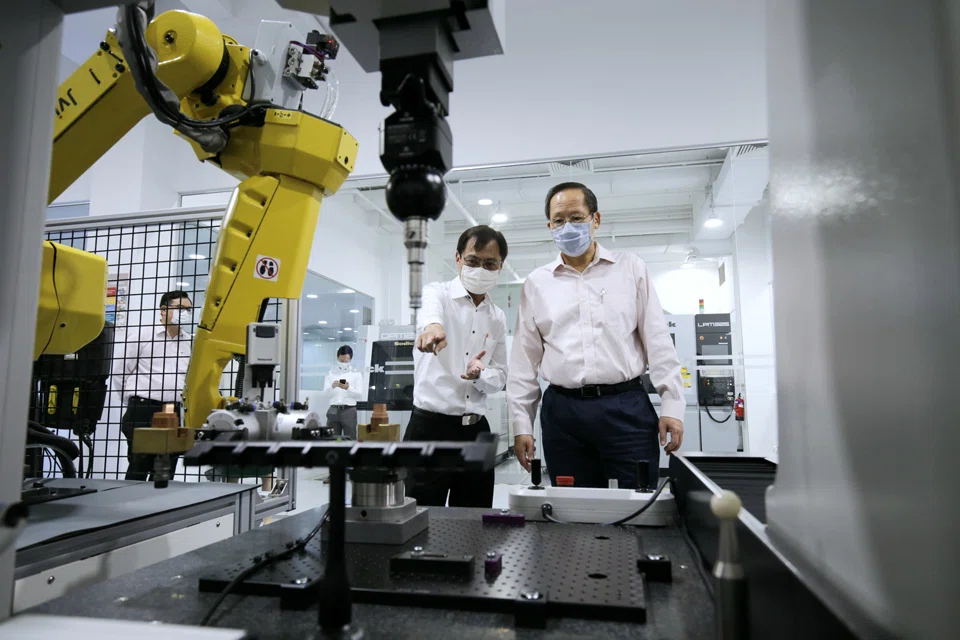
OVER the next 18 months, the Jurong Innovation District (JID) is expected to account for 4,500 jobs, with 1,200 being new and 3,300 being existing workers relocating into the area, said Second Minister for Trade and Industry Tan See Leng during his visit to the Sodick Singapore Techno Centre (SSTC) on Wednesday.
Developed by the JTC Corporation, the 600 hectare JID will establish companies such as German conglomerate Siemens and South Korea's Hyundai Motor Group in a single campus. Partnerships with institutes of higher learning are also nurtured, to create a talent pool in the community.
As companies such as infrastructure and urban development consulting group Surbana Jurong and bicycle component, fishing tackle and rowing equipment manufacturer Shimano move into their facilities in the JID, more jobs will be created in the area, said Dr Tan.
This is expected to include positions in industries such as advanced manufacturing, urban mobility and urban solutions.
Between October 2019 and October 2020, JID attracted S$420 million in new investments, as previously reported by The Business Times. It will be developed over the next 20 years. Fully developed, the advanced manufacturing hub is projected to create over 95,000 new jobs.
"We believe that the environment will reap that creativity that is required to innovate and to transform," Dr Tan said, calling it an ecosystem of innovation.
At his tour of the SSTC, Dr Tan also announced the launch of a new technical reference (TR) to equip local additive manufacturing (AM) companies with industry best practices.
Developed by a working group of members from organisations, ministries and institutions appointed by the Singapore Standards Council overseen by Enterprise Singapore (ESG), TR 87: 2021 sets out key safety considerations covering aspects such as material storage, equipment requirements, workplace operations and hazardous waste management.
AM companies manufacture by layering materials on top of each other. Key in the process are typically microscopic hazardous materials such as fine metal powders, which pose a health risk to workers. They are also flammable and combustible, and need to be stored and handled appropriately.
"We will also continue and develop other guidelines, as we see the needs of the industry evolving," he added.
To implement these guidelines, many AM companies already have safety officers and training necessary, but they can also reach out to ESG and JTC for assistance, Dr Tan said. If smaller companies struggle even after seeking help from organisations such as the Singapore Civil Defence Force, the government will step in to see how they can bridge the gap, he added.
Dr Tan said: "The entire international scene can see what we are doing, the type of emphasis that we're placing and making sure that quality is maintained ... It gives them the confidence to either come here, add to our ecosystem, set up an ecosystem, buy our products, or even use this as a sort of a platform to launch whatever products they have all over the world."
TR 87: 2021 was conceptualised four to five years ago and began development as early as 2018. It is part of a proactive approach that the industry has been looking into, said Dr Tan, in response to questions raised about whether recent incidents such as the Tuas fire last month sparked the implementation of guidelines.
However, he also acknowledged that both the technical reference and the Tuas fire deals with combustible powders and recognised the possibility of extending standards to increase the area of coverage beyond TR 87.
Located in JID, the SSTC was set up by Sodick, a global manufacturer of high-technology machines, in collaboration with JTC and the Economic Development Board. It showcases the latest manufacturing technologies, including its own AM machines.