

Kim Jong Un blasts US, signals return to nuclear and ICBM tests
He orders ruling party leaders to 'promptly examine the issue of restarting all temporarily suspended activities'; S Korean defence stocks rise
 Add BT as a preferred source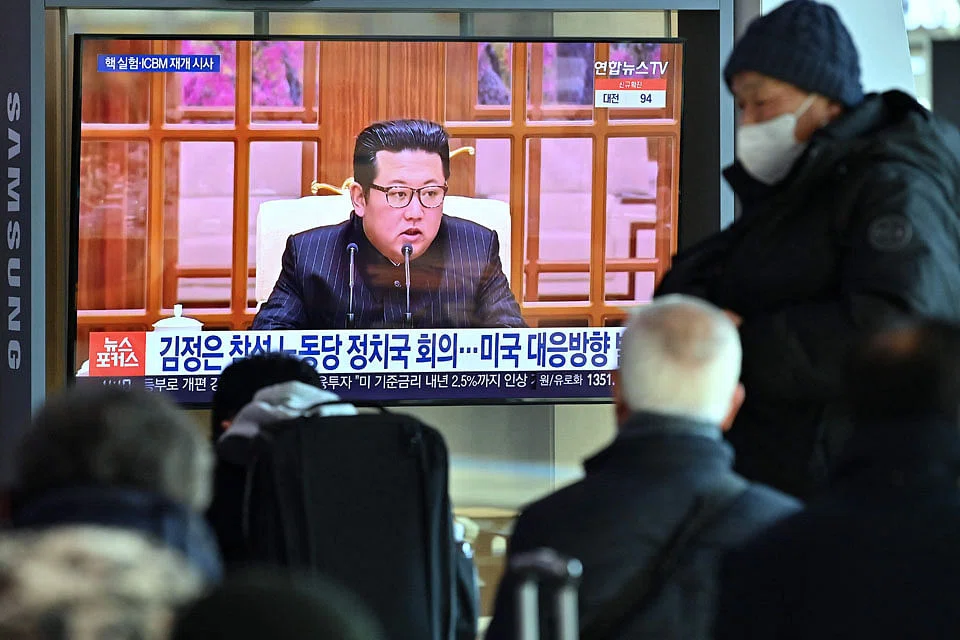
DeeperDive is a beta AI feature. Refer to full articles for the facts.
Hong Kong
KIM Jong Un indicated that he may end a 4-year-old freeze on major weapons tests, threatening to ratchet up tensions with the United States. and force North Korea's nuclear programme back onto the Biden administration's agenda.
Kim ordered ruling party leaders on Wednesday (Jan 19) to "promptly examine the issue of restarting all temporarily suspended activities", state media said, in an apparent reference to the moratorium he started ahead of unprecedented talks with former President Donald Trump.
North Korea must reconsider its "trust-building measures" and begin "immediately bolstering more powerful physical means, which can efficiently control the hostile moves of the US," Kim told the Workers' Party meeting, according to the official Korean Central News Agency.
While North Korea has fired off sporadic volleys of short-range rockets for more than 2 years, Kim hasn't launched an intercontinental ballistic missile (ICBM) since November 2017 or tested a nuclear bomb since September of that year. The absence of tests that directly threaten the US has made it easier for President Joe Biden to avoid another confrontation with Kim, like when Trump threatened to unleash "fire and fury" against the regime.
The meeting in Pyongyang represents the clearest sign yet that Kim is moving to end his self-imposed isolation after rejecting overtures from the US and South Korea and closing his border with China to prevent coronavirus outbreaks.
Navigate Asia in
a new global order
Get the insights delivered to your inbox.
Forcing a crisis with Washington may be the 38-year-old leader's best chance to break a diplomatic stalemate that has kept crippling sanctions in place and left the economy smaller than when he took power a decade ago.
South Korean defence stocks rose after the statement, with Victek jumping as much as 9.3 per cent to its highest level since Sept 17.
North Korea has already in January conducted the most ballistic missiles tests in a month since 2019, while promising a "stronger and certain reaction" to a fresh round of US sanctions against people accused of securing materials for the regime's weapons programme.
In the past week, North Korea resumed rail-borne trade with its biggest benefactor China, in another sign it needs outside help. Kim could use the national holiday on Feb 16 marking what would've been the 80th birthday of his late father, Kim Jong Il, to show off his newest weaponry.
Satellite imagery of Pyongyang shows signs of preparations for a military parade, the DongA newspaper reported, an event North Korea has often used to unveil its advances to the world.
"One of things we don't know is just how dire the food, economic and health situation is inside the country right now," said Scott Harold, a senior political scientist with the Rand Corp who specialises in North Asia security policies.
"If what's behind the reality is that they are really, really suffering, that Kim fears he's losing control and the only way out is an 'escalate to de-escalate' scenario, you can imagine that something that looks to the outside like a risky scenario could be something that might appeal to the young leader."
The US has sought United Nations Security Council action over North Korea's missile tests, which violate the body's resolutions. On Wednesday, US Deputy Secretary of State Wendy Sherman condemned the tests and, during a call with South Korean counterpart Choi Jong-kun, expressed support for a return to talks.
The tensions ensure North Korea will be high on the agenda during South Korea's presidential election planned for March 9.
"Especially the present US administration persists in manoeuvres to deprive the DPRK of its right to self-defence," the KCNA dispatch said, citing the meeting led by Kim. "We should make more thorough preparation for a long-term confrontation with the US imperialists."
Ankit Panda, a senior fellow in the nuclear policy programme at the Carnegie Endowment for International Peace, said Kim was likely using the latest US sanctions as an excuse to resume testing of new and yet-unproven weapons.
Those include what's believed to be the world's largest road-mobile ICBM, which North Korea paraded through Pyongyang in October 2020.
"Kim's giving himself some flexibility, but is laying the groundwork for a resumption of long-range missile testing," said Panda, who also wrote Kim Jong Un and the Bomb: Survival and Deterrence in North Korea. "They were bound to get back to testing longer-range missiles at some point."
The new ICBM could allow North Korea to pack multiple atomic weapons on a single rocket in an attempt to overcome the missile shields that protect the US mainland. Kim has also displayed medium-range missiles, such as Pukguksong-4 and Pukguksong-5, that appeared designed to be launched from either land or sea and potentially have ranges to hit all of Japan.
Other potential actions include a satellite launch or firing a missile over Japan, something North Korea hasn't done since September 2017. Detonating another nuclear bomb would be even more provocative, although it's unclear where such tests could be conducted after Kim dismantled the underground facility used for the country's previous 6 tests.
"Kim's ultimate goal is to lift sanctions," said Cha Du-hyeogn, who was a security adviser to former South Korean President Lee Myung-bak and now is a visiting research fellow at the Asian Institute for Policy Studies.
"If he doesn't see that, he is most likely to accelerate his nuclear capabilities designed to target the US mainland, which would be in turn boost his negotiating power against Washington."
North Korea long ago restarted some "temporarily suspended activities", such as restarting plutonium-producing operations at its main Yongbyon nuclear site and expanding a plant that enriches uranium for weapons.
"While this is more strongly worded than past formulations, it still leaves room for Kim Jong Un to ratchet up or lower rhetoric as he sees fit," said Jenny Town, a senior fellow at the Stimson Center and the Director of Stimson's 38 North Program. "It's a strong response to the recent sanctions, as you would expect from North Korea." BLOOMBERG
Decoding Asia newsletter: your guide to navigating Asia in a new global order. Sign up here to get Decoding Asia newsletter. Delivered to your inbox. Free.
Share with us your feedback on BT's products and services
TRENDING NOW
Ministry of Home Affairs Permanent Secretary Pang Kin Keong to retire
Shelving S$5 billion office redevelopment plan proved ‘wise’ as geopolitical risks mount: OCBC chairman

Richard Eu on how core values, customers keep Singapore’s TCM chain Eu Yan Sang relevant

China pips the US if Asean is forced to choose, but analysts warn against reading it like a sports result

