Kim Jong Un lied about firing newer version of ICBM, says Seoul
 Add BT as a preferred source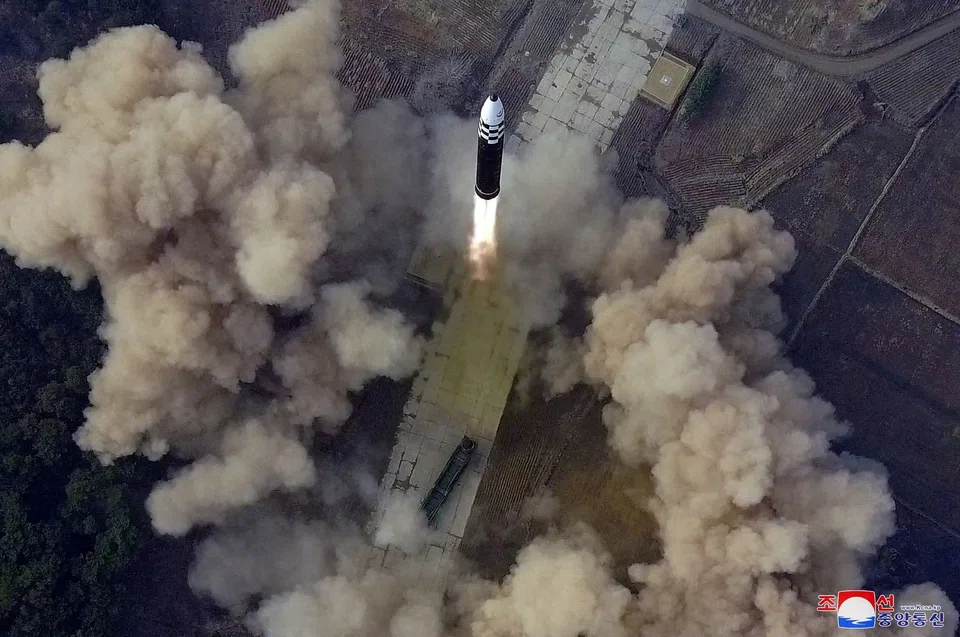
DeeperDive is a beta AI feature. Refer to full articles for the facts.
[SEOUL] North Korea tried to deceive the world about the type of missile it fired last week, claiming that it successfully tested a "huge," new ICBM while actually firing off a rocket first launched in 2017, South Korean defence officials said.
The intercontinental ballistic missile that North Korea launched last week was likely a Hwasong-15, which was successfully tested in November 2017 and designed to carry a single nuclear warhead, the South Korean defence ministry told lawmakers in a report Tuesday. That's less advanced than the Hwasong-17, a multiple-warhead missile, which Pyongyang triumphantly declared a success with a slick, highly produced video.
South Korean officials said the shadows in the video of the Hwasong-17 launch fell in a direction indicating the footage was shot between 8 am and 10 am, rather than Thursday afternoon, when an ICBM rocketed into space and fell in the sea off of Japan. The cloud cover shown in the video also didn't match the weather on the day of the launch, the officials said. That suggests North Korea may have used video from a failed Hwasong-17 test on the morning of March 16 and launched an actual Hwasong-15 to sell it as a success, as previously reported by NK News.
The Kim regime has long relied on weapons tests to bolster its image as a national protector, giving it an incentive to cover up missile that failed in an explosion that could be seen in the skies over Pyongyang.
South Korea's defence ministry said eight days was "not enough time" to identify technical problems and carry out another test of the Hwasong-17. The ministry added that North Korea needed a tool for propaganda after its citizens witnessed the failure of the earlier launch.
North Korea's state media said Friday that Kim called the successful launch of the new missile a "priceless victory won by the great Korean people," adding his forces are "are fully ready to thoroughly curb and contain any dangerous military attempts of the US imperialists."
Navigate Asia in
a new global order
Get the insights delivered to your inbox.
The ICBM fired on Thursday reached an altitude of 6,200 km and travelled 1,080 kilometers, according to South Korea's Joint Chiefs of Staff, higher and farther than North Korea's previous ICBM test. The Hwasong-15 has a range that could deliver a nuclear warhead to all of the US mainland, weapons experts have said.
North Korea also altered video footage when it tried to pass off a January 2016 failed test of a submarine-launched ballistic missile as a success, NK News said at the time. It also tried to doctor out evidence of Kim's presence at another SLBM test in October 2019, it added.BLOOMBERG
Decoding Asia newsletter: your guide to navigating Asia in a new global order. Sign up here to get Decoding Asia newsletter. Delivered to your inbox. Free.
Copyright SPH Media. All rights reserved.