

Knot most likely heir to Lagarde at ECB
Knot was one of the ECB’s most influential officials during his 14 years on the governing council
 Add BT as a preferred source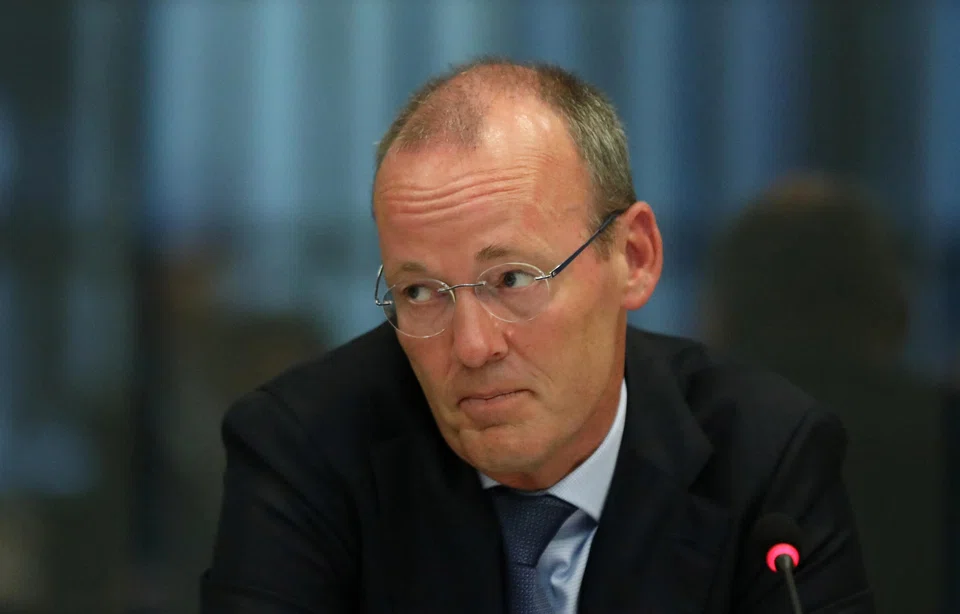
[BRUSSELS] Dutchman Klaas Knot is most likely to succeed Christine Lagarde at the helm of the European Central Bank, despite other candidates being better qualified, a Bloomberg survey of economists suggests.
Knot, whose stint as head of the Netherlands’ central bank ended last year, leads a ranking that places Bank for International Settlements chief Pablo Hernandez de Cos second and Bundesbank president Joachim Nagel third.
At the same time, respondents singled out executive board member Isabel Schnabel as having the best skill set to take over from Lagarde when her term expires next year. De Cos, a former governor of the Bank of Spain, was second with Knot close behind.
The poll comes after Croatia’s Boris Vujcic got the nod this week to become ECB vice president from June – the first step in a two-year reshuffle of the Frankfurt-based institution’s executive board.
Hailing from the region’s east, Vujcic’s appointment leaves the door open to candidates from both the north and south to compete for Lagarde’s position. Similarly, his moderate hawkishness is unlikely to be a major issue as eurozone officials seek to strike a balance between the profiles of the ECB’s two top policymakers.
Whoever prevails will inherit an institution facing a far more unpredictable global backdrop, with recent weeks underscoring how quickly geopolitical and institutional norms can be tested.
Survey respondents value an economics degree and work experience within a central bank as most important for an ECB president. A career in finance and expertise running a monetary authority are also seen as useful, as are stints in politics and other European institutions.
Being a woman – a flashpoint in past leadership selections – is among the least important considerations, according to the poll.
Rumours about front-runners have circulated for months, focusing mainly on Knot and de Cos. Both are highly regarded and have been praised publicly by Lagarde herself.
Knot “has the intellect, he has the stamina, he is capable of including people and that is a skill that is rare and is very necessary,” she said in October. She’s described de Cos as a “fantastic team player” and “very thorough economist.”
Knot was one of the ECB’s most influential officials during his 14 years on the governing council, eventually staking out more middle-ground positions after starting his career on a hawkish foot. He also helped keep global regulatory coordination intact through periods of market stress as chairman of the Financial Stability Board.
Schnabel, too, has been encouraged by Lagarde, who said last month there are “plenty of very good candidates, and Isabel is one of them.” An economics professor and an adviser to Germany’s government before joining the ECB in 2020, she digs deeper into key debates than many peers and has become the official economists listen to most.
Schnabel, despite being viewed as the most capable candidate, faces legal hurdles, however, since ECB appointments are non-renewable and there’s no clear evidence yet of a loophole. Her policy stance – at the very hawkish end of the spectrum – could also be an impediment.
In general, “you probably want someone more centrist to maintain the consensus-building nature and to placate the sort of polarised elements of the Governing Council,” said Andrzej Szczepaniak, a former ECB economist who now works at Nomura.
While Knot, de Cos and Nagel would fit that bill, their governments are yet to reveal their plans at this early stage.
The Netherlands and Germany haven’t commented publicly, though Lars-Hendrik Roeller – a former economic adviser to Chancellor Angela Merkel – has said it’s time for one of his countrymen to get the presidency.
Spain does want another Executive Board seat once incumbent Vice President Luis de Guindos leaves in May, according to Economy Minister Carlos Cuerpo.
Other candidates deemed likely or qualified successors to Lagarde include France’s Francois Villeroy de Galhau and Italy’s Fabio Panetta, whose countries have both held the presidency at least once. There’s also Finland’s Olli Rehn, who came second in the vice-presidency race.
Among less likely options for survey resondents are European Investment Bank president Nadia Calvino from Spain and Joerg Kukies, Germany’s interim finance minister after its last government collapsed.
Amid the speculation, it’s worth remembering that a dark-horse candidate could yet emerge, with Lagarde herself not among the favourites before being nominated.
Most respondents expect a decision in the second quarter of 2027, though some see an earlier deal. Almost half thinks it will be part of a broader package that includes replacing chief economist Philip Lane, with another quarter anticipating a three-way agreement covering Schnabel’s seat as well. BLOOMBERG
Decoding Asia newsletter: your guide to navigating Asia in a new global order. Sign up here to get Decoding Asia newsletter. Delivered to your inbox. Free.
Share with us your feedback on BT's products and services
TRENDING NOW

‘I felt like dying’: Thai Singha beer scion speaks up after disclosure of alleged sexual abuse

DBS to launch tokenised physical gold for retail customers in Singapore

S$500 CDC vouchers for all Singaporean households from June 11; Government ready to do more if needed: DPM Gan

Singapore men, are you OK?

