

Lagarde calls ECB hike ‘no brainer’ as markets bet on more ahead
The decision was guided by fresh projections showing inflation averaging 3% this year
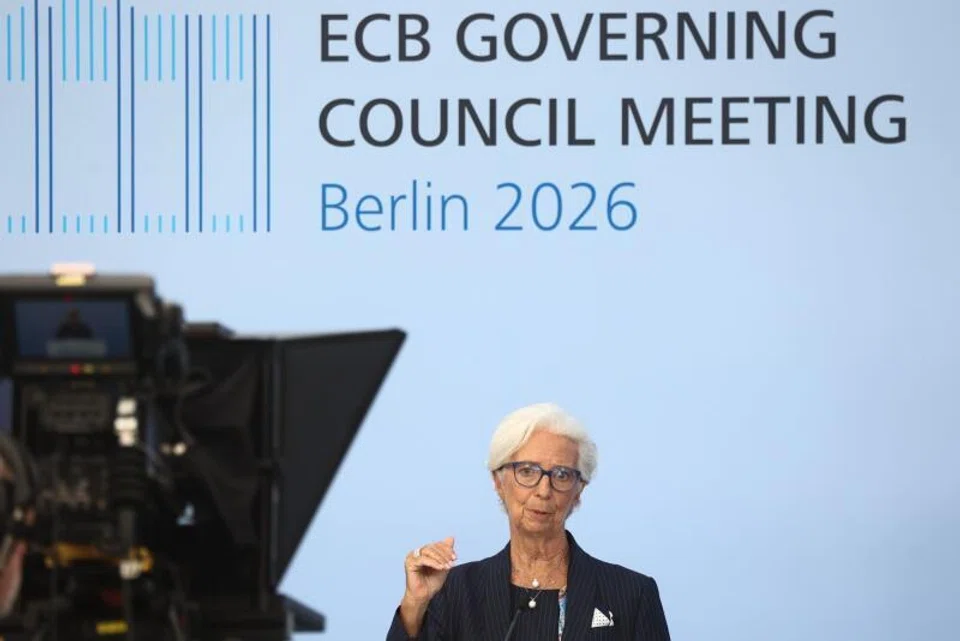
[BERLIN] The European Central Bank lifted interest rates for the second time since the Iran war broke out, with a renewed advance in oil prices prompting investors to boost bets on further hikes.
The deposit rate was lifted by a quarter-point to 2.5 per cent, as expected. While the ECB reiterated that it won’t pre-commit to further steps, forecasts for faster inflation alongside an acknowledgement of the eurozone’s surprising economic strength convinced markets that more monetary tightening is on the way.
Traders are now fully pricing three more rate increases by October 2027, cementing the ECB as the top hawk among Group of Seven central banks. It made its first move in June and responded again on Thursday to a war-induced energy-price surge that’s produced the fastest inflation in almost three years.
President Christine Lagarde called the latest hike “a no brainer” that was decided on unanimously and is “robust” against all three scenarios the ECB mapped out for the region’s economy.
Asked about investor wagers on rates, she said “markets do what they have to do, and we do what we have to do, which is to provide price stability.”
The ECB’s stance contrasts with the Federal Reserve and the Bank of England, which are yet to follow suit over the fighting in the Middle East and may refrain again next week.
“The conflict in the Middle East continues to generate inflation pressures, and inflation is set to remain well above target for an extended period,” the ECB said in a statement. “The outlook remains highly uncertain, with risks to the upside for inflation and to the downside for economic growth.”
The decision was guided by fresh projections showing inflation averaging 3 per cent this year before slowing to 2.5 per cent in 2027 and 2.1 per cent in 2028. After economic growth in the eurozone jumped in the second quarter, the full-year forecast was upgraded to 0.9 per cent.
The expansion between April and June was “broad-based across countries and sectors,” Lagarde told journalists in Berlin, this year’s venue for the one meeting annually that the ECB holds outside its Frankfurt base. “This pattern is likely to have continued into the third quarter.”

She warned, however, that higher energy costs are set to feed through gradually to core and food-price inflation.
“The conflict in the Middle East and recent developments in Russia’s unjustified war against Ukraine have pushed the path of energy prices up further,” Lagarde said. “This is likely to keep headline inflation well above target into the first half of 2027.”
With oil hitting US$105 a barrel and European natural gas costs at levels last seen in the winter after Russia invaded Ukraine, consumer prices in the 21-nation currency bloc advanced 3.3 per cent from a year earlier in August.
There have also been more encouraging signals, though, as underlying inflation and a closely watched gauge of services prices retreated. Wage pressures also eased.
That should help calm officials who argued at the ECB’s July meeting that a “mildly restrictive” stance may be needed to return inflation to target. Getting there would need the deposit rate to rise beyond 2.5 per cent, the top of a range broadly seen as neutral for economic activity. BLOOMBERG
Decoding Asia newsletter: your guide to navigating Asia in a new global order. Sign up here to get Decoding Asia newsletter. Delivered to your inbox. Free.
Share with us your feedback on BT's products and services
TRENDING NOW

DBS, OCBC, UOB rout lops billions off STI as inflation, rate concerns spook investors

Grab CEO’s wife Chloe Tong on life with Anthony Tan and finding her purpose

OCBC sheds S$8 billion in value as shares close nearly 6% down; analysts cautious on banks

Deal between tycoon friends sparks scrutiny of Philippine power sector

