

Lianhe Zaobao serves as window to Chinese culture and the wider world, says PM Lee
Singapore
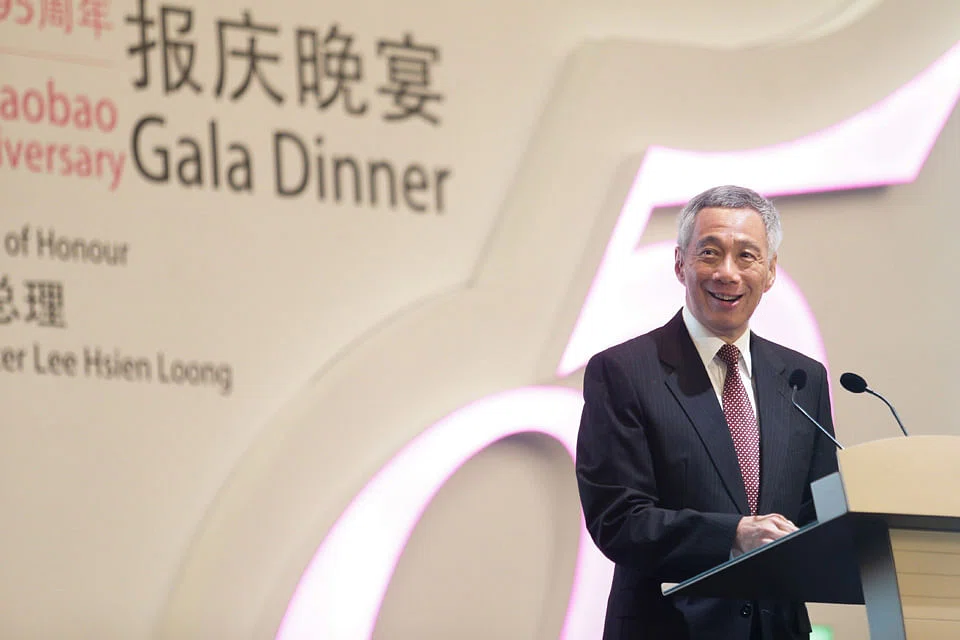
DESPITE the challenges confronting traditional media, the almost-100-year-old Lianhe Zaobao newspaper is doing well partly because it serves as a window to the Chinese culture and the world for Singapore's younger generation, said Prime Minister Lee Hsien Loong yesterday.
Having transformed itself to meet the challenges from new media, Zaobao is now not just a staple for the Chinese-educated elderly readers, Mr Lee said in Mandarin at the daily's 95th anniversary dinner.
"As the younger generations become more bilingual, you provide an alternative perspective from the English media," he added.
In doing so, the paper gives them a more rounded perspective on the world and Singapore, he said.
Mr Lee also highlighted another key role of Zaobao: promoting the Chinese language and culture in the context of Singapore's multiracial society.
"Over the years, we have developed our own variation of Chinese culture, and an identity that resonates with the Chinese Singaporeans, as well as with our fellow Singaporeans of other races," he told the 500 guests at the gala event held at Shangri-la Hotel.
He cited a series of stories published in The Straits Times and Zaobao in February this year that was based on an exchange of six letters between Zaobao's Ng Wai Mun and ST's Yuen Sin.
Both journalists, who are bilingual, had exchanged views on issues such as the Special Assistance Plan schools that offer more opportunities for enriched Chinese-language learning and reflected on the Chinese Singaporean identity.
He noted that Zaobao's NewsHub editor Han Yong May said in a commentary that it would take at least three generations for a population's collective identity to form.
Already, the two journalists reflected the younger generation's views on Chinese Singaporean identity and culture and it is different from that of the older generation.
"They grew up in our multicultural society and understand our culture is unique, and not just a copy of another country's culture and heritage," he said.
Mr Lee expressed the hope that Zaobao, with other Chinese groups, will create programmes that encourage people to preserve and promote Chinese culture.
This will help strengthen "our national identity" and inspire the young to deepen the understanding of their own culture and pass it on to future generations, he said.
Zaobao's competitive edge also lies in how it interprets regional developments through a Singaporean lens, Mr Lee said. "Singaporean readers find the views relatable, and foreign Chinese readers find them refreshing. As international attention on China and the region grows, Zaobao has continued to provide an objective and credible perspective on developments in China and Asia."
Zaobao, he added, has established considerable trust among its readers. He cited how its reporting perspective remains objective and balanced amid the tensions between China and the United States.
In an April poll done by a China news agency and university, it ranked as the most influential Chinese new media outlet in the world.
Lianhe Zaobao traces its origins back to the Nanyang Siang Pau, which was started in 1923 by philanthropist Tan Kah Kee. Singapore Press Holdings chairman Lee Boon Yang, who also spoke on Thursday, said "the battle is not won" even after 95 years.
Apart from the disruptive forces shaking up the traditional media industry, he said Zaobao faces the unique challenge of drawing younger readers who are often less proficient in Chinese.
"...our journalists and editors have also adopted a more direct and digestible style, to report news with more graphics and visual content to convey the message," he said.
Despite these challenges, readership grew to 471,000 last year. This represented a year-on-year growth of 5.4 per cent and was a "significant achievement", Dr Lee said.
The paper is the top Chinese-language newspaper, with a combined daily circulation of 197,500 copies in print and online since August 2017. It has a combined daily readership of 14.7 per cent among Chinese Singaporeans.
TRENDING NOW

JPMorgan, BlackRock among those making bid to manage CPF savings

GIC in talks to lease bulk of 88,000 sq ft CapitaSky space to be vacated by Allianz

BN-PN’s Melaka election landslide puts spotlight on jobs, investments and political divides
Why Singapore, Johor and Riau Islands should build a cross-border ecosystem for AI

