

Little impact on ringgit seen from Najib's RM20b stockmarket boost
Kuala Lumpur
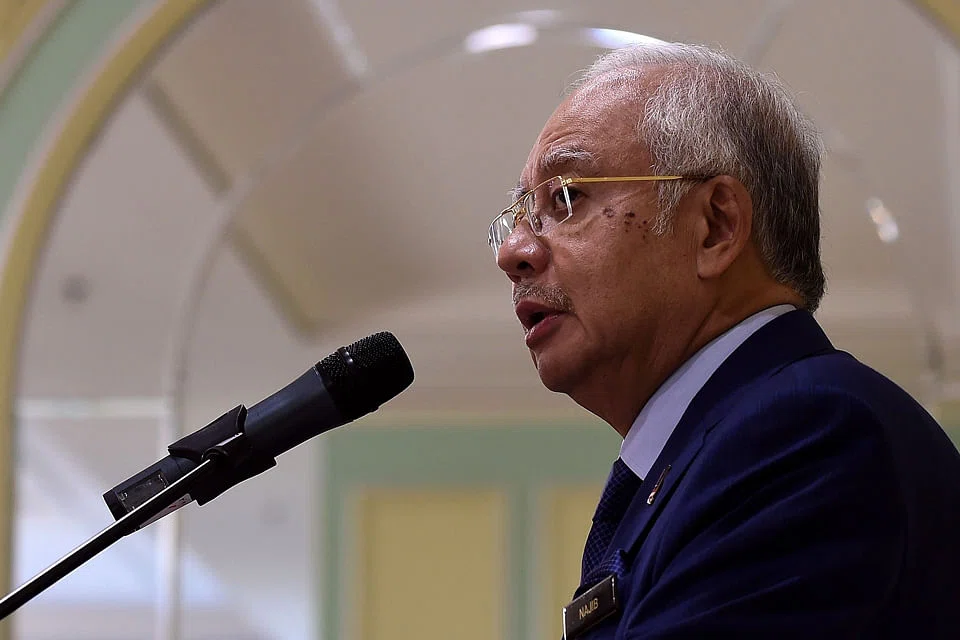
A PACKAGE of measures announced by Prime Minister Najib Razak on Monday to stabilise the flagging economy gave the stock market a boost as RM20 billion (S$6.54 billion) would be injected into government-linked fund manager ValueCap to purchase undervalued shares.
But the move was seen to be lacking in substance to halt the deterioration in the ringgit which has dropped to an 18-year low. Because the real problems impacting the economy and currency continue to be swept under the carpet, analysts do not expect significant investor buy-in or a reversal in sentiments.
"I don't find the measures to be sufficient to stabilise the ringgit," observed RHB Research Institute head of Asean economics Peck Boon Soon, noting that government-linked companies had already been instructed to repatriate their profits from overseas investments and to reinvest the amounts locally in January when Mr Najib reviewed the 2015 budget following the collapse in global oil prices.
Mr Peck was of the view that more should have been done to encourage exporters to bring their earnings back to the country, or to impose more curbs on individuals opening foreign exchange accounts to halt the ringgit's slide.
But he acknowledged that Bank Negara, having eased foreign exchange controls in 2013 when international reserves hit a high of US$140 billion, did not want to tighten up now for fear of being seen as indecisive.
A significant portion of Mr Najib's press briefing in Putrajaya touched on global uncertainties and Malaysia's economic fundamentals, which he reiterated were robust enough to withstand external and domestic challenges. Still, the moderation in the economy necessitated steps to protect the real economy, said the embattled 63-year-old who is in the centre of a political crisis, caught in the financial scandal surrounding 1MDB and public outrage after the Wall Street Journal reported in early July that nearly US$700 million was deposited into his personal bank accounts in Ambank in 2013.
Mr Najib, who is also the finance minister, said that the funds were a political donation from an Arab but many Malaysians believe the monies to be linked to the debt-laden state-owned strategic development company. Alluding to the trust deficit, he reiterated the government's commitment to "strengthening the integrity of its institutions" on 1MDB, assuring that the sale of its power assets under Edra Global Energy would be transparent, as would the development of the new Bandar Malaysia township.
Mr Najib, who will be tabling the budget next month, did not take any questions after announcing the measures mooted by a special economic taskforce formed three weeks ago and headed by Abdul Wahid Omar, a minister in his department, who used to helm the country's biggest banking group Maybank.
Consumer and business confidence have nose-dived to lows last experienced during the global financial crisis of 2008-09 and are in danger of falling further given the ringgit's rapid deterioration against most other currencies. Having tumbled to 4.30 to the US dollar and 3.05 to the Singapore dollar, the feeble ringgit has resulted in the cost of goods and services rising sharply - in many cases by double digits although official inflation is 3.3 per cent.
Given the ringgit's performance, corporations have been slow to repatriate foreign currency profits although Mr Najib has assured that Malaysia does not intend to impose capital controls as its banking system and capital markets are now more resilient compared to the Asian financial crisis of 1997/98.
Malaysia has seen net investment outflows over the past 7-8 years and up to June - external investments amounted to RM522 billion against foreign direct investments of RM477 billion.
Capital flight has accelerated this year, the equities market losing nearly RM12 billion as at end July against RM7 billion for the whole of last year.
News of the RM20 billion to be injected into ValueCap by its state-linked shareholders Khazanah Nasional, Permodalan Nasional and Retirement Fund Incorporated, saw the market rally to close 2.2 per cent higher.
Even so, feelings are mixed about ValueCap's role given that the market is already dominated by government funds. Established in 2003 to prop up undervalued shares after the dotcom bust, not many are aware of its current status. "I thought it was already wound-up," remarked Philip Capital chief investment officer Ang Kok Heng. He acknowledged that the fund was useful in the last round, but noted "that was when the stock market was at the bottom of the cycle".
Some sceptics also expect ValueCap to incline more towards GLCs, and perhaps because of the perception, gainers included Felda Global, Sime, Tenaga, and Malaysia Airports.
In addition to speeding up the building of affordable housing, Putrajaya plans to open more government-run or sponsored shops and clinics that offer services and goods at cheaper costs.
Small-to-medium sized enterprises will get some relief in the import duty exemption of 90 tariff lines for spare parts and stocks, pending a recovery in the global economy, and access to a RM7 billion capital guaranteed scheme.
READ MORE: M'sia to allow rally amid concerns over racial tensions






