

London ‘doing well and thriving’ in post-Brexit era: Lord Mayor
Little disruption is expected to policies after UK’s general election on Jul 4, says Michael Mainelli

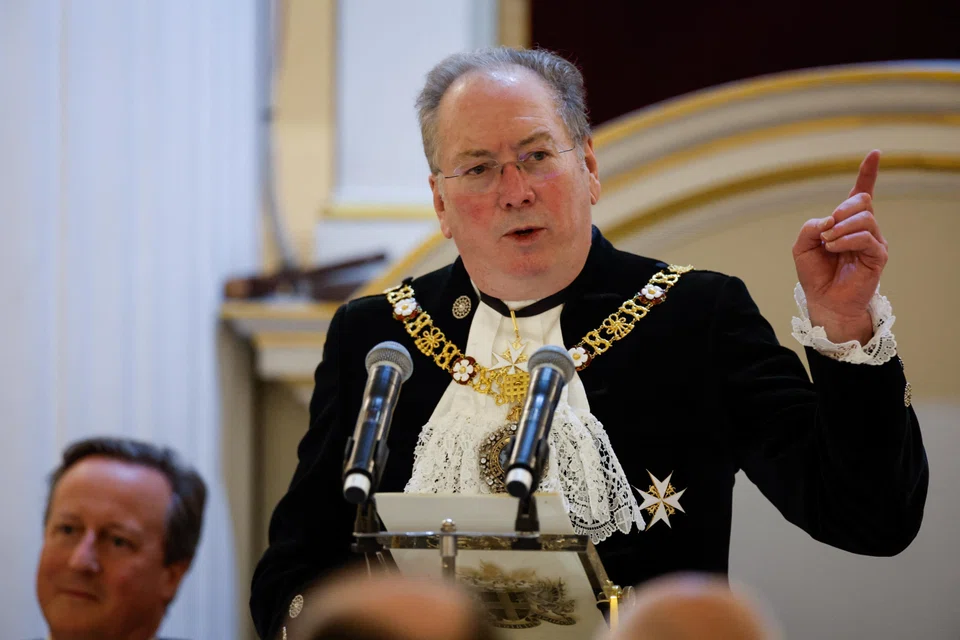
THE City of London – the financial district of the British capital – is “doing well and thriving” in the current post-Brexit environment, more than four years after the UK officially exited the European Union (EU).
Michael Mainelli, the Lord Mayor of the City of London, made this point in an interview with The Business Times during a recent two-day visit to Singapore.
“(Brexit) wasn’t what most of us wanted. London voted 60 to 40 to remain (in the EU), and the City of London voted 70 to 30 to remain,” said the 65-year-old scientist, economist and accountant.
He noted how, at the time of the vote in June 2016, the City of London had 525,000 workers. This number has grown to 615,000 today.
The City also used to manage about 12 per cent of global assets, and this rate has increased slightly to just under 14 per cent.
“The assets under management (AUM) has grown, and that is my big measure. Others focus on the stock exchange, but those are just listed equities,” he said.
“I don’t look at the stock exchange as a very important thing, but rather it’s the overall amount of AUM. We’ve got (a little under) 14 per cent of global AUM, with 1 per cent of the world’s population, and that’s not too bad.”
Mainelli added that London has, in recent years, become the springboard for those who want to make investments, particularly throughout Europe and the Americas from Asia, and vice versa into Asia from the Americas and the Middle East.
According to a ranking of global financial centres released in March this year by London-based commercial think tank Z/Yen, London remains second on the list – behind leaders New York, and one rung ahead of Singapore.
In the area of fintech, New York is also on top, with London and San Francisco in second and third respectively. Singapore is sixth, behind Shenzhen and Washington, DC.
Building relations
Mainelli is currently on sabbatical from being chairman of Z/Yen, having begun his year-long term as Lord Mayor in November 2023.
The roles of the Lord Mayor of the City of London, and the Mayor of London (who is currently Sadiq Khan), are often thought of as one and the same. They are complementary but have a completely different remit.
The Mayor of London leads the Greater London Authority and is responsible for the strategic governance of Greater London.
As Lord Mayor, Mainelli serves as an international ambassador for the UK’s financial and professional services sector and works closely with the Mayor of London.
His role involves a fair amount of overseas travel, with a typical year seeing a Lord Mayor spending around 100 days abroad in some 25 countries.
Mainelli – the first Italian Lord Mayor and the first to be born in the US – was in Singapore last week as part of an Asian tour when he also visited Tokyo.
While in Singapore, he had meetings with business leaders, financial organisations and institutions including DBS, the Singapore FinTech Association and the Infocomm Media Development Authority.
“Forty per cent of our trade with South-east Asia is through Singapore – so Singapore is extremely important to us, and it’s already a trusted partner to us in many different fields,” said Mainelli.
“For Singapore, the priorities are always professional services and financial services. Those are going very strongly and we have a lot of dialogue, corridors and linkages. But you can’t take these relationships for granted.”
He added that in a world that is becoming more complicated with artificial intelligence (AI) and the pressures of climate change, building global collaboration in fintech, AI and green finance takes on even greater importance.
“There is no better place for the City of London to focus strongly than a fellow global financial centre in Singapore, which is renowned for open and adept regulation,” he said.
Continuity in the UK
The second half of Mainelli’s 12-month term coincides with the UK’s next general election, which will take place on Jul 4 with the ruling Conservatives widely expected to experience a heavy defeat to the opposition Labour Party.
While there is likely to be a change of government led by a new prime minister, Mainelli said he did not expect any major disruption to the work that his office does.
“(The City of London) is 14 centuries old, and we’ve been through this a lot. I can’t see that any of the programmes I’ve got at the moment would suffer from a change of government,” he said.
“It’s more telling on areas that we don’t really influence, such as the macroeconomic environment, and the general approach to taxation, efficiency and productivity. Britain’s got a productivity issue that’s widely acknowledged, and we’d really like to see the government pay attention to that.”






