
Lower-income hit hardest by Covid-19, as better off still buying stocks, homes, cars

Economists see 'K-shaped' recovery with tech, financial services charging ahead; hospitality, aviation limping behind

Kelly Ng
Published Sun, Oct 25, 2020 · 09:50 PM

    Singapore

    COVID-19 has handed Singapore its deepest recession since the country's independence, but the pain inflicted by the pandemic has been unevenly spread.

    Economists have dubbed the crisis as one primed for a "K-shaped" recovery, one where different parts of the economy recover at different rates, different times or different magnitudes. Thus in Singapore, lower-income workers have been hit hard particularly by retrenchments, but there are also others with cash to spare and secure jobs to hang on to.


    Egged on by a low interest environment, the latter have been snapping up properties, pushing up property prices; and they are putting money in stocks even as the virus continues to spread.

    This has raised the question of whether the pandemic is going to widen the wealth gap in Singapore - a likely fallout of the Covid-19 outbreak that's already being closely watched in other parts of the world. And, along with the impact of the structural shift in parts of the economy, how far will the gap widen?

    Jobs

    The latest job figures show the resident unemployment rate climbing to 4.5 per cent, the highest since the global financial crisis. That crisis pushed the rate up to 4.9 per cent in September 2009.

    Among the recent jobless, low-income earners in clerical, sales and service as well as production, cleaning and transportation formed a bigger group than professionals, managers, executives and technicians (PMETs), according to the Ministry of Manpower's labour market report for the second quarter of 2020.

    For every 1,000 PMETs, 2.7 were axed in April-June this year. The figures were 4.5 for clerical, sales and service workers, and 4.0 for production and transport operators, cleaners and labourers.

    The disparity has widened since the first quarter when the retrenchment rates among all groups of workers were more similar - 1.7 for every 1,000 PMETs, 1.5 for clerical and service staff and 1.6 for workers in roles that included production and transport operations.

    The number of low-wage workers who were temporarily laid off in the second quarter was also significantly higher, according to the report. Some 30,770 production, transport operators, cleaners and labourers were furloughed, compared with 8,180 clerical and service staff and 4,180 PMETs.

    These discrepancies suggest that blue-collar workers were more disproportionately affected by the severe circuit breaker restrictions in the second quarter - and as businesses looked to slash costs.

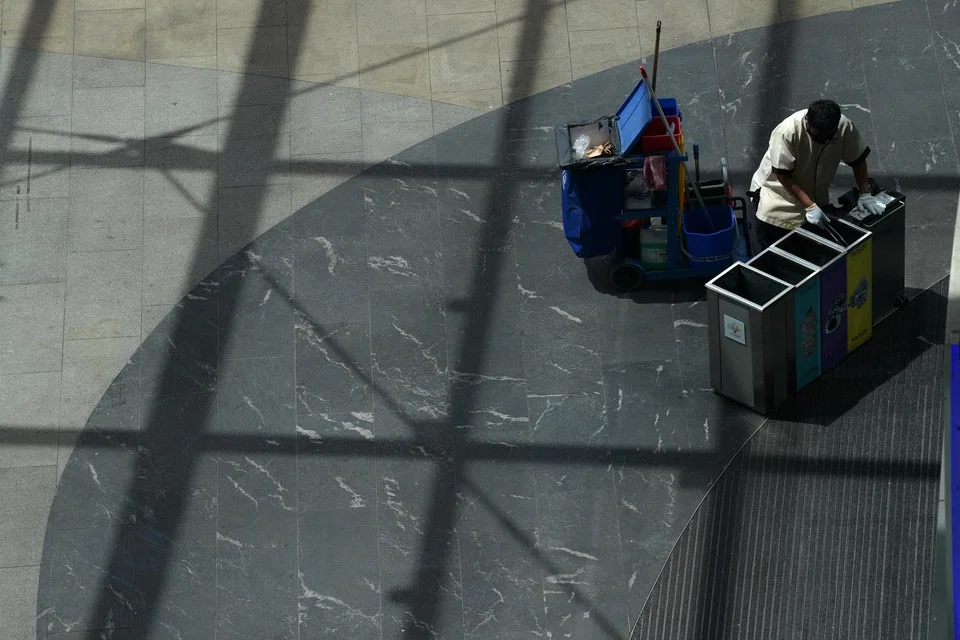
    While white-collar professionals could work from home during the shutdown, the nature of the work of many blue-collar workers required them to be present physically at the workplace and many lost their income and jobs when the authorities ordered the closure of all non-essential work premises, notwithstanding the support given by the government.

    Low-wage workers also bore the brunt of the impact of the 2008-9 financial crisis, according to unemployment data disclosed by DBS's research department. Among workers earning less than S$2,500 per month, a net total of 61,000 became unemployed in 2008; there was no loss of jobs for the rest of the workforce.

    In 2009, employees earning at least S$10,000 did see job losses, though this was off a strong job growth base in the previous year.

    This time, a pandemic has ripped sharply through some 12 per cent of Singapore's economy. The Monetary Authority of Singapore (MAS) said businesses at the epicentre of the Covid-19 crisis will take some time to recover.

    Even if strong growth is posted in the second half of this year, it would not be enough to return business in industries such as construction, travel, and retail to pre-crisis levels, MAS said in July. Many employees in these industries have already lost their jobs for good, or been furloughed.

    Projections by DBS economist Irvin Seah show that the hotels and restaurants sector is likely to be the worst affected, with quarterly figures so far pointing to a projected 33.7 per cent drop in the sector's annual output.

    Along with the construction and transport sectors, this sector also tends to hire more low-wage workers.

    In contrast, financial services have been relatively robust and could see up to 6.7 per cent increase in real output this year.

    The local banking trio (DBS, UOB and OCBC) has pledged not to cut jobs this year. Mr Seah said: "We expect a gradual improvement in services growth in the (third quarter), though the pace of recovery will be uneven across various services segments."

    Singapore's economy shrank 7.0 per cent in the third quarter, easing from the 13.3 per cent plunge in the second quarter, according to advance estimates released recently by the Ministry of Trade and Industry.

    Economists have suggested a "K-shaped" recovery, with technology, advanced manufacturing and financial services charging ahead and sectors like hospitality and aviation limping behind.

    Some also expected the uneveness of the recovery to be sharper than previous downturns. Chua Hak Bin, a senior economist at Maybank Kim Eng, said this recession has a larger impact across a wider range of sectors than the 2008-9 slump, which was concentrated in the financial sector. And the 2008-9 crisis was short-lived.

    "More workers will have to switch jobs across sectors in this pandemic than during the global financial crisis," he said. "This recession will likely lead to higher structural unemployment as some workers, particularly older workers, may struggle to retrain and reskill in order to move into new sectors."

    Income

    From March to May this year, Singapore's largest bank, DBS, pored over anonymised data of 1.2 million retail customers to produce a report, made public in August. The report showed that lower-income earners (S$2,999 and below) made up about 49 per cent of DBS customers that saw a drop in salary. Within this group, about half saw their income fall by over 50 per cent.

    Four in 10 of these DBS customers had less than a month's emergency funds.

    The extent of income deterioration in the F&B, hospitality and aviation sectors was even more pronounced compared with other industries. In the aviation sector, some 40 per cent of workers' income declined in March. This doubled to 80 per cent in May.

    The phenomenon is not confined to Singapore. In the US, up to 86 per cent of the initial impact of the pandemic fell on jobs commanding less than US$40,000 in annual pay, according to a study by McKinsey & Company. The study also found that industries with the lowest wages and education qualifications, such as accommodation and food services, as well as retail trade, tend to be the hardest hit.

    The rise in retrenchments and pay cuts have led again to calls for minimum wage and unemployment insurance to be introduced. Deputy Prime Minister and Finance Minister Heng Swee Keat in September said the government will keep an open mind to such ideas to boost safety nets in Singapore.

    Overall, the incomes of the bottom 10 per cent of Singapore's workers rose by more than 50 per cent over the past decade, to S$2,045 in 2019 - a real increase of S$684. Those at the top decile went up by 36.6 per cent - up S$8,380 in real terms.

    Meanwhile, a UBS report said Singapore's list of billionaires has grown longer, despite the pandemic, with four more billionaires added to and one dropped off the list.

    Stocks

    Despite the deep recession, there's been active trading in the local stock market. Between Jan 1 and Sept 28 this year, more than S$8 billion flowed into retail funds, while institutional investors withdrew a net S$6.4 billion.

    The retail investors piling into the stock market are likely to be people earning comfortably above the median salary with sufficient savings to plan ahead, DBS's Mr Seah said.

    Among DBS's retail customers - that is, excluding private banking customers - some 12 per cent of those with a monthly income of at least S$10,000 invest in stocks and other assets. In contrast, only about 2.0 per cent of customers with a monthly income of below S$3,000 invest their money.

    With payments for mortgages, car loans, insurance premiums and food bills taking up the bulk of the salary, there's little left for investments for those taking home less than S$5,000 monthly, Mr Seah pointed out.

    A new Credit Suisse report released recently said Singapore recorded a gain of US$23,380 in household wealth per adult in 2019, but the gain was driven by households with a growing equity portfolio - thanks to a bull market.

    The S&P 500 closed at an all-time high in mid-August this year, ending the shortest bear market in US history. According to the UBS report, the V-shaped rebound in global stocks from April to July this year increased the wealth of billionaires globally to a new high of US$10.2 trillion.

    Property and cars

    The private residential market has also seen a disconnect with the general economic under-performance, given the recent surge in home sales and property prices. The private home price index rose 0.8 per cent in the third quarter of this year over the preceding three months. The index is now up 0.65 per cent from a year ago, data released by the Urban Redevelopment Authority on Friday showed.

    Prices of landed homes increased by 3.7 per cent quarter on quarter, after remaining unchanged in the previous quarter. Sales of private homes also rebounded strongly after the Singapore economy started to reopen after a near-lockdown. The number of units that changed hands in the private residential market jumped almost five times from 277 units in April this year to 1,329 in September.

    The number of new launches in the market more than doubled from 597 in June to 1,582 in August, then dipped to 1,340 in September. The previous highs for both metrics were in September last year, with new sales at 1,270, and new launches at 1,714.

    Low interest rates, liquidity, and a pent-up demand among buyers who have deferred their home purchases due to Singapore's partial lockdown, spurred buying.

    Private-apartment ownerships and data on household income trends over the past decade show the rate at which people in the 61st-90th income deciles upgraded into condominiums outpaced those from the lower-income deciles.

    "This helps explain to some extent why condos are still selling despite the current economic uncertainties and who exactly are buying them," said Christine Sun, head of research and consultancy at real estate agency OrangeTee & Tie.

    Major cities around the world are seeing similar divergences. Bloomberg reported in October that sales of luxury homes in the US jumped some 40 per cent from a year ago. Sales of mid-priced homes rose just 3 per cent.

    The demand for automobiles in Singapore has also not dulled despite the pandemic, as rising Certificate of Entitlement (COE) premiums for small and large cars suggest. A study by financial analysis platform ValueChampion showed that the ultra-luxury car market remained relatively resilient, with four in 10 new car registrations in April and May accounted for by luxury brands, despite the suspension of COE bidding and showroom closures.

    Whither wealth gap?

    Against this backdrop, DBS's Mr Seah noted that the pandemic is a "highly regressive" event. But most economists have refrained from concluding, at least for now, that it has widened the gap between the haves and the have-nots.

    Mr Seah noted that the government has rolled out a suite of economic support measures, estimated to draw on nearly S$100 billion from its coffers. This includes measures targeted at firms and individuals in various forms of distress.

    He thinks the measures offer the required support for the lower-income. "The policy measures that we have thus far could help to smoothen out the uneven recovery, so it may not be the case that the wealth gap will widen."

    The Credit Suisse report said it's still early days to fully assess the impact of Covid-19 on global wealth distribution. But it acknowledged that particular groups, including the low-skilled and small businesses, have suffered from this crisis.

    The report noted that the combination of fiscal support and monetary measures to create a low interest rate environment has helped to soften the blow on households, but it also pointed out that government assistance is due to be curtailed.

    "The pandemic will have important repercussions on income distribution," the report said. "Although emergency benefits in high-income countries offset the effect to some extent, unemployment and reduced economic activity will almost certainly increase income inequality within countries since they tend to affect those with lower incomes disproportionately."

    Some economists such as Maybank Kim Eng's Dr Chua said the government's fiscal support measures could be more targeted and generous towards the lower-wage workers and those retrenched.

    While employed workers in hard-hit sectors each get thousands of dollars via the Jobs Support Scheme, those who have lost their jobs were cut off from the fund.

    A question to ask, said economics professor Walter Theseira from the Singapore University of Social Sciences, is the extent of the impact falling on businesses and workers who can bounce back in one form or another. How would this compare against businesses which are losing capabilities that took decades to build up?

    "My sense so far is that much of the headline job and GDP losses are really from the more flexible part of the economy - lower-end services - which is still a tragedy for individual businesses and workers, but which presents less structural long-term damage to the economy," he said.

    READ MORE: Covid-19 and Singapore's wealth gap


