

Macau's fortunes dip as New Year gamblers fail to show up
Beijing
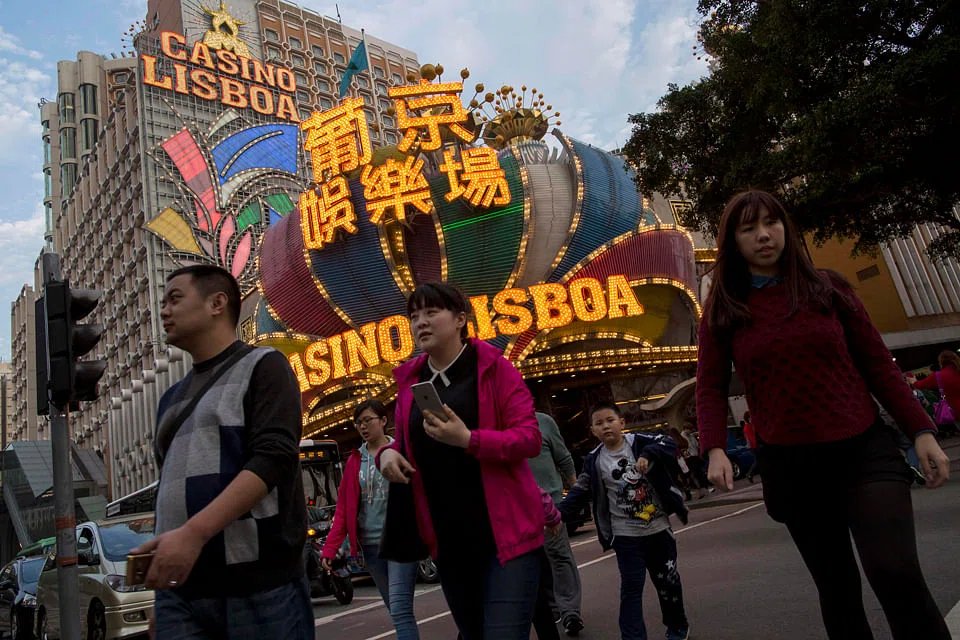
XU Meihua joined hundreds of thousands of fellow Chinese tourists who travelled to Macau over Lunar New Year last week. She wasn't there to gamble though.
The 58-year-old accountant dropped by casinos owned by Wynn Macau, Sands China and SJM Holdings to snap photographs and window shop. Travelling with her sister and husband, she was more interested in taking in sights than spending money at the baccarat tables.
"I don't plan to gamble at all; I don't have that much money," said Ms Xu, recording a dancing water fountain with her smartphone on Feb 23. "Why would I risk thousands of yuan?" Macau's troubles are turning from bad to worse. A slide in gambling revenue last year is threatening to turn into a rout as middle-income consumers join high rollers in pulling back. As so-called VIPs avoid the former Portuguese enclave amid a government clampdown on graft and money laundering, China's economic slowdown, as well as new restrictions on visas and cigarette smoking, have also deterred mass market gamblers.
Players failed to materialise during what is traditionally one of the busiest weeks of the year, prompting analysts to slash their estimates for gambling in February. Casino revenue is now projected to plunge 53.5 per cent for the month, according to the median estimate from eight analysts surveyed by Bloomberg, compared with the 40 per cent drop forecast before the holiday started.
That would mark the ninth straight month of decline, the longest losing streak since monthly records started in 2005. The city's casino regulator is expected to release monthly gaming data by March 4.
The Lunar New Year which started on Feb 19 was "shockingly bad" for Macau gaming, DS Kim, an analyst at JPMorgan Chase & Co, wrote in a note on Feb 25. Gambling numbers over the holiday period were "very disappointing to us, as it was nearly 40 per cent below what we had anticipated".
While a decline from VIP gambling was expected as these high-stakes players tend to arrive a week later to avoid the crowds, "we understand even premium mass demand remained very muted, primarily due to the deteriorated player mix", Mr Kim wrote, cutting his February forecast to a slump of as much as 55 per cent, from a 45 per cent expected drop.
This holiday, the Year of the Goat, is in sharp contrast to the Year of the Horse last February. That month was the Macau casino industry's best ever as they raked in 38 billion patacas (S$6.48 billion). This year's downturn comes despite a record high of more than 800,000 Chinese tourists having flooded Macau in the first seven days of the Year of the Goat.
"Perhaps the Year of Goat isn't a lucky year for casinos," said UOB-Kay Hian Holdings analyst Victor Yip in an interview, adding that the VIP gambling business still accounts for at least 60 per cent of Macau's gambling revenue. "It won't work if you only got retail customers but very few VIP gamblers as they fail to boost the gross revenue." The recent wave of mainland Chinese visitors also spend less than before, a further blow to the fine-dining eateries, luxury retail malls, and high-end hotels that casinos have set up next to their gambling halls. Excluding gambling, per-capita shopping expenses by Chinese tourists dipped 32.8 per cent to 1,079 patacas in the fourth quarter of 2014, according to data from the Macau government.
Average occupancy at 3-star to 5-star hotels for the so- called Golden Week period of Chinese holiday, which ran from Feb 18 to 24, fell 6.9 percentage points to 87.5 per cent, while average room rates declined 15.4 per cent, the Macau Government Tourist Office announced on Feb 26.
Analysts had looked to the opening of new projects on Macau's Cotai strip from later this year by operators such as Galaxy Entertainment Group and Melco Crown Entertainment as a glimmer of hope. Even those prospects are starting to look questionable amid concerns the Macau government would allow fewer gambling tables at the new resorts.
"We envisage a scenario where the Macau government could lower the allocation of tables to indicate it is more serious about 'controlling' growth in gaming," Anthony Wong, an analyst at UBS Group, wrote in a report on Feb 24, citing concerns raised by corporate management teams.
"We believe a low allocation for the first project could negatively impact sentiment on all future projects initially," he wrote, noting that while table capacity of new projects are in the 400-500 range, "the recent concern has been that some new projects might obtain well below 200 tables".
Insufficient tables means a new casino resort can accommodate fewer gamblers, hitting revenue. There are also "soft factors", according to Mr Wong, pointing out that insufficient tables could make a large casino floor "look empty and lack energy, impacting player sentiment".
China's President Xi Jinping in December urged Macau to wean itself off its reliance on casinos and turn the city into a world tourism and leisure centre. Mr Xi's campaign against graft began within weeks after he became head of the ruling Communist Party in late 2012, and has snared more than 100,000 "flies and tigers," or low- and high-level officials, according to official data.
The tourist Xu, for one, is cheering on the Chinese president's crackdown. "I'm proud of President Xi because he's doing something significant and difficult," Ms Xu said. "Who knows whose money those guys in casinos are spending; if they're officials, they could be spending mine." BLOOMBERG
TRENDING NOW

Nvidia reinstates Jensen Huang as CEO; Trump says move poses no national security risk

Indonesia’s coal tycoon Low Tuck Kwong replaced as Bayan Resources president-director

Nvidia surges 33% after reinstating Jensen Huang, reviving AI trade; stocks soar in US and Europe

Consider lowering homeownership barriers for some non-resident foreigners

