

Malaysia King to decide on next PM as no coalitions secure majority support
Tan Ai Leng
MALAYSIA’S King is stepping in to resolve a political deadlock, after no political coalition managed to secure the necessary alliances to form a government. The King will have an audience with 30 Members of Parliament (MP) from Barisan Nasional (BN) at 10.30 am on Wednesday (Nov 23), said the Palace in a statement on Tuesday.
The statement came after the King met the leaders of the two coalitions that had secured the most parliamentary seats at Malaysia’s 15th general election, which concluded on Nov 19.
The Pakatan Harapan (PH) coalition has the most seats while Perikatan Nasional (PN) is in second place, but neither coalition managed to secure the simple majority of 112 seats required to form the government.
Since Sunday, both coalitions have been in discussions to form alliances with other coalitions and parties. They were to have presented their numbers and proposed a candidate for prime minister by 2 pm on Tuesday.
PH chairman Anwar Ibrahim and his PN counterpart Muhyiddin Yassin were at the Palace for an audience with the King on Tuesday.
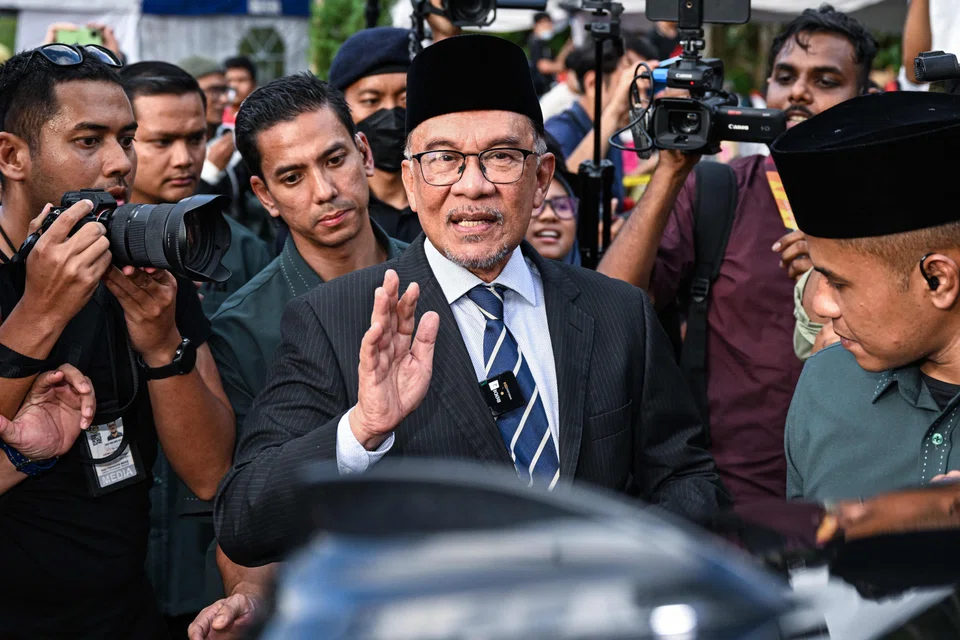
Anwar left around 5.45 pm, and told reporters gathered outside that the King had yet to decide the appointment of PM and no timeline was set to form the federal government.
“His Majesty has expressed his desire to form a government inclusive of all races, religions and regions,” he said, adding that a minority government is not an option now.
Anwar also dismissed the report that he was being appointed as the interim PM. “The (PM) post is now vacant and open for application,” he jokingly replied to a media question as he was leaving the Palace.
Muhyiddin said the King suggested PN and PH cooperate to form a unity government, but that he does not support this as PN has always maintained that it will not work with PH.
The long-ruling coalition Barisan Nasional, which secured 30 seats, has said it intends to remain in opposition and declined to back any alliances to form a coalition government.
Ismail Sabri Yaakob, vice-president of the United Malays National Organisation (Umno) – which is leading the BN coalition – said the decision was made by the coalitions’ Supreme Council after a meeting on Tuesday.
“BN does not support PH nor PN. So far, BN has agreed to remain in opposition,” he said in a Facebook post.
Earlier, Gabungan Parti Sarawak (GPS) had announced it would leave the King to decide the appointment of prime minister. GPS and Gabungan Parti Sabah (GRS) have 23 seats between them, and were in talks with PN to form a new government with BN.
PH, which obtained 82 out of 222 parliament seats in the snap polls, lacks 30 seats. PN, which holds 73 seats, needs another 39 seats to meet the requirements.
Political analysts see a few possibilities, including the appointment of a new PM by the King, the forming of a minority government, or a fresh election.
Lau Zhe Wei, assistant professor at the International Islamic University Malaysia’s department of political science, was surprised with BN’s decision of not taking the opportunity to be part of the government again.
“After the election, BN has become the kingmaker with 30 seats, which are direly needed by both leading coalitions to form a new government, but they choose to remain as opposition,” he told The Business Times.
Political analyst Liew Wui Chern said the divided opinions within BN had caused its Supreme Council to make such a decision, as some MPs are leaning towards supporting PN, some want to work with PH, and some oppose the idea of working with any coalitions.
He noted that the best solution could be a repeat of what happened in March 2020, when the PH government led by Mahathir Mohamad collapsed and the King appointed Muhyiddin as PM after interviewing all 222 MPs.
“The best scenario is the King will appoint the candidate that has the majority’s support to form a unity government. However, if all MPs have divided opinions with no candidate having majority support, a minority government or a fresh election will be the last resort,” said Liew.
He added that a minority government will not be an ideal model, as it will be challenging for the government to pass or implement new policies with a large number of opposition MPs in the house.
Lau, however, had a different take: “Like it or not, Malaysians have to adapt to the possibilities of a minority government in this round or in the future,” he said, as he foresees the same situation will repeat in future elections if the country continues to have more than two strong coalitions.






