

Many opportunities for Singapore firms in Dresden, says PM Lee
Recent protests not likely to affect companies' decisions to invest in the eastern German city

Lee U-Wen
Dresden, Germany
THE recent anti-Islam protests in Dresden are unlikely to have an adverse impact on the decisions by Singapore companies to invest in the promising eastern German city, said Prime Minister Lee Hsien Loong on Monday.
"It's the job of business leaders to look at all factors and weigh them up judiciously. As of now, I don't think it will have an effect on their decisions, but of course they will be watching carefully to see how things develop," he said at a press conference shortly after meeting Saxony's Minister-President Stanislaw Tillich.
Dresden, with a population of about 530,000, is the capital of the state of Saxony and the third-largest city in eastern Germany after Berlin and Leipzig.
The anti-Islam group Pegida has staged numerous rallies that have attracted tens of thousands of people on the streets in recent weeks. The right-wing populist group, founded in October last year, was due to hold its first march in the Austrian capital Vienna on Monday evening.
German Chancellor Angela Merkel has asked the country to avoid attending rallies by anti-Islam groups. Last month, she joined a Muslim community rally to foster religious tolerance and stave off rising Islamophobia in the European Union's largest economy.
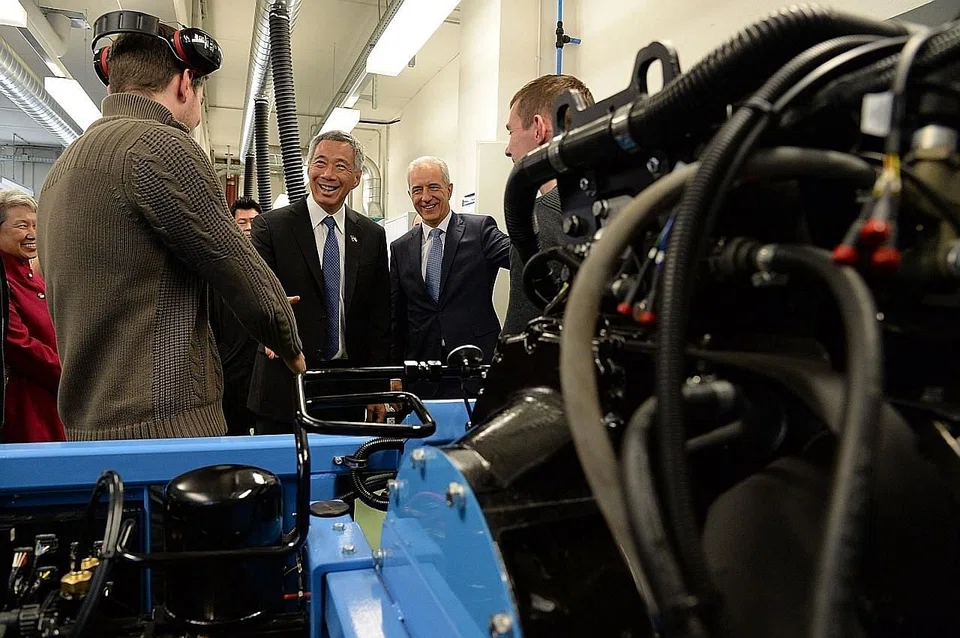
Mr Lee is in Germany for a four-day official visit and began his trip with a stop in Dresden. His 77-strong delegation includes the heads of many Singapore companies eager to explore new business opportunities in the city, which has a deep research culture and strong high-tech industries such as microelectronics.
In his remarks, the Prime Minister said he has been following the news of the protests closely over the last few weeks and that it was one of the many topics raised during the hour-long meeting with Mr Tillich at his office.
While he acknowledged that the situation was not unique to Dresden, one had to accept that there would be movements at the fringes of the traditional political process in many countries. "We take it in our stride. Of course, we will watch and see how things develop. But I believe that, overall, there are many opportunities in Dresden and Saxony, otherwise I wouldn't be here," said Mr Lee.
He added that, during the meeting with Mr Tillich, the pair discussed the social circumstances and challenges faced by both Singapore and Saxony, such as low birth rates and an ageing population.
The two leaders also stressed the need to develop high-quality technical, engineering and scientific education for their people, and how to help them adjust and adapt to a rapidly changing world.
"These are not easy problems that will go away overnight, but it's issues that affect many societies all around the world. By comparing notes, we hope to learn from one another - how you solve your problems, what approaches you're taking, and how we can perhaps do a little bit better and learn from each other's mistakes and successes," said Mr Lee.
Mr Tillich, meanwhile, praised Singapore for being one of the most innovative countries in the world and said that Germany had much to learn from the Republic in this respect.
In the latest global innovation index, released last year by graduate business school Insead, the World Intellectual Property Organisation and Cornell University, Singapore came in seventh while Germany was ranked 13th.
"Germany lags behind Singapore. We want to know how Singapore manages to be among the top scorers in the innovation index, so that we can be as successful in translating new ideas into innovation," said Mr Tillich.
Mr Lee wrapped up his stay in Dresden by attending a state dinner hosted by Mr Tillich. The Singapore delegation later made its way to the capital Berlin where Mr Lee will meet Dr Merkel and several German ministers on Tuesday.
TRENDING NOW

Indonesia’s coal tycoon Low Tuck Kwong replaced as Bayan Resources president-director

OCBC names Ang Eng Siong as global corporate banking head in rejig of wholesale banking business

Consider lowering homeownership barriers for some non-resident foreigners

DBS opens flagship investment strategy to retail investors with new fund

