



Maybank Singapore defends consumer banking turf, eyes growth amid fintech disruption
It remains a key income driver for Malaysia’s largest bank and South-east Asia’s fourth-largest by assets

[KUALA LUMPUR] Maybank is holding its ground as Singapore’s top foreign player, even as its global peers scale back in the traditional consumer banking sector. It plans to grow its income share from 18 per cent to 25 per cent within three years despite rising competition from fintech and digital banks, its Singapore chief said.
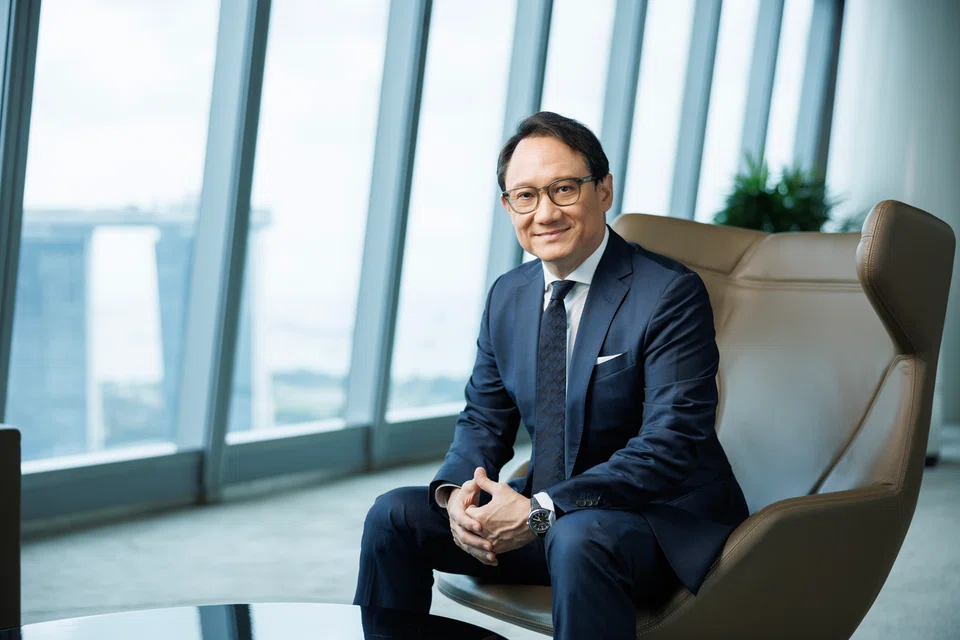
“We are looking to refurbish more branches to create a customer-centric and digital-friendly environment,” noted Alvin Lee, country chief executive of Maybank Singapore, in an interview with The Business Times.
“This approach ensures that we continue to offer a customer-first experience without scaling back our consumer banking operations,” said the 58-year-old veteran, who joined Maybank in 2013 and brings a wealth of experience from previous roles at JPMorgan Singapore, Barclays Bank in London and Citibank Singapore.
While digitalisation remains a core focus for Maybank Singapore, Lee believes the human touch is crucial in a highly competitive market. “Digital transformation is essential to future-proof our business, but the human element remains a critical aspect of differentiating our services.”
The fact that Maybank has the largest branch network among foreign banks in Singapore – with 18 branches and six premier hubs – is a key differentiator, Lee added.
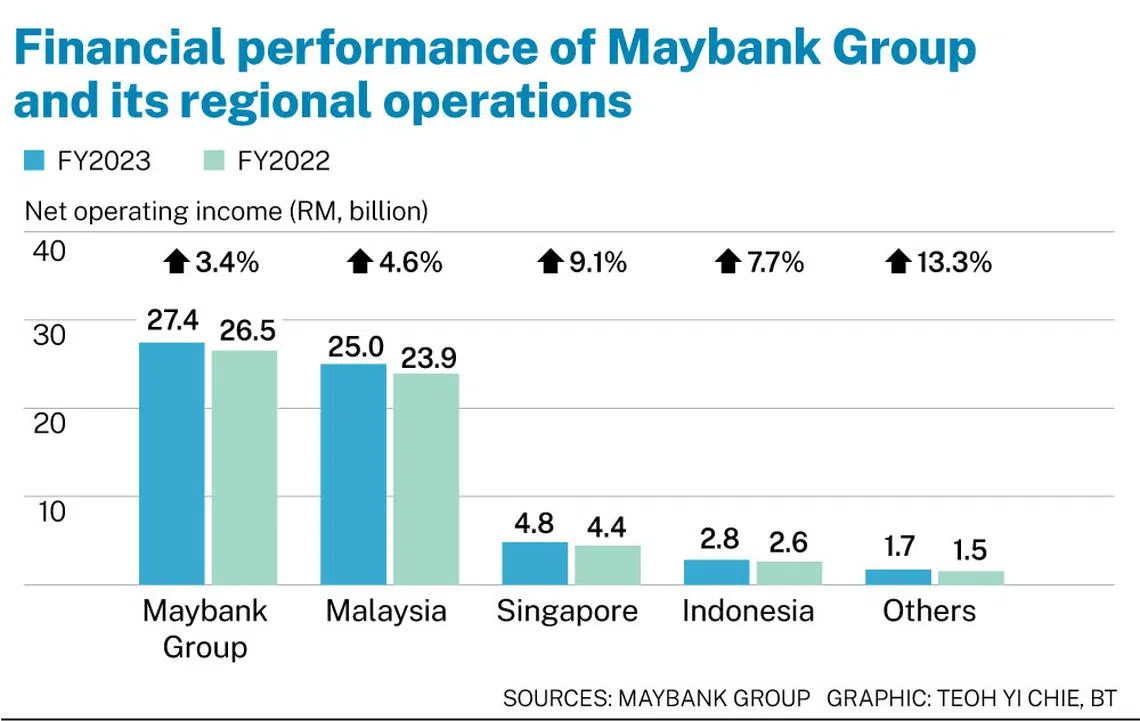
Maybank Singapore remains a key income driver for Malaysia’s largest bank and South-east Asia’s fourth-largest by assets, contributing RM4.8 billion (S$1.5 billion) in net operating income for the financial year ended December 2023 – nearly 18 per cent of Maybank Group’s total RM27.4 billion.
As the group’s second-largest income contributor, the bank is central to Maybank’s regional strategy. Lee is confident about raising its contribution to the group to 25 per cent by 2027, underscoring its growing role in the group’s expansion plans.
“We are confident this target can be achieved by capitalising on growth in wealth management, cross-border banking and Islamic financial solutions,” Lee said.
Maybank Group chairman Zamzamzairani Mohd Isa echoed this sentiment in the bank’s annual report, noting that the launch of the regional offshore Islamic wealth management hub in Singapore marks a significant milestone.
“This allows us to offer end-to-end Islamic wealth management solutions and reach vast markets, leveraging Singapore’s status as a regional financial centre,” he said.
However, Lee pointed out that Singapore’s banking sector remains highly competitive, with 13 local and qualifying full banks alongside more than 140 financial institutions. He added that the rise of fintech firms and digital banks has further intensified the race.
As at last September, Maybank group’s total assets stood at RM1.05 trillion.
Riding on fintech and digital banking
Maybank Singapore adopts a complementary rather than confrontational approach, with Lee seeing new players as partners in expanding financial inclusion. He noted that by improving access to financial services, these companies help grow the overall market, benefiting the industry as a whole.
Maybank Singapore, like other incumbents, is also embracing fintech innovations by integrating solutions – such as artificial intelligence tools for personalised financial solutions and leveraging blockchain for security – to transform operations and value propositions.
“This ongoing shift allows banks to remain competitive and innovative in an increasingly digital market and economy,” said Lee, who assumed his current role on Jan 1, 2024.
Islamic banking edge
A key pillar of Maybank Singapore’s growth strategy is its expertise in Islamic banking. As the regional offshore hub for Islamic wealth management, the bank aims to capture growing demand for ethical and values-based investing.
“Increasing numbers of customers are seeking investments that adhere to ethical and socially responsible principles… This shift has driven rising interest in Islamic financial solutions in Singapore,” said Lee.
With the recent launch of Takaful offerings, Maybank Singapore is well-positioned to lead the growth of Islamic wealth management beyond Malaysia and Indonesia, extending its reach to Gulf Cooperation Council markets.
Lee highlighted Singapore’s strategic role as a gateway to Asean markets and a regional financial hub.
“Singapore serves as a critical launchpad for investment opportunities in Asia. Coupled with our expertise in the Malaysia-Singapore corridor, we are uniquely positioned to support clients’ cross-border needs and business expansion plans,” he added.
Navigating regional opportunities
Maybank Singapore’s growth ambitions are supported by regional economic developments such as the Johor-Singapore Special Economic Zone and a regional renewable energy power grid, which are expected to enhance Asean integration.
Lee pointed out that these developments will require unique funding solutions, particularly in sustainability.
“There will also be significant demand for capital market funding and advisory services… Banks with integrated regional operations will have a competitive advantage, driving opportunities in wholesale banking and cross-border finance,” he added.
He noted that as global companies increasingly position themselves in Singapore as a springboard for Asean expansion, banks with a strong regional presence are well-positioned to meet the growing demand for seamless cross-border banking solutions.
“The group’s robust regional network and expertise in the Malaysia-Singapore corridor enable us to support clients’ evolving needs effectively,” Lee said.
Maybank Group operates an extensive international network of more than 2,600 branches across 18 markets, including 10 Asean countries.
It has operations in Malaysia, Singapore, Indonesia, the Philippines, Brunei, China, Hong Kong, Vietnam, the UK, US, Cambodia, Laos, Myanmar and Thailand.
With the exception of Malaysia, Singapore and Indonesia, no other individual market contributed more than 10 per cent of the consolidated operating revenue before operating expenses and of total assets.
TRENDING NOW

First Resources blames El Nino, outside fires for Kalimantan hotspots amid haze scrutiny

High Court rules against Julius Baer’s Singapore trust arm in US$50 million family trust dispute
Singapore key exports jump by higher-than-expected 68.4% in September, led by non-electronics

MSCI proposes downgrading Indonesia to standalone market status

