

Merkel buys time on refugee crisis after defusing coalition spat
Berlin
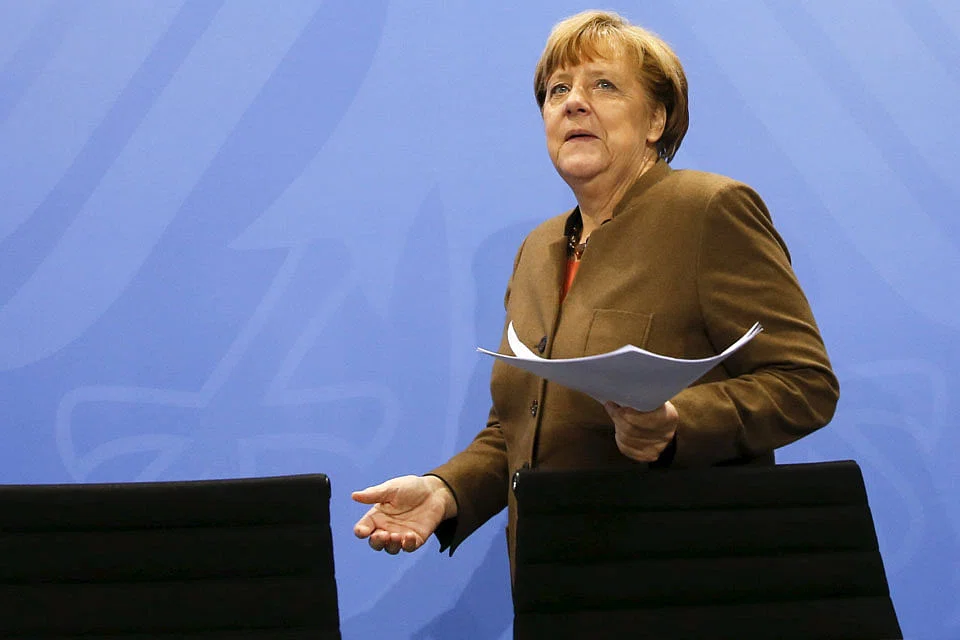
GERMAN Chancellor Angela Merkel won time to reach a Europe-wide solution to the region's refugee crisis after securing a deal to defuse a spat with her coalition partners that threatened her chancellorship.
The pact between Mrs Merkel's Christian Democratic-led bloc and the Social Democrats will ease deportations and restrict family reunions for asylum seekers who make their way to Germany. Still, her pledge to reduce the number of newcomers in 2016 will hinge on persuading Turkey and European Union member states to act. She's likely to discuss the crisis on Friday with Italian Prime Minister Matteo Renzi when they meet in Berlin.
"I feel fortified following the results of today," Mrs Merkel said at a press conference late on Thursday in Berlin after a meeting with coalition leaders and Germany's state premiers. "We are getting a lot of things accomplished." The beleaguered chancellor's options in the 28-member European Union are narrowing as Sweden and Denmark tighten their borders, Austria seeks to impose a cap on migration and eastern European member states refuse to take in migrants. Mrs Merkel is pushing Mr Renzi to set up EU processing centres for refugees arriving on Italy's shores, while the Italian leader has accused the chancellor of focusing too much on French President Francois Hollande in seeking solutions. "Of course I'd be grateful if Angela and Francois could solve all the problems, but usually it doesn't work like that," Mr Renzi told the Frankfurter Allgemeine Zeitung newspaper this week.
With public backing for the chancellor's open-door policy waning in Germany and the stumbling EU response, Mrs Merkel was under growing pressure to resolve a political brawl in her three-party coalition that intensified after New Year's Eve sexual assaults on women in Cologne. Some 40 per cent of Germans want her to resign for her handling of the crisis, according to an Insa poll for Focus magazine published on Friday.
Looming over Thursday's meeting at the chancellery in Berlin was a threat by the Christian Social Union, the CDU's Bavarian sister party, to challenge Mrs Merkel's policy in Germany's constitutional court.
The deal, meant to reduce the inflow of asylum seekers after more than one million poured in last year, expands the list of countries deemed safe for refugees to return to and bars families of some refugees from joining them in Germany for two years, Vice-Chancellor Sigmar Gabriel, who heads the Social Democratic Party, said in Berlin. Mrs Merkel, Mr Gabriel and Bavarian Premier Horst Seehofer, who heads the CSU, hammered out the deal after weeks of feuding over how to handle the influx as Mrs Merkel seeks to defend passport-free travel and commerce in the European Union. The trio now have to sell the agreement to their constituencies in order to get it through parliament.
Bavaria's threat of suing Mrs Merkel's government prompted the first public warning by a senior politician that the coalition could collapse. Thomas Oppermann, the Social Democrats' leader in parliament, accused Mr Seehofer on Tuesday of seeking to break up the coalition, suggesting that the CDU and SPD, Mrs Merkel's junior partner, had enough seats to govern without the CSU.
The agreement announced on Thursday widens the list of so-called safe countries to include Morocco, Tunisia and Algeria. "We want to integrate those who look like they will be allowed to stay, but we will need to send home those who don't look like they'll be able to remain," Mrs Merkel said.
The chancellor won renewed public support on Thursday from her finance minister, Wolfgang Schaeuble, who ruled out a cap on migration and tightening Germany's borders. "It's going slowly, that's true, but the chancellor is working tirelessly," Mr Schaeuble told the Stuttgarter Zeitung newspaper in an interview. "I support her in this with everything I have." Mr Seehofer, who governs the state where the vast majority of refugees enter Germany from Austria, has become Mrs Merkel's chief antagonist. While she insists on the country's moral and legal obligation to shelter refugees and a broader EU plan, Mr Seehofer has called for a cap on migration - and threatened the legal challenge if Mrs Merkel doesn't change course.
Germany's stance is under growing pressure from other EU countries that are seeking to limit migration, such as Sweden and Austria. In Sweden, which has tightened border controls as the country struggles with the influx, the government said on Thursday that it may reject almost half of the 163,000 asylum seekers who entered the country last year.
EU leaders will gather in three weeks in Brussels where the crisis will be one of the topics on the agenda. Bloomberg
TRENDING NOW

Can a first-time homebuyer couple earning S$18,000 a month afford a new EC unit?

He built the Vingroup empire. Now South-east Asia’s richest man is handing some key roles to his sons

Asia needs new energy security architecture

Chagee, Mixue and Luckin won the market. Sustaining their edge is the harder part

