Merz eyes India business, defence deals in his first Asia trip
Both nations also aim to deepen cooperation in the pharmaceuticals sector and between defence companies
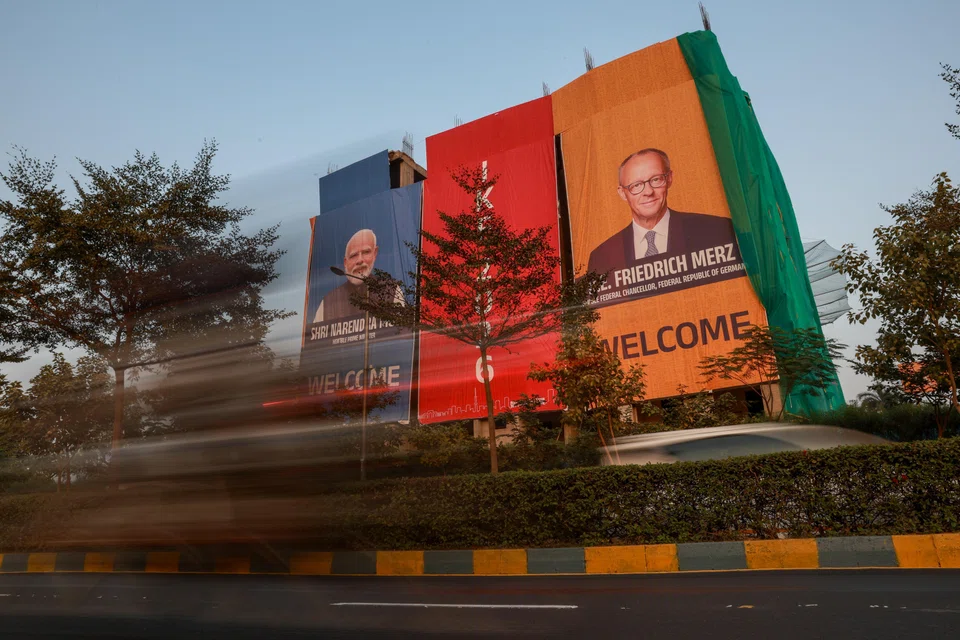
[BERLIN] German Chancellor Friedrich Merz will seek to expand business and defence ties with India in his first trip to Asia, aiming to bolster Europe’s biggest economy as tensions with its main trading partners, China and US grow.
Merz will meet his counterpart Narendra Modi on Monday (Jan 12) in the western city of Ahmedabad in the Indian prime minister’s home state of Gujarat. Both leaders will hold bilateral talks as well as visit a Mahatma Gandhi memorial site and attend a local kite festival.
The high-profile visit is an opportunity for the two leaders to showcase stronger economic and security ties amid strained relations with the US under President Donald Trump. The US leader’s repeated threats to annexe Greenland has shocked European allies, while India remains saddled with one of the highest US tariff rates of 50 per cent.
During Merz’s two-day visit, Germany and India are expected to sign agreements on business cooperation, semiconductor development and defence projects. Germany also hopes to gain better access to critical minerals from India, with the two sides expected to sign a memorandum of understanding on the matter. Berlin is struggling to reduce its supply chain dependencies for rare earths and other raw material from China.
Both sides are also expected to ink an agreement to lower the hurdles for Indian health care workers to come to Germany, where labour shortages in many sectors of the economy are holding back economic growth.
Merz will be accompanied by a large group of German business leaders, including the chief executive officers of Siemens, DHL Group, Infineon Technologies, Uniper and Airbus Defence and Space. There are also managers from several small- and medium-sized companies from the so-called Mittelstand that forms the backbone of Germany’s once powerful, but now struggling manufacturing sector.
Both nations also aim to deepen cooperation in the pharmaceuticals sector and between defence companies, with senior managers from Boehringer Ingelheim and ThyssenKrupp Marine Systems travelling with Merz.
Merz will likely use his meeting with Modi to speed up negotiations between the European Union and India on a free-trade agreement. Negotiators are rushing to finalise a deal by the time EU President Ursula von der Leyen heads to India later in January, with talks stuck on a few key issues such as steel and automobiles, Bloomberg News previously reported.
As the fastest-growing economy in the G20, India is a key economic partner in the Indo-Pacific region for Germany. More than 2,000 German companies are doing business in India, and more than 700 Indian companies invest in Germany. With a bilateral trade volume of almost US$50 billion, Germany is India’s most important partner in the European Union.
SEE ALSO



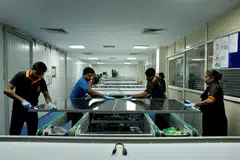
On his second day in India on Tuesday, Merz plans to visit a Bosch facility in the business hub of Bangalore.
In the defence sector, Germany and India are currently hammering out the details of a submarine manufacturing deal worth at least US$8 billion – the largest-ever defence agreement for New Delhi, Bloomberg News reported last week.
Germany’s Thyssenkrupp Marine Systems GmbH and Indian state-owned Mazagon Dock Shipbuilders are negotiating the details of an agreement that would include technology transfer for submarine production, sources familiar with the matter said.
It’s unclear if the agreement will be announced during Merz’s visit.
India’s navy operates about a dozen ageing Russian submarines and six new French-made models. The South Asian nation remains reliant on Russia for military equipment, and Germany sees the submarine deal as a chance to reduce that dependence.
India’s ties with Russia, which invaded the eastern European nation of Ukraine in 2022, will likely also come under discussion during Merz’s visit. India increased oil purchases from Russia since the Ukraine invasion, although it’s reduced buying in recent months after the US sanctioned major energy producers from that country. BLOOMBERG
Decoding Asia newsletter: your guide to navigating Asia in a new global order. Sign up here to get Decoding Asia newsletter. Delivered to your inbox. Free.
Share with us your feedback on BT's products and services