

Merz sets limits on Draghi’s push for EU revival and common debt
Since taking office in Germany, he has become impatient with what he sees as a slow change of pace in the region
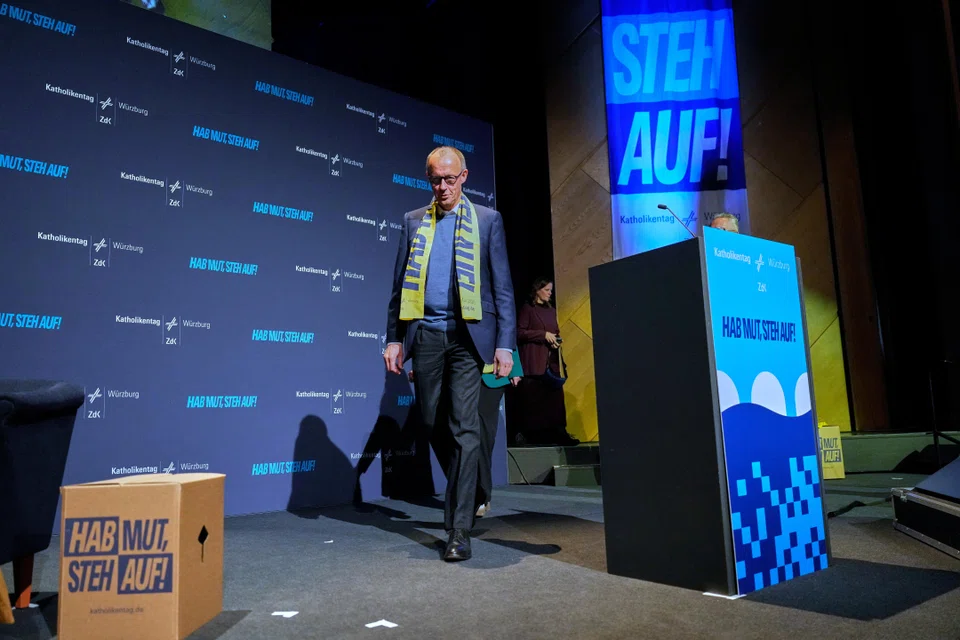
[AACHEN] German Chancellor Friedrich Merz said that the situation facing the EU is more challenging than anything he has ever seen, as he called for dramatic reforms to strengthen its economy rather than more common borrowing.
He was speaking in Aachen, Germany on Thursday (May 15) at a prize-giving ceremony for former European Central Bank president Mario Draghi.
Merz said that the EU has woken up to the threats it faces and has started on the path to becoming a geopolitical force in its own right.
Yet, he also placed limits on the lengths he was willing to go to deepen financial integration with Berlin’s EU partners.
The chancellor said: “Some suggest now that we could evade this painful task by taking on new debt, European debt, by financing regular expenditures through borrowing.
“Germany cannot follow this path, including for Constitutional reasons.”
The EU is wrestling with an increasingly hostile global environment shaped by the return of US President Donald Trump to the White House.
His disregard for the traditional alliance of US with the EU has at times shocked the bloc’s leaders.
Trump has dialled back support for Ukraine, threatened to seize Greenland from Denmark and launched a war on Iran that hit European economies hard.
“We are now experiencing weekly crises,” Merz said.
“In this situation, Europe must maintain a clear course and a cool head. We must confidently define our own interests.
“And we must be prepared to take action to protect those interests.”
Merz calls for more assertive European position
Since taking office in Germany in 2025, Merz has become increasingly impatient with what he sees as a slow pace of change in the EU.
He has called for a more assertive European position versus the US and China.
In March, he urged German lawmakers to overcome “the forces of resistance” within the European bureaucracy.
While he offered broad praise for Draghi’s contribution to the European project, he pushed back against the former central banker’s calls for the EU to issue joint debt as a cornerstone of a deeper economic union.
Draghi has argued that joint-debt issuance can enable the bloc to invest in the transition to a low-carbon energy system, ramp up its defences and increase the competitiveness of its economy.
“There is no alternative to a fundamental modernisation,” Merz said.
Yet, the chancellor has also struggled to push through the changes that he says are necessary to revive the German economy, which has barely grown since emerging from the Covid-19 pandemic.
His efforts to repair the finances of the healthcare system, cut income taxes and shore up the state-pension scheme have become tangled up in infighting between the chancellor’s conservative group and its Social Democrat coalition partners.
Draghi, accepting the Charlemagne Prize for cooperation in Europe, made the case for the deeper integration of national markets as the central pillar of a strategy to revive the bloc’s economic power.
He offered a clear riposte to Merz’s concerns about joint debt.
“The more Europe reforms, the less it must rely on debt – national or common – to compensate for its fragmentation,” he said.
Having also served as Italian prime minister, he said the checks and balances that helped the EU to sustain peace and prosperity on the continent for 70 years have now become an obstacle to the bloc’s success.
Its single market has become fragmented by national interests, and companies are held back by red tape.
“We denied those markets the continental scale they needed to succeed,” he said.
“The result was not a true market economy, but an asymmetric one. And from this asymmetry flow many of the vulnerabilities now confronting Europe.”
Picking up the themes of his 2024 report on European competitiveness, Draghi said that the EU has become too dependent on sales to foreign partners and raw materials sourced outside its borders.
Meanwhile, it has fallen behind in critical technologies such as artificial intelligence.
“The question now is how to correct that imbalance,” he said, warning against relying on the old recipe of free trade to fix Europe’s problems in an increasingly protectionist world.
Yet, he also cautioned that protectionist measures alone are likely to backfire – unless politicians can forge the agreements required to create a real continental economy that can compete with the US and China.
“A truly integrated European economy would itself change the field on which industrial policy operates,” he said.
“The lesson is that external toughness requires internal depth.” BLOOMBERG
Decoding Asia newsletter: your guide to navigating Asia in a new global order. Sign up here to get Decoding Asia newsletter. Delivered to your inbox. Free.
Share with us your feedback on BT's products and services






