

Modi clinches big wins as key opponents ousted in state polls
The BJP has won control of the national capital, Delhi, after more than two decades
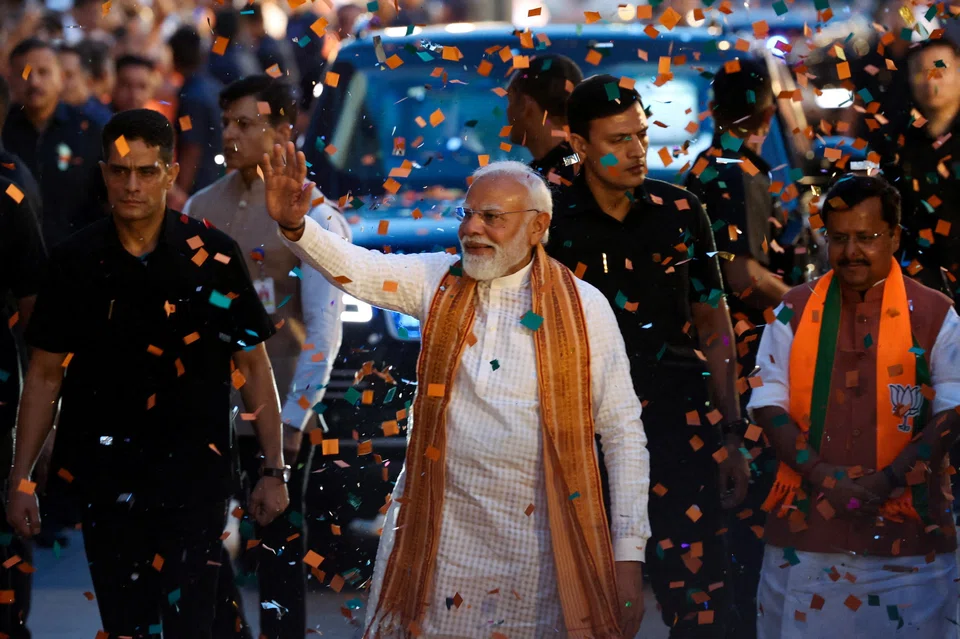
[NEW DELHI] Two years ago, Indian Prime Minister Narendra Modi was dealt a humbling blow in national elections, failing to win a majority for the first time since he came to power.
This week, he showed his enduring popularity by expanding his party’s support base beyond its traditional strongholds in the north and west, eliminating two of the opposition’s most vocal leaders in the process. That gives him fresh momentum to push through his political and economic agenda, including longstanding goals of his Hindu-dominant Bharatiya Janata Party (BJP).
Modi said the results showed that voters opposed “appeasement of minorities and violence”, while vowing to ensure women’s safety, create jobs for young people and crack down on illegal migration.
“The people of India voted for stability as wars and conflict create instability across the world,” Modi said on Monday (May 4) at the party’s headquarters in New Delhi. “The war in Iran affects everyone, but despite these difficult circumstances, India has fared well.”
Modi’s BJP won a resounding victory in the eastern state of West Bengal, the first time it’s won in a region that’s been an opposition stronghold for decades. That ended the 15-year rule of Chief Minister Mamata Banerjee, India’s highest-profile female politician, who was seen as the only opposition leader capable of mounting a serious challenge against Modi in the 2029 national elections.
In Tamil Nadu, India’s most industrialised state and home to Apple’s iPhone plants, voters delivered a blow to chief minister MK Stalin, another key Modi rival, by voting in a popular movie star, C Joseph Vijay. Although the BJP is a minor player in the southern state, Stalin’s loss opens the door for Modi’s allies in the region to possibly align with Vijay, a change in government that would raise uncertainty for multinationals in the southern manufacturing hub.
“With today’s victory, the BJP captures the last major opposition fortress in eastern India, an objective decades in the making,” said Milan Vaishnav, director of the South Asia programme at the Carnegie Endowment for International Peace. It neutralises Banerjee, Modi’s most combative critic and a linchpin of the opposition alliance, he added.
Indian stocks climbed on Monday, supported by a broader regional tech-led rally and optimism after the election results. Adani Group companies, which have aligned themselves closely with the prime minister’s development goals, jumped, with flagship Adani Enterprises rising 3.2 per cent to its highest level since November.
Since the 2024 national elections, Modi’s party and its allies have made steady gains in state elections, using a mix of religion and economic policy to lure voters. The BJP secured victories in Maharashtra and Haryana, and retained power in Bihar with coalition partners. The party also won control of the national capital, Delhi, after more than two decades.
While Modi still faces restraints in parliament, seen by his inability last month to push through a constitutional amendment on giving women more seats in the chamber, the state election victories may encourage his party to revive contentious reforms such as the uniform civil code. Currently, matters of marriage, divorce, adoption and inheritance are governed by multiple religious and customary laws. A uniform civil code would bring them under a common framework, a move opposed by minority groups, including Muslims.
‘Return to dominance’
Then there is Modi’s desire to hold simultaneous state and national elections, saying the constant poll cycles are becoming an impediment to the nation’s progress. Opposition groups are staunchly opposed to the change, which would require a constitutional amendment, concerned that it would favour the ruling party in the polls.
“After the 2024 national elections, the single-party dominance had broken and we were back to coalition governments and that certainly did empower the opposition to some degree,” said Yamini Aiyar, a senior visiting fellow at Brown University. “What we are seeing now is a return to dominance, particularly after the victory in West Bengal.”
Modi was the star campaigner for the Hindu-nationalist BJP in the West Bengal election, criticising Banerjee’s government for being soft on illegal migration, favouring minorities over the Hindu majority, and failing to tackle corruption. He targeted women voters and unemployed young people with promises of higher cash handouts.
Large-scale voter roll revisions just three weeks before the polls likely also influenced the results. To clean up the registered roll, the Election Commission removed nine million names, or almost 12 per cent of voters in the state, from the list. Home Minister Amit Shah said that the voter revision was to weed out fake voters and combat illegal migrants. Opposition groups alleged that Modi’s Hindu-nationalist party used the exercise to target mainly poor and Muslim voters.
West Bengal is politically significant in the national parliament, contributing the third-largest number of seats in the lower house. The BJP’s decisive win in the state also increases its support in the upper house of the parliament, where it already holds a majority.
The election win means “Modi emerges much stronger and one expects him to mount his claim for 2029”, when the next general election is due, said Nilanjan Mukhopadhyay, an author of several books on Indian politics, including a biography about Modi. “The Bengal victory also provides an opportunity for the BJP to move ahead with pending issues,” such as expanding the size of parliament and holding simultaneous national and regional elections, which opposition groups are against.
West Bengal has traditionally been a holdout for the opposition and was governed by leftist parties for decades before Banerjee came to power in 2011. Modi’s victory puts him in a strong position ahead of elections next year in Uttar Pradesh, India’s biggest state, where the BJP’s support waned two years ago.
The win will give the BJP more power in the parliament and “beyond that, the policy agenda of the Modi government will find a more enabling political environment”, according to Ashok Malik, India chair at the Asia Group.
“West Bengal was, in some sense, the last frontier,” he said. “Largely absent here in 2014, when Modi came to power, the BJP now dominates eastern India.” BLOOMBERG
Decoding Asia newsletter: your guide to navigating Asia in a new global order. Sign up here to get Decoding Asia newsletter. Delivered to your inbox. Free.
Share with us your feedback on BT's products and services
TRENDING NOW

LTA proposes combining car COE categories, adding rebate-surcharge system

StarHub to acquire MyRepublic’s mobile business amid ongoing telco consolidation

DBS, OCBC, UOB rout lops billions off STI as inflation, rate concerns spook investors

Grab CEO’s wife Chloe Tong on life with Anthony Tan and finding her purpose

