Multiple free trade agreements can support supply chain resilience: Iswaran
 Add BT as a preferred source
DeeperDive is a beta AI feature. Refer to full articles for the facts.
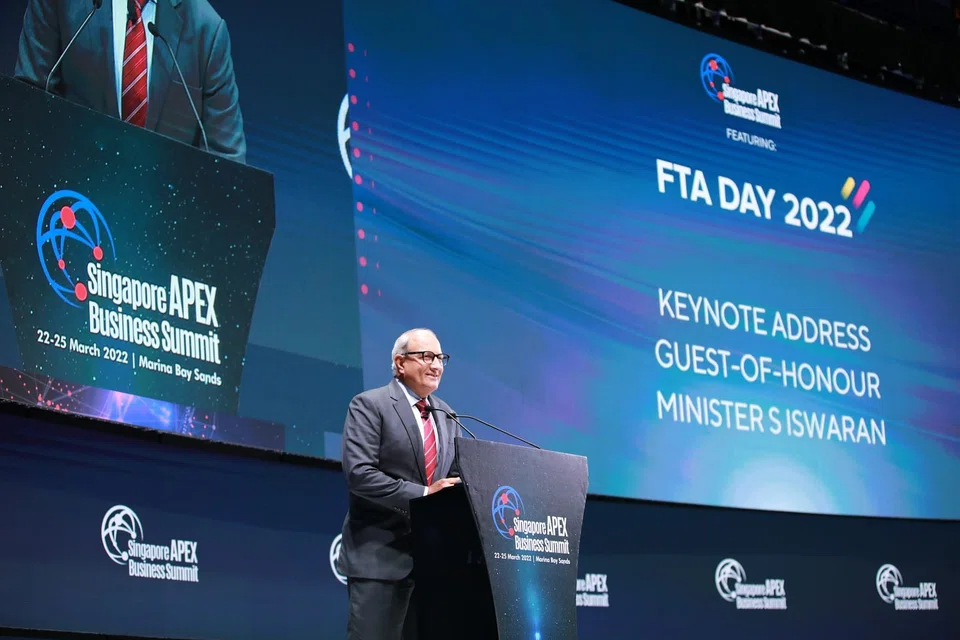
A LATTICE of free trade agreements (FTAs) can provide resilience in a time when supply chains face disruption from geopolitical tensions and the Covid-19 pandemic, said S Iswaran, Minister-in-charge of Trade Relations, on Friday (Mar 25).
"It's not just about (having) 1 platform, but a multiplicity of bonds," he said at FTA Day, organised by the Singapore Business Federation as part of the Singapore Apex Business Summit 2022.
In his opening remarks, Iswaran noted that FTAs underpin the government's Trade 2030 strategy by enhancing Singapore's trade connectivity and standing as a global trading hub.
He added that the government aims to further strengthen Singapore's trade foundations on 3 counts - broadening the geographical coverage of its trade agreements; deepening existing partnerships through new initiatives like digital and green economy agreements; and working with like-minded partners in setting new standards for wider adoption.
Iswaran, who is also Minister for Transport, said that the foundation of global trade has to be the World Trade Organization's multilateral rules-based trading system.
Singapore therefore seeks to build its trade network at 3 levels - multilateral, regional or plurilateral, and bilateral, he said: "These reinforce one another as part of our larger trade strategy."
Navigate Asia in
a new global order
Get the insights delivered to your inbox.
Among agreements, mega FTAs like the Comprehensive and Progressive Agreement for Trans-Pacific Partnership and Regional Comprehensive Economic Partnership (RCEP) cover large proportions of global economies, said Iswaran in a panel after the speech.
This has in turn allowed them to address the need for supply chain resilience, in an era with more distributed manufacturing, he added.
Such FTAs are therefore crucial for small and medium-sized enterprises (SMEs) who aim to broaden their horizons and access global markets, said the minister.
For example, RCEP, which came into effect for 10 signatory countries on Jan 1, "allows for the kind of supply chain integration that SMEs need to do now", he observed.
Iswaran added that the focus today is on "the movement of bits and bytes, and also how green these movements can be".
The former has already begun to take shape in the form of digital economy agreements (DEAs).
Along with FTAs, DEAs can help to "democratise the economy" for SMEs, said Iswaran, noting that SMEs today can access customers, business counterparties and financing solutions globally using digital platforms.
Meanwhile, Singapore is working on new green economy agreements, which will serve as a "strategic pathfinder that can contribute to building global capacity to address climate change", said Iswaran.
READ MORE:
- Trade associations and chambers key in companies adapting to changing consumer trends
- Singapore GDP likely to grow but recession, stagflation not ruled out: Lawrence Wong
- Singapore's productivity grew 3.9% per annum from 2019 to 2021 despite Covid-19: DPM Heng
Decoding Asia newsletter: your guide to navigating Asia in a new global order. Sign up here to get Decoding Asia newsletter. Delivered to your inbox. Free.
Copyright SPH Media. All rights reserved.