

Myanmar now a much riskier destination for foreign firms after military coup
Bangkok
MYANMAR, a country known to carry its fair share of risk for foreign investors over the years, has become a much-riskier destination following the Feb 1 military coup.
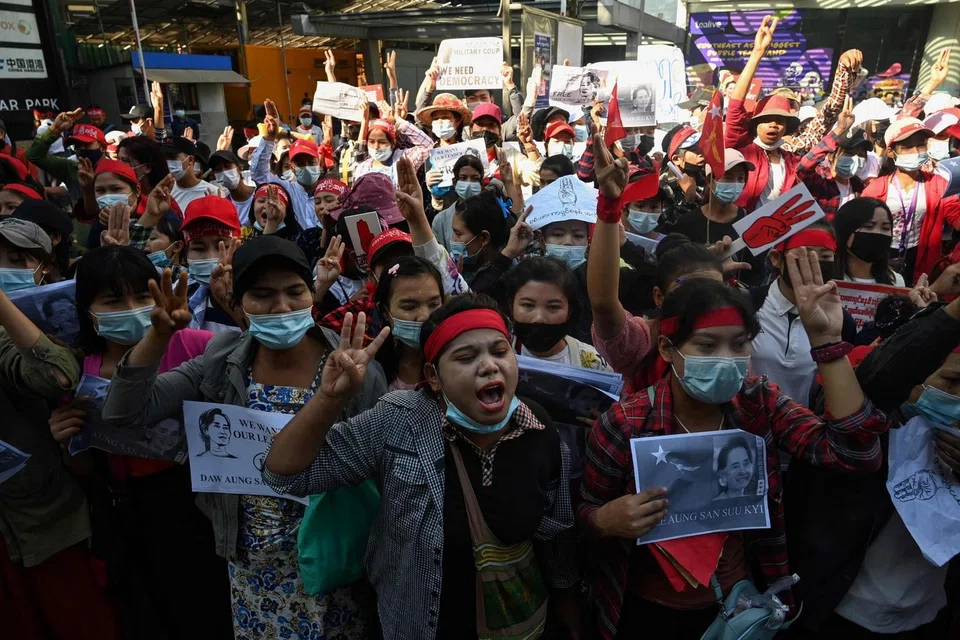
In the last week, some multinationals have pulled out or suspended their operations there, with more likely to follow as the country enters into a period of heightened political uncertainty.
There is, firstly, the likelihood that the current wave of anti-coup protests will eventually lead to another military crackdown.
On the other hand, if the protests do succeed in somehow toppling the Tatmadaw (military), the situation could get even more uncertain.
"If the Tatmadaw disappeared tomorrow, Myanmar would not just be a failed state. It would be a failed state on steroids," said Tony Davis, a security analyst for Jane's Defense & Security Intelligence, during a panel discussion organised by Nikkei Asia.
There is the inevitability of enhanced economic sanctions in the wake of the coup.
On Wednesday, US President Joe Biden announced two new executive orders to impose fresh sanctions on Myanmar's coup-makers.He has also barred Myanmar generals from accessing US$1 billion in Myanmar funds being held in the US.
Myanmar is no stranger to economic sanctions. It was among the world's most penalised states for nearly three decades following the military's brutal crackdown on the popular uprising of 1988, the subsequent detention of pro-democracy leader Aung San Suu Kyi in 1990, and the refusal to acknowledge the electoral win of her National League for Democracy (NLD) party thereafter.
US, European Union and multilateral lenders' sanctions on Myanmar were dropped only in 2011-2012, after former president Thein Sein opened the door for Ms Suu Kyi to join the national political process.
This allowed her to contest and win a seat in a by-election in 2012, and eventually lead the NLD to a landslide victory in the 2015 election.
The Tatmadaw calculated that allowing Ms Suu Kyi and the NLD to enter politics would end the sanctions and the street protests, while the 2008 constitution would maintain their grip on real power.
Myanmar's charter grants the military a 25 per cent quota in Parliament that allows them to veto legislation and have three ministerial posts.
But the power-sharing deal started to fall apart after the November 2020 election when the NLD won handsomely again, garnering over 80 per cent of the 476 contested seats, while the military-backed Union and Solidarity Party won just 33 seats.
Tatmadaw commander-in-chief Min Aung Hlaing, claiming widespread fraud, declared a coup on Feb 1, with Ms Suu Kyi and about 100 other NLD members detained.
"This was a naked power grab," said Thitinan Pongsudhirak, head of the Bangkok-based Institute of Security and International Studies. "The bare facts come down to Min Aung Hlaing's personal ambition and the military's corporate interests."
A new Cabinet, including several ministers from Mr Thein Sein's government who served from 2010 to 2015, was quickly named in a bid to show that Myanmar was still "business as normal".
The military-backed Thein Sein regime was widely credited for introducing sound economic reforms and following pro-business policies that endeared it to many Myanmar and foreign investors. By contrast, the first NLD government (2016 to 2020) was initially seen as inefficient and wary of the private sector, although it started to implement needed reforms over its past 18 months in power.
While the new Cabinet includes "friendly faces" such as former finance minister Win Shein as the new Minister of Planning, Finance and Industry, and Aung Naing Oo as Minister of Investment and External Economic Relations, their roles in promoting business and investment are expected to be limited by the political realities.
Already, some foreign companies have seen their operations affected by the coup. Singapore-based Puma Energy had to briefly suspend its operations from its refined products terminal in Myanmar.
Puma Energy, majority-owned by commodity trader Trafigura, operates the country's largest fuel import terminal at Thilawa. The suspension related to the distribution of fuel by road from the terminal while the terminal itself had remained operational.
Japan's Kirin Holdings has announced it will end its joint ventures with the military-affiliated Myanma Economic Holdings and Myanma Economic Corp to operate the Myanmar Brewery.
Thailand's Amata Group has also suspended construction of its US$1 billion industrial complex outside Yangon.
READ MORE: US sanctions Myanmar military leaders
TRENDING NOW
Prima to move out of historic Keppel Road flour mill building in 2028

Grab CEO’s wife Chloe Tong on life with Anthony Tan and finding her purpose

OCBC sheds S$8 billion in value as shares close nearly 6% down; analysts cautious on banks

As Asia’s food delivery giants rejig the pie, who will win the market?

