Myanmar police fire into air to disperse protest
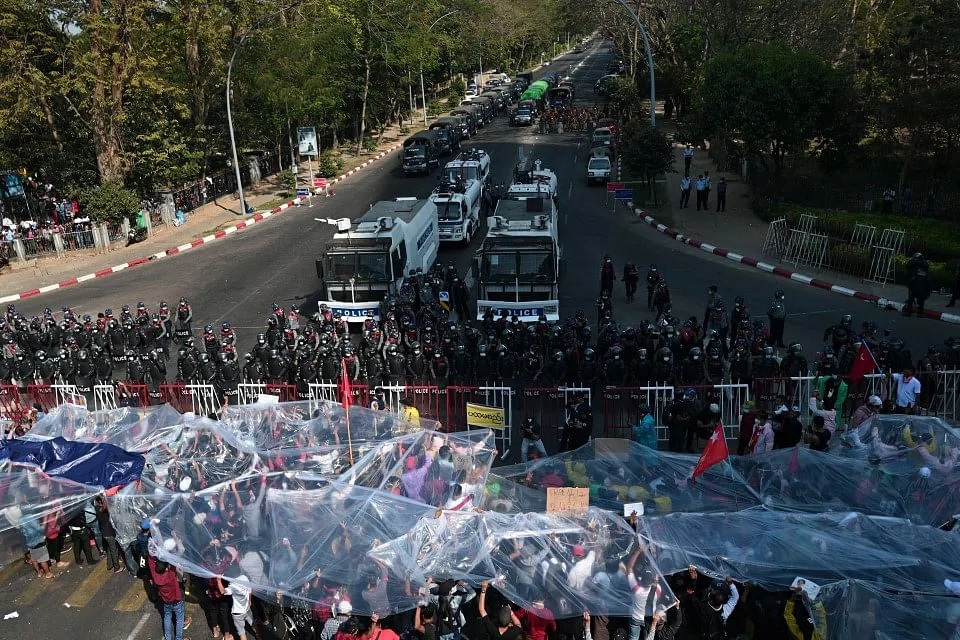
Yangon
POLICE fired gunshots into the air and used water cannon and rubber bullets on Tuesday as protesters across Myanmar defied bans on big gatherings to oppose a military coup that halted a tentative transition to democracy.
Four people were hurt by rubber bullets in the capital Naypyitaw, and one of them, a woman, was in critical condition with a head wound, a doctor said.
The Feb 1 coup and detention of elected civilian leader Aung San Suu Kyi has brought the largest demonstrations in more than a decade and a growing civil disobedience movement affecting hospitals, schools and government offices.
Witnesses said police fired guns into the air in Naypyitaw as a crowd refused to disperse on the fourth straight day of protests. One witness told Reuters demonstrators ran away as guns were fired into the air.
A doctor said four people, including the woman with a head wound, were brought to his hospital after being struck by rubber bullets.
Police had earlier fired water cannon at the protesters, who responded by throwing projectiles, the witness said.
Video from the town of Bago, north-east of the commercial hub of Yangon, showed police confronting a large crowd and blasting them with jets from water cannon.
Police arrested at least 27 demonstrators in the second-biggest city of Mandalay, including a journalist, domestic media organisations said.
The unrest has revived memories of almost half a century of direct army rule until the military began a process of withdrawing from civilian politics in 2011, though it never gave up its overall control over Ms Suu Kyi's civilian government after it won a 2015 election.
That transformation was brought to a halt by the coup that ousted the government as it was preparing to begin its second term in office after Ms Suu Kyi's National League for Democracy (NLD) swept a November election.
"We are so disappointed and so sad whenever we think about why this has befallen us again," Yangon resident Khin Min Soe said of the return of military rule.
Promises on Monday from junta leader General Min Aung Hlaing to eventually hold a new election in his first address since seizing power drew scorn. He repeated unproven accusations of fraud in the election which he used to justify the coup.
"We will continue to fight," youth activist Maung Saungkha said in a statement, calling for the release of political prisoners and the end of "dictatorship".
Activists are also seeking the abolition of a 2008 constitution drawn up under military supervision that gave the generals a veto in parliament and control of several ministries, and for a federal system in ethnically diverse Myanmar.
An older generation of activists who confronted the military in bloody 1988 protests called for strike action by government workers for another three weeks.
The civil disobedience movement, led by hospital workers, has resulted in a plunge in coronavirus tests, official testing figures showed.
Myanmar has suffered one of the worst coronavirus outbreaks in South-east Asia with 31,177 deaths from more than 141,000 cases.
A curfew from 8 pm to 4 am has been imposed on Yangon and Mandalay.
State media signalled possible action against the protests on Monday when it said the public wanted rid of "wrongdoers" and while orders banning gatherings of more than four people have been imposed, there has been no elaboration from authorities.
Myanmar workers in Thailand are adding to a chorus of dissent against a coup by organising protests, gathering supporters and distributing posters of their beloved leader Ms Suu Kyi.
The military coup has sent shockwaves through the normally quiet community, who have begun staging near daily protests across Bangkok. "We Burmese who live abroad can't stay quiet. We all need to go demand justice in front of our embassy and stage protests," said Kyaw Thu Ya, a worker living in Samut Prakan province, an hour south of the capital. "I feel uncomfortable because I'm not living in my country and I understand my limits," he said. "If I were in Myanmar right now, I'd go out and protest everyday." For now, they do what they can.
In the protest outside the United Nations building over the weekend, the Myanmar workers sang an old revolutionary song, Kabar Ma Kyay Bu, or We Won't Forget Until the End of the World.
The song was popularised during a 1988 uprising against army rule, which came to a brutal end when the military gunned down thousands of people in the streets.
Western governments have widely condemned the coup, although there has been little concrete action to press the generals.
New Zealand has suspended all high-level political and military contact and will ensure aid does not benefit the military and impose a travel ban on its leaders.
A Singapore businessman plans to exit his investment in a Myanmar tobacco firm linked to the military, joining Japanese drinks giant Kirin Holdings which last week scrapped its Myanmar beer alliance.
The UN Security Council has called for the release of Ms Suu Kyi and other detainees. The UN Human Rights Council will hold a special session on Friday to discuss the crisis at the behest of Britain and the European Union.
Ms Suu Kyi, 75, faces charges of illegally importing six walkie-talkies and is being held in police detention until Feb 15. Her lawyer said he has not been allowed to see her. The US State Department said it tried to reach her but was denied. REUTER, AFP
READ MORE: Razer co-founder and director Lim Kaling exits Myanmar JV
Decoding Asia newsletter: your guide to navigating Asia in a new global order. Sign up here to get Decoding Asia newsletter. Delivered to your inbox. Free.
Share with us your feedback on BT's products and services