

Najib rides on mass transit achievement
Many are grateful yet some think it's govt's job to ensure KL remains liveable as Klang Valley's population grows
Kuala Lumpur
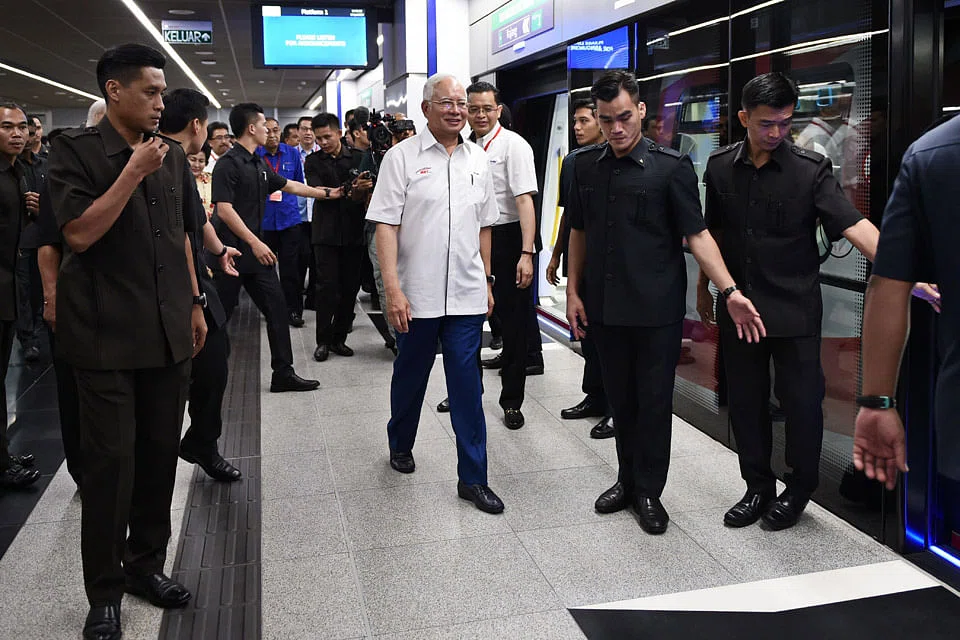
MALAYSIA'S Prime Minister Najib Razak sees the Klang Valley MRT (Mass Rapid Transit) line as a "game changer" spurring public transport integration, productivity and real estate prices but, perhaps more importantly, boosting public appreciation for his administration.
"We are not just seeing the MRT but the shape of the future of Malaysia before our very own eyes," he declared on Monday at the launch of the 51km track which stretches from Sungei Buloh to Kajang.
Kuala Lumpur's newest mega project is opening ahead of its hosting of the 29th SEA Games next month, as well as a general election which has to be held by August next year.
For days, mainstream newspapers have front-paged the potential benefits, including the daily reduction of 160,000 vehicles from Kuala Lumpur's roads and higher property values in the vicinity of the MRT as demand for such real estate expands.
Transport Minister Liow Tiong Lai said the MRT, cast as a milestone achievement for Mr Najib who took office in 2009, was the prime minister's legacy to the county, while Communications Minister Salleh Keruak took it a step further, describing it as his "gift" to the people.
Yeah Kim Leng, a professor of economics at Sunway University School of Business, believes the MRT could enhance Mr Najib's image given the traffic congestion and Kuala Lumpur's need for a world-class public transport system to keep pace with other cities.
"Modernisation is inevitable and the MRT does have PR impact as it's a project that benefits a large segment of users. Greater KL (Kuala Lumpur) needs such a system but it also has to enhance public transport efficiency.
"The question is whether it will translate into votes given the other factors," he said.
Many are grateful. Yet others consider it Putrajaya's job to ensure the country's most industrious city remains liveable as the Klang Valley's five to six million population is forecast to hit 10 million by 2020.
"Najib can ride on the MRT's popularity, but most people are still struggling to make ends meet because of the shrinking ringgit," a rail executive punned.
Mr Najib's alleged role in 1MDB's financial scandals and the listless economy have galvanised his once mentor, Mahathir Mohamad, into working with opposition politicians to unseat him. The MRT gave Mr Najib an opportunity to gainsay the country's longest-serving prime minister and now his biggest political foe by pointing out his sore neglect of public transport despite more than two decades in office.
A big part was because of Dr Mahathir's championing - Mr Najib described it as obsession - of Proton, the national car project which he insisted on establishing in 1982 despite Malaysia's lack of a comparative advantage. Indeed, public transport as a modal share fell under his watch. Now at about 20 per cent, the authorities hope to double it by 2030.
Last month, China's Zhejiang Geely was allowed to acquire 49.9 per cent of the loss-making carmaker in which RM13 billion (S$4.14 billion) in taxpayers' monies had been ploughed over the years.
Dr Mahathir, however, is credited with having the foresight to build the 772km North South Highway, running from Bukit Kayu Hitam in Kedah's north to Johor Baru in the south.
The milestone infrastructure project was completed in 1994 after which he agreed to build some rail networks in the Klang Valley. But they were limited and lacked integration as they were awarded to various contractors to split the pie, critics say.
Jones Lang Wootton Malaysia executive director Malathi Thevandran said expanding rail transportation in the Klang Valley is a positive implementation which has enhanced connectivity and mobility between places. "However, the challenge moving forward is to ensure the smooth implementation of the rail infrastructure and also the seamless connectivity with other rail transportation such as the LRT and buses."
Mr Yeah said the daily ridership volume would be crucial to the MRT's operational viability as the capital costs would be partially if not fully absorbed by the government.
Ms Malathi stressed the importance of safety, maintenance and management. "If they can get the ticket price to cover operations and maintenance, they will be lucky," said the rail executive who wondered if the maintenance budget was adequate.
The lack of a maintenance culture is a valid concern as Mr Najib's rail vision includes at least two more Klang Valley MRT lines, the KL-Singapore high-speed rail and the East Coast Rail Line. Operational breakdowns could result in a severe backlash.
The cost of building the MRT lines remains controversial with opposition lawmakers claiming a lack of transparency on the true costs. Billions of ringgit have been raised via debt papers which Putrajaya could end up shouldering in the longer term as government contingent liabilities.
In the shorter term, the challenge will be to wean KL-ites from the comfort of their air-conditioned vehicles. The heat and rain aside, many roads lack proper pedestrian paths. Also, getting feeder buses to run on time in heavy traffic could be daunting.
TRENDING NOW

From legacy to launch: Francis Yeoh and Yeoh Pei Xien on family unity and YTL’s next‑gen ventures

Could Japan trigger the next global financial crisis?
Wealthy Indonesians snap up government bonds as yields near 8%: OCBC

‘You buy more picks and shovels because you keep hitting gold’: Why AI spending needs to see results

