New 112 billion rupee airport near Delhi to test India’s build-out boom
After missing multiple deadlines, it was inaugurated on Mar 28 by Prime Minister Narendra Modi
[NEW DELHI] Realtors in Jewar are ecstatic. A construction frenzy sparked by an airport project has swept through this otherwise monotonous farming town near New Delhi.
Landowners are rushing to put up dummy houses to inflate valuations, leaving behind piles of bricks and debris. Fenced-off plots have become a common sight, some of them marked by billboards touting future industrial zones: Apparel Park, Medical Park, Leather Park and Toy Park.
Two banks have recently opened, a service that was previously miles away. An eatery “Jewar Airport Restaurant”, still smelling of fresh paint, serves a hodgepodge menu of North Indian curries, noodles, pizzas and burgers. Most of its customers are farmers who sold ancestral land during the ongoing real estate rush.
“The airport has brought prosperity in our area and that has added to my business,” said Aakash Chaudhary, the restaurant owner. And this is even before the Noida International Airport at Jewar, some 80 km out of India’s capital city, opened to fliers.
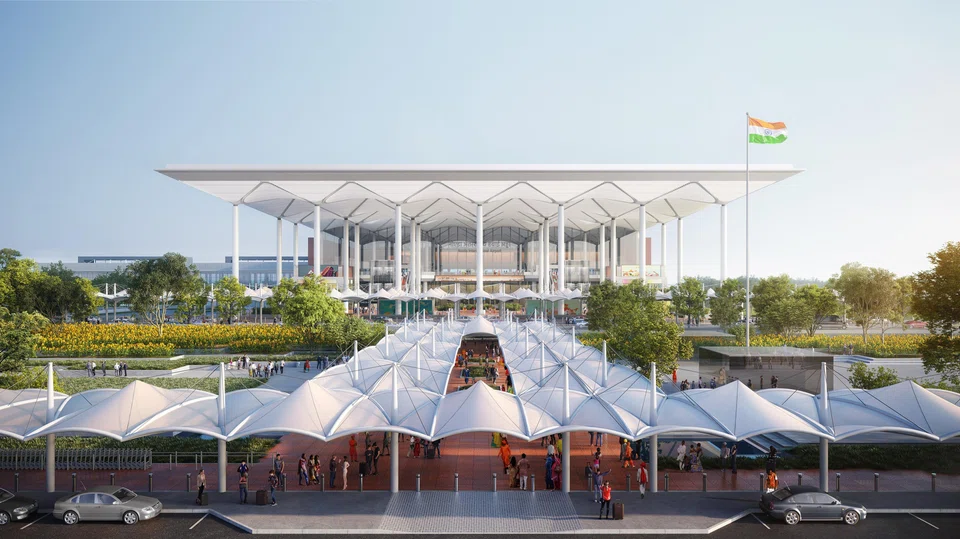
After missing multiple deadlines, the airport was finally inaugurated on Saturday (Mar 28) by Prime Minister Narendra Modi. About 112 billion rupees (S$1.5 billion) was invested in the first phase of the project that will be able to handle 12 million fliers annually.
Billed as India’s largest upon completion, the six-runway airport is planned across 7,200 acres (2,913 hectares) – eight times the size of New York City’s Central Park – and counts Zurich Airport International as its sole investor.
It is one of the biggest projects in India’s infrastructure overhaul that has seen billions being poured into building bridges, highways, ports and airports.
The success of large-scale projects which have foreign investment such as the Jewar airport are crucial for the country to continue attracting overseas capital and not just rely on home-grown national champions such as billionaires Gautam Adani and Mukesh Ambani.
Christoph Schnellmann, the airport’s chief executive officer, described the country as “one of the most compelling” markets, which had proved its resilience through periods of disruption such as the pandemic.
Zurich Airport won the contract in 2019, attracted by the opportunity to develop a “large, greenfield airport from the ground up in a strategic location” close to New Delhi, he said.
“The underlying fundamentals of the market have remained robust, with a clear trajectory toward long-term expansion,” Schnellmann said.
A land rush similar to Jewar has also gripped Navi Mumbai, an edge city across the harbour from India’s financial capital Mumbai. The Adani conglomerate flattened a hill to build the metropolis’s second airport with an initial annual capacity for 20 million travellers. It started operations in December.
Both these fledgling mega airports will test whether India’s ambitious infrastructure plans can justify the billions spent on them. India has the third-largest domestic aviation market – trailing only the US and China. Yet many of its new airports remain underutilised, with many turning into ghost terminals.
“Economic jigsaw”
“This new infrastructure is much needed but it must be organised efficiently and with the required surface access in order that airlines can fulfil their role in the economic jigsaw,” said John Strickland, the director of UK-based JLS Consulting, an aviation advisory firm.
Unlike in many other countries, public transport access in India tends to lag the airports themselves – a key factor that holds back the terminals from taking off.
Modi’s administration this month approved a plan to build a roughly 30 km corridor for direct and high-speed links from New Delhi and its satellites cities to the Jewar airport and a rapid rail link is also being planned, but these will take years to be realised.
For the Navi Mumbai terminal, plans are afoot to build a metro line by 2029 connecting it with the older city airport and adding high-speed road connectivity. For now, there are water taxis for those wanting to avoid Mumbai’s traffic jams.
The new airports are trying to make up partially by improving the flying experience: the Navi Mumbai airport is planning an advanced baggage-tracing system that will let passengers follow their luggage in real time. The Jewar facility is planning self-drop and self-boarding gates within the terminal.
Indian fliers have more than doubled since 2014 to more than 160 million travellers in 2025, data from the local aviation regulator shows. Indian carriers are bulking up too, with an order book of 1,350 new aircraft and are expected to add 100 aircraft to their fleets every year.
The Jewar facility is counting on its strategic location in Uttar Pradesh, India’s most populous state and proximity to Agra, which is home to the tourist hotspot Taj Mahal.
About 174 acres of cargo and warehousing belt are also being planned around the Jewar airport. Several private firms, including the Adani group, are bidding for the construction of a logistics hub.
Ambitious industrial plans in the area are expected to bring more footfalls to the new airport. These include a Foxconn semiconductor facility, a solar manufacturing hub and new factories by wire and cables maker Havells India, as well as agri-machinery maker Escorts Kubota.
“There is a lot of interest from local and global companies in investing in the area,” said Shailendra Bhatia, additional chief executive officer of the Yamuna Expressway Industrial Development Authority which oversees development in Jewar.
Near-duopoly
Ultimately, an airport’s success depends on airlines, and that’s complicated by a near duopoly in India’s aviation sector where IndiGo and Air India have nearly 90 per cent of market share.
Additionally, the Jewar airport will also have to compete with the current airport at New Delhi to lure carriers, unlike the Adani Group which operates both the older and new Navi Mumbai airports. That gives Adani bargaining power in coaxing airlines to populate the new terminal.
India’s leading airlines – IndiGo, Akasa Air and Air India Express – have shown interest in starting flights from the Jewar airport, said Bhatia, adding that the management has lowered airport charges and reduced value-added tax on jet fuel to 1 percent. The current Delhi airport charges 25 per cent.
IndiGo had signed a pact to be Jewar airport’s “launch carrier” as early as November 2023.
The airlines are also lured by the large catchment area of Jewar that has a lot of fliers headed to the Gulf countries on the international routes and to the eastern and southern parts of India in the domestic circuit.
For now, the residents of Jewar are looking forward to how far the new terminal can change their lives. First conceived more than two decades back, the project only picked up pace when Zurich Airport signed on in 2019.
“We all have huge expectations from the airport, which is finally getting inaugurated,” said the restaurant-owner Chaudhary. BLOOMBERG
Decoding Asia newsletter: your guide to navigating Asia in a new global order. Sign up here to get Decoding Asia newsletter. Delivered to your inbox. Free.
Share with us your feedback on BT's products and services