

New UK finance minister slashes taxes - and hopes growth will pay for it
 Add BT as a preferred source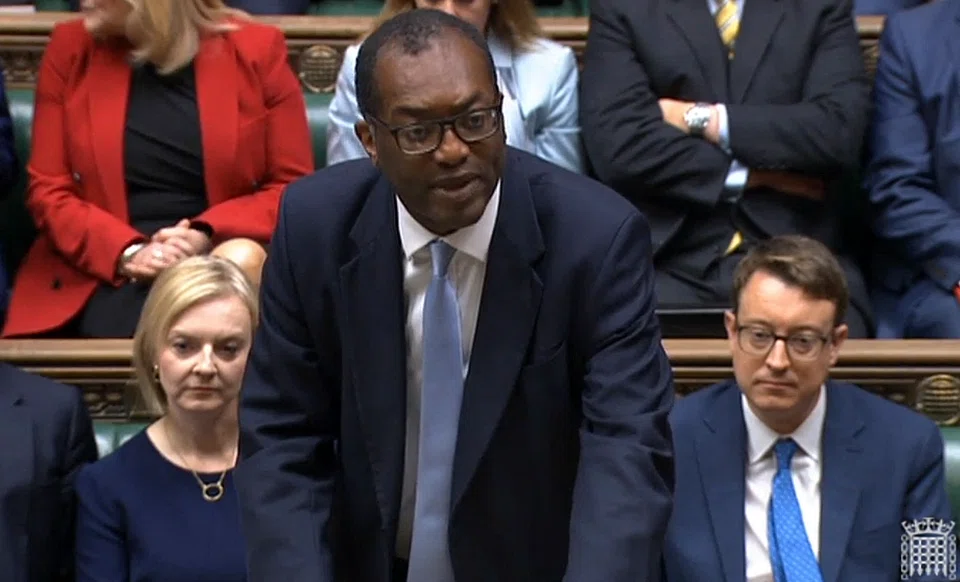
DeeperDive is a beta AI feature. Refer to full articles for the facts.
BRITAIN’S new finance minister Kwasi Kwarteng unleashed historic tax cuts and huge increases in borrowing on Friday ( Sep 23) in an economic agenda that floored financial markets, with sterling and British government bonds in freefall.
Kwarteng scrapped the country’s top rate of income tax, cancelled a planned rise in corporate taxes and for the first time put a price tag on the spending plans of Prime Minister Liz Truss, who wants to double Britain’s rate of economic growth.
Investors unloaded short-dated British government bonds as fast as they could, with the cost of borrowing over 5 years seeing its biggest one-day rise since 1991, as Britain raised its debt issuance plans for the current financial year by £72.4 billion to £234.1 billion (S$366.7 billion).
The pound slid below US$1.11 for the first time in 37 years.
Kwarteng’s announcement marked a step change in British economic policy, harking back to the Thatcherite and Reaganomics doctrines of the 1980s that critics have derided as a return to “trickle down” theory.
Truss, elected as prime minister earlier this month by a vote of the Conservative Party’s 170,000 members, has vowed to cut regulations and pursue overall economic growth even if it favours the wealthy at a time when millions are struggling to cover basic household bills.
Navigate Asia in
a new global order
Get the insights delivered to your inbox.
“That is how we will compete successfully with dynamic economies around the world,” Kwarteng said. “That is how we will turn the vicious cycle of stagnation into a virtuous cycle of growth.”
The so-called mini budget is designed to snap the economy out of a period of double-digit inflation driven by surging energy prices and a 15-year run of stagnant real wage growth.
Moves to subsidise energy bills will cost £60 billion just for the next six months, Kwarteng said - part of a promise to support households for two years.
Tax cuts - including an immediate reduction in a property purchase tax - would cost a further £45 billion by 2026/27, he said, costs that could be recovered by a rise in annual economic growth of 1 percentage point over 5 years - a feat most economists think unlikely.
Britain also will accelerate moves to bolster the City of London’s competitiveness as a global financial centre by scrapping the cap on banker bonuses ahead of an “ambitious deregulatory” package later in the year.
“In 25 years of analysing budgets this must be the most dramatic, risky and unfounded mini-budget,” said Caroline Le Jeune, head of tax at accountants Blick Rothenberg.
“Truss and her new government are taking a huge gamble.”
Financial markets ramped up their expectations for British interest rates to hit a peak of more than 5 per cent midway through next year.
The market backdrop could barely be more hostile for Kwarteng, with the pound performing worse against the dollar than almost any other major currency.
Much of the decline reflects the US Federal Reserve’s rapid interest rate rises to tame inflation - which have sent markets into a tailspin - but some investors have taken fright at Truss’s willingness to borrow big to fund growth.
A Reuters poll this week showed 55 per cent of the international banks and economic consultancies that were polled judged British assets were at a high risk of a sharp loss of confidence.
The opposition Labour Party said the plans were a “desperate gamble” by a government running out of ideas after 12 years in power.
“Lower growth, lower investment, lower productivity. And today, we learn we have the lowest consumer confidence since records began. The only things that are going up are inflation, interest rates and bankers’ bonuses,” said Labour’s finance spokeswoman Rachel Reeves.
The Institute for Fiscal Studies said the tax cuts were the largest since the budget of 1972 - which is widely remembered as ending in disaster because of its inflationary effect.
On Thursday the BoE said Truss’s energy price cap would limit inflation in the short term but that government stimulus was likely to boost inflation pressures further out, at a time when it is battling inflation near a 40-year high.
“We are likely to see a policy tug of war reminiscent of the stop-go 1970s. Investors should be prepared for a bumpy ride,” said Trevor Greetham, head of multi-asset at Royal London Asset Management.
Despite the extensive tax and spending measures, the government did not publish new growth and borrowing forecasts from the Office for Budget Responsibility (OBR), a government watchdog.
The National Institute of Economic and Social Research (NIESR) said the budget deficit looked set to rise to 8 per cent of gross domestic product during the current financial year.
The OBR forecast in March that Britain would have a budget deficit of 3.9 per cent of GDP. Kwarteng said the OBR would publish its full forecasts later this year.
“Fiscal responsibility is essential for economic confidence, and it is a path we remain committed to,” he said. REUTERS
Decoding Asia newsletter: your guide to navigating Asia in a new global order. Sign up here to get Decoding Asia newsletter. Delivered to your inbox. Free.
Share with us your feedback on BT's products and services
TRENDING NOW

From 1MDB to ‘corporate mafia’: Is Malaysia facing a new governance test?

Higher costs, lower returns: Why are Singaporeans still betting on real estate?

South-east Asian markets account for 8.8% of global capital inflows from 2021 to 2024: report

Richard Eu on how core values, customers keep Singapore’s TCM chain Eu Yan Sang relevant

