

North Korea test-fires submarine-launched ballistic missile, South Korea says
 Add BT as a preferred source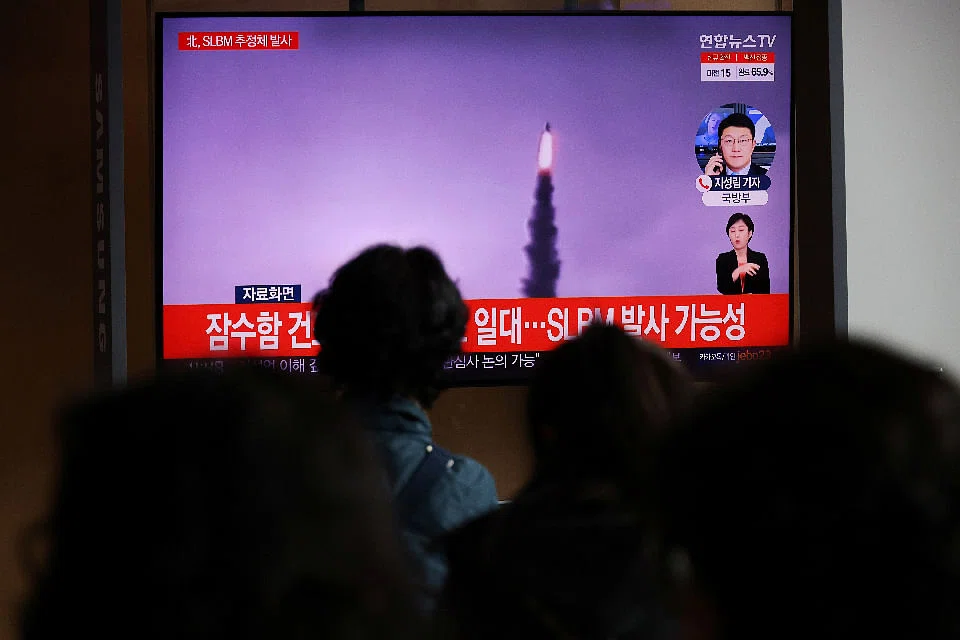
DeeperDive is a beta AI feature. Refer to full articles for the facts.
Seoul
NORTH Korea fired a submarine-launched ballistic missile (SLBM) off its east coast on Tuesday, South Korea's military said, pulling Japan's new prime minister off the campaign trail and overshadowing the opening of a major arms fair in Seoul.
The US military's Indo-Pacific Command condemned the launch as destabilising, but judged it did not pose an immediate threat to the United States or its allies.
South Korean and US officials were investigating if the missile was a smaller, previously unseen version displayed last week at an exhibit in Pyongyang, a South Korean military source told Reuters, citing ongoing analysis.
They were also examining whether the missile was fired from North Korea's experimental Gorae-class submarine, he added, speaking on condition of anonymity.
The launch, reported by officials in South Korea and Japan, came after US and South Korean envoys met in Washington on Monday (Oct 18) to discuss the nuclear stand-off with the North.
Navigate Asia in
a new global order
Get the insights delivered to your inbox.
The launch is the latest weapons test by North Korea, which has persisted with military development despite international sanctions over its nuclear weapons and missile programmes.
"Our military is closely monitoring the situation and maintaining readiness posture in close cooperation with the United States, to prepare for possible additional launches," South Korea's Joint Chiefs of Staff said in a statement.
They said the missile was launched at about 10.17 am local time from the sea in the vicinity of Sinpo, where North Korea keeps submarines as well as equipment for test-firing SLBMs.
It was not immediately clear if the missile was fired from a submarine or from a submersible test barge, as in most previous tests.
A military source said it flew about 430 to 450 km to a maximum altitude of 60 km.
North Korea's last SLBM test was in October 2019, when a Pukguksong-3 missile was fired from an underwater platform, flying 450 km to a maximum altitude of 910 km.
Kim Dong-yup, a former South Korea Navy officer who is a professor at Seoul's Kyungnam University, said the latest test probably involved an SLBM recently unveiled by North Korea.
The North displayed new Pukguksong-4 during military parades in October and January respectively, and a previously unseen, smaller missile was spotted at last week's defence fair in Pyongyang.
North Korea has also been working on what would be its first operational submarine capable of launching an SLBM, South Korean officials said.
The Washington-based Nuclear Threat Initiative has said SLBM capability could provide North Korea with additional options for nuclear launch, and a hedge against destruction of land-based nuclear systems.
South Korea's national security council expressed regret over the test and urged the North to resume talks.
Japanese Prime Minister Fumio Kishida said two ballistic missiles had been detected, adding that it was regrettable that North Korea held a string of missile tests in recent weeks.
There was no immediate explanation from South Korea or Japan over the conflicting number of missiles detected.
Kishida cancelled scheduled campaign appearances in northern Japan, and the deputy chief cabinet secretary said he planned to return to Tokyo to deal with the missile situation.
Spy chiefs from the US, South Korea, and Japan who were meeting in Seoul on Tuesday (Oct 19), shared information on the missile test and agreed to strengthen intelligence sharing, South Korea's National Intelligence Service said in a statement.
The US special representative for North Korea, Sung Kim, said that he would visit Seoul for talks this week.
"The US continues to reach out to Pyongyang to restart dialogue," Kim said after meeting his South Korean counterpart in Washington on Monday.
"We harbour no hostile intent towards (North Korea), and we are open to meeting with them without preconditions."
The recent launches as well as the unusual military show in its capital suggest North Korea may be looking again to military and world affairs after nearly two years of focusing on the Covid-19 pandemic, said Chad O'Carroll of Korea Risk Group.
"Pyongyang tends to focus on one big strategic issue at a time, so the renewed testing could suggest military - later foreign policy - (is) now (the) priority," he said on Twitter.
The missiles tested recently by North Korea appear aimed at matching or surpassing an arsenal South Korea has been expanding quietly, analysts have said. Its successful test last month of an SLBM made the South the first country without nuclear weapons to develop such a system. North Korea test-fired a missile from a train the same day.
This month, the neighbours held duelling defence exhibitions to showcase their latest weaponry amid a spiralling arms race.
News of Tuesday's missile launch broke as representatives of hundreds of international companies and foreign militaries gathered in Seoul for the International Aerospace and Defence Exhibition, which organisers called its largest defence expo ever.
South Korea is also preparing to test-fire its first homegrown space launch vehicle on Thursday.
Analysts say the rocket has few potential applications as a weapon, but such tests are unlikely to be welcomed by North Korea. REUTERS
Decoding Asia newsletter: your guide to navigating Asia in a new global order. Sign up here to get Decoding Asia newsletter. Delivered to your inbox. Free.
Share with us your feedback on BT's products and services
TRENDING NOW

Shelving S$5 billion office redevelopment plan proved ‘wise’ as geopolitical risks mount: OCBC chairman

Eurokars Group introduces rental car franchises Enterprise Rent-A-Car, National Car Rental, and Alamo to Singapore

20 photos that show how dramatically Singapore has changed in two decades
Singapore’s key exports up 15.3% in March from electronics surge, exceeding forecasts

