

Not enough to just hit net zero, Singapore’s transition must be just enough


SINGAPORE is seeking public feedback on whether the nation should accelerate its climate goals and aim to be net zero by 2050.
The current goal, as described during the national budget in February, is to be net zero “by or around” 2050. A hard 2050 target is meaningfully more ambitious because it eliminates whatever elbow room Singapore had.
But ambition comes with a price, and getting to net zero by 2050 — which is just over 27 years from now — will have a significant impact on costs in Singapore. How those costs are paid, and who pays them, are just as important as technical questions about energy sources and consumption patterns. Making the transition an equitable one could well be the bigger challenge of the day.
The technical pathway to net zero could actually be within reach, even given Singapore’s natural limitations. In March this year, a study by the Energy Market Authority (EMA) found that transitioning Singapore’s power sector to net zero by 2050 was feasible and realistic. The power sector contributed about 39 per cent of Singapore’s 51.6 million tonnes of carbon dioxide emissions equivalent in 2019, so that finding probably emboldened the government to aim higher.
But the study also cautioned that the pathway to net-zero power required transformational changes along the entire energy value chain, and was subject to significant uncertainties surrounding geopolitical and technological factors. Specifically, net-zero Singapore will have to shift its source of power from one that is predominantly from fossil fuels to one that is mostly dependent on imported renewable energy and on hydrogen.
Both options are unlikely to be as cheap as fossil fuels, at least at the start. The demand for renewable energy will grow as more countries look to decarbonise their economies, which will make it more expensive for Singapore to import renewable energy. Hydrogen is still significantly more expensive than fossil fuels, although that cost has been falling and is likely to fall with increased scale.
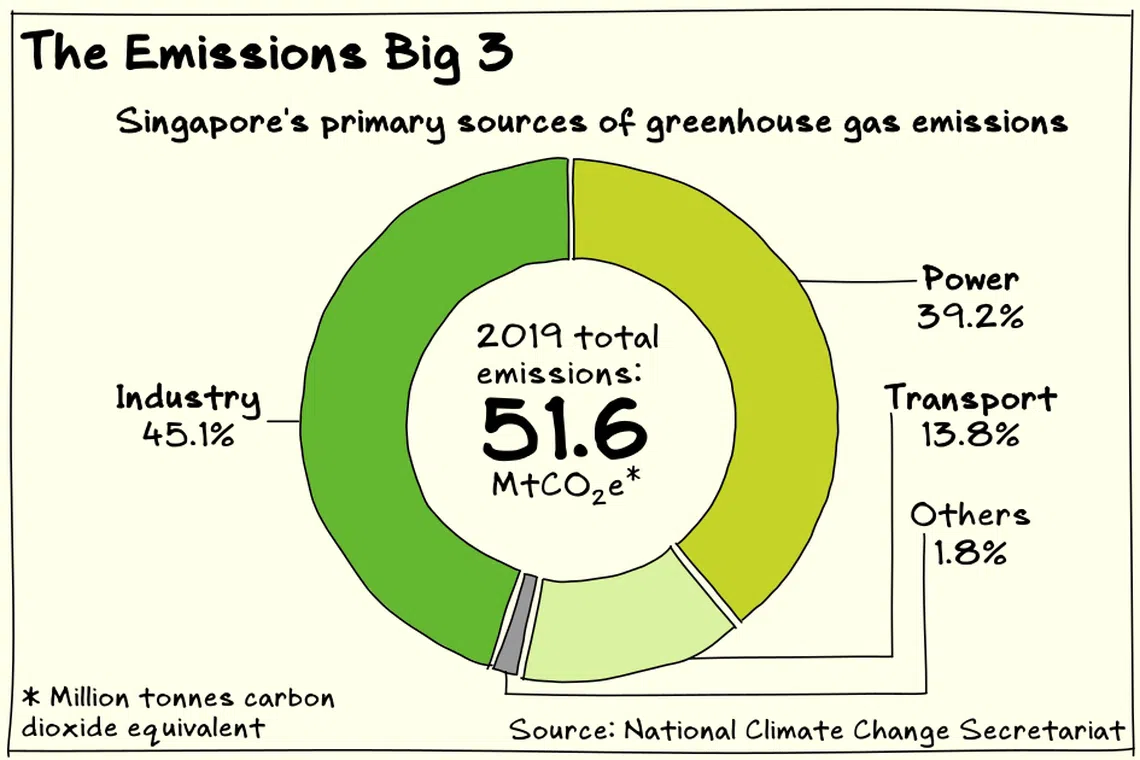
The power sector is also not the only one that needs to be decarbonised.
Industry was the largest single source of primary emissions for Singapore in 2019, accounting for 45 per cent of the total. A large part of this includes Singapore’s sizeable chemicals and petroleum sectors — chemicals and refined petroleum products contributed S$88 billion, or just north of 23 per cent, of the country’s total manufacturing output in 2021. Many of the businesses, assets and jobs in these sectors will not fit in a net-zero economy.
Efforts to realign demand also invariably mean internalising the cost of carbon, as seen in Singapore’s carbon tax. Currently set at S$5 per tonne, Singapore’s carbon tax is expected to rise to between S$50 and S$80 per tonne by 2030. These costs will find their way to consumers, and will be especially painful for those who are less well off, and to small businesses.
To its credit, the Singapore government, as outlined during the 2022 national budget, has already begun to address some of these cost implications with vouchers for households. As a matter of policy, Singapore has also stated its intention to use part of the revenue from the carbon tax to help mitigate the impact on households and businesses. But many costs of decarbonisation are not tied to the carbon tax or transitioning, and are likely to persist even after Singapore achieves net zero. Sometimes the carbon-free option is simply more expensive. Help might need to be more substantial, and more sustained.
Why would Singapore embark on such an arduous path?
The real threat of climate change notwithstanding, the optimistic theory is that there are valuable opportunities for a country in South-east Asia that can achieve net zero, which will more than offset the potential costs. As companies and investors place higher value on sustainability, Singapore will be better placed to attract investments, jobs and talent. Singapore could also place itself at the regional nexus of the capital, businesses, technology and research that are needed for decarbonisation in the coming decades.
A more sobering theory is that Singapore is making the move out of necessity. Europe’s Carbon Border Adjustment Mechanism is a preview of global carbon pricing, and for trade-dependent Singapore to remain competitive in such a world requires getting to net zero, at the least. Singapore’s heavy reliance on fossil fuel as an industry and as a power source also highly exposes the country to stranding risk, and moving quickly and deliberately is the best way to build economic and energy security.
The two theories are not mutually exclusive. But it seems certain that Singapore is now on the brink of a historically challenging economic pivot.
As with any major economic restructuring — and the enormity of the net-zero transition is hard to overplay — there will be losers. If crossing the bridge widens the disparity between those in the front and those in the back, the value of net zero could be a net zero.
This commentary also appears in BT’s ESG Insights weekly newsletter. To get more of these insights delivered to you, sign up here.
TRENDING NOW
Two Singapore-listed palm oil firms named in Greenpeace report on Indonesian plantation fires
Singapore Airlines flight returns to San Francisco after ‘unruly’ passenger incident
Singapore looking into which companies responsible for haze-causing fires: PM Wong
Deluge IPO 3.86 times subscribed ahead of SGX debut

