Obama remains determined to get TPP trade pact ratified under his watch
He says the pact would be a big plus for US firms and workers and that US trade deals "eventually get done"

Lee U-Wen
Hangzhou, China
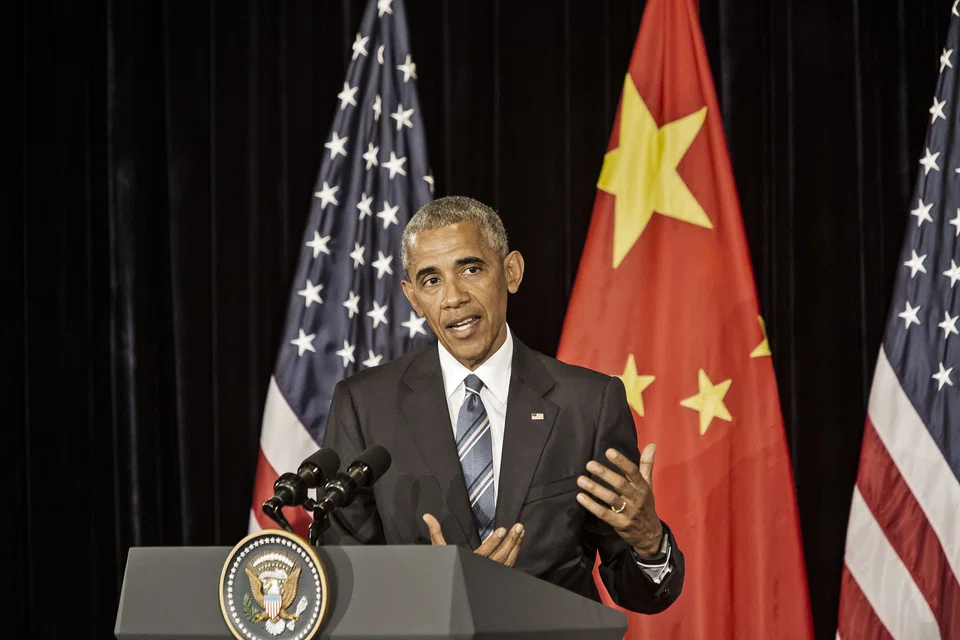
US President Barack Obama on Monday made another desperate pitch for the Trans-Pacific Partnership (TPP), stressing that this mega free trade deal would be nothing but a big plus for American companies and workers over the long haul.
At a packed press conference in Hangzhou after he attended the Group of 20 (G-20) Summit, Mr Obama said that the Asian members of the 12-nation TPP, such as Japan and Vietnam, are already fully convinced of the merits of the pact.
The TPP involves Singapore, the US, Japan, Australia, Peru, Malaysia, Vietnam, New Zealand, Chile, Canada, Mexico, and Brunei. The deal has already been signed but now needs to get the all-important go-ahead from the US Congress.
Mr Obama reiterated his point that the TPP can be ratified under his watch - he is due to step down from office in January 2017 - despite the widespread political opposition that has left the deal in limbo.
With America gearing up to elect its next president in November, hopes are fading for the world's largest economy to get the TPP through Congress.
"The US has never had a smooth, uncontroversial path to ratifying trade deals, but they eventually get done. It's my intention to get this one done," said Mr Obama at the end of what was his eighth and final G-20 Summit as US president.
He added that he is "yet to hear a persuasive argument" from any group about why they wouldn't want a trade framework that would raise labour and environment standards, protect intellectual property, lower tariffs and level the playing field for US businesses.
"It is indisputable that it would create a better deal for us, compared to the status quo," he said.
At a separate media conference to officially close the G-20 summit, Chinese President Xi Jinping said that world leaders had reached "extensive consensus on pursuing innovative, invigorated, interconnected and inclusive world economic growth".
"Facing current risks and challenges in the world economy, we will continue to reinforce macro policy communication and coordination," he said.
"We are determined to break a new path for growth to inject new dynamism into the world economy," said Mr Xi, adding that a G-20 blueprint on innovative growth was unanimously adopted at the two-day summit.
The Chinese leader said G-20 members have to shift from short-term policies to those that are medium and long-term, as well as focus on supply-side reform.
Countries agreed to oppose protectionism and stop declines in global trade, while closely coordinating macro-economic policies, said Mr Xi.
"We agree that facing the risks and challenges of the current world economy, and maintaining a peaceful and stable international environment are crucial," he said.
Mr Xi added that G-20 countries should help one another coordinate more closely on macro-economic policies, and use effective policy tools such as fiscal, monetary and structural reforms.
"(We) will not only fend off short-term risks, but also pay attention to the medium-to-long-term growth potential."
This was China's first time hosting the G-20 Summit. The next summit will take place in the German city of Hamburg in 2017, with Argentina set to hold the rotating presidency in 2018.