
Pakistan PM calls for Parliament to be dissolved, fresh elections
 Add BT as a preferred source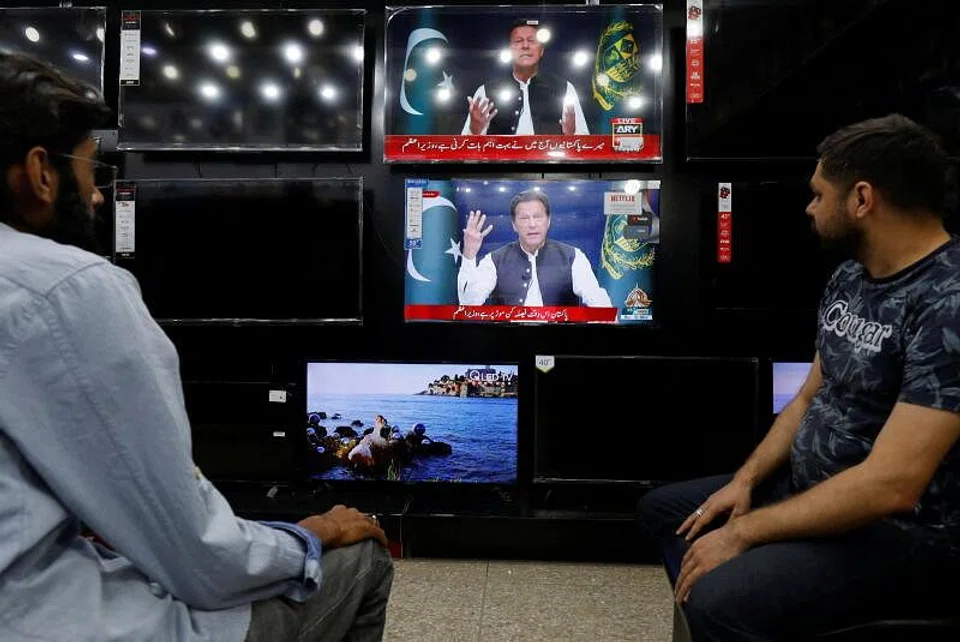
[ISLAMABAD] Pakistan Prime Minister Imran Khan on Sunday (Apr 3) called for the president to dissolve Parliament and hold a fresh election, minutes after the national assembly deputy speaker declined to hear a no-confidence motion into his rule.
In an address on state TV, Khan said there had been unacceptable interference in Pakistan's democratic institutions, and an interim government should be formed to hold fresh elections.
"I have sent advice to the president to dissolve the assemblies ... We will go to the public and hold elections and let the nation decide," he said.
"When the advice reaches the president, assemblies will be dissolved which will be followed by the process of setting up a caretaker government," he added.
No premier of Pakistan has ever completed a full term, and Khan has been facing the biggest challenge to his rule since being elected in 2018, with opponents accusing him of economic mismanagement and bungling foreign policy.
On Sunday, Parliament was due to debate a no-confidence motion on Khan, but the deputy speaker refused to accept it, causing uproar in the chamber.
Navigate Asia in
a new global order
Get the insights delivered to your inbox.
"I rule out this no-confidence motion in accordance with the constitution," said deputy speaker Qasim Suri, a Khan loyalist, as the session started.
Khan's Pakistan Tehreek-e-Insaf party (PTI) effectively lost its majority in the 342-member assembly last week when a coalition partner said its 7 lawmakers would vote with the opposition.
More than a dozen PTI lawmakers had also indicated they would cross the floor.
Khan has accused the opposition of conspiring with "foreign powers" to remove him because he will not take the West's side on global issues against Russia and China.
Earlier this week, he accused the United States of meddling in Pakistan's affairs.
Local media had reported that Khan had received a briefing letter from Islamabad's ambassador to Washington recording a senior US official saying they felt relations would be better if Khan left office.
In Washington last week, State Department spokesman Ned Price told reporters there was "no truth" to the allegations.
The opposition is headed by the Pakistan Muslim League-N (PML-N) and the Pakistan Peoples Party (PPP) - 2 usually feuding dynastic groups that dominated national politics for decades until Khan forged a coalition against them.
Khan was elected after promising to sweep away decades of entrenched corruption and cronyism, but has struggled to maintain support with inflation skyrocketing, a feeble rupee and crippling debt.
Some analysts say Khan has also lost the crucial support of the military - claims both sides deny - and Pakistan's army is key to political power.
There have been 4 military coups - and at least as many unsuccessful ones - since independence in 1947, and the country has spent more than 3 decades under army rule.
Debate on the no-confidence motion was due to start last Thursday, but the deputy speaker - from Khan's party - suspended proceedings when legislators declined to first address other items on the agenda.
Khan, a former international cricket star who in 1992 captained Pakistan to their only World Cup win, hinted on Saturday he still had a card to play.
"I have a plan for tomorrow, you should not be worried about it. I will show them and will defeat them in the assembly." AFP
Decoding Asia newsletter: your guide to navigating Asia in a new global order. Sign up here to get Decoding Asia newsletter. Delivered to your inbox. Free.
Share with us your feedback on BT's products and services

